


Consumer inertia has long been a quiet profit centre. People let subscriptions renew, accept higher insurance premiums and book through the same travel site because finding a better deal takes time.
Meta’s new Muse agent has brought that business model into focus, and markets have noticed. Its launch triggered a sell-off across a basket of companies exposed to consumer inertia with Planet Fitness, Charles Schwab, Allstate, Booking Holdings and Charter Communications among those hit.
So, the theme is much broader than Muse itself. Investors now question what happens when AI can shop around, negotiate and switch providers on a customer’s behalf.
We think that AI agents could reshape the “inertia economy” by making comparison effortless and shifting bargaining power, and potentially profits, away from companies and towards consumers.
The middlemen face a margin squeeze
AI agents could make switching almost frictionless and make it much easier to compare prices, cancel services/subscriptions and switch providers without requiring the customer to spend an afternoon making calls.
That creates potential pressure on:
- Insurance: Allstate, Progressive and Travelers
- Telecoms: AT&T, T-Mobile, Charter, BT and Orange
- Subscriptions: Netflix, SiriusXM, The New York Times and Planet Fitness
- Tax and financial services: Intuit, H&R Block, Charles Schwab and Ameriprise
These businesses are not about to disappear. But easier switching could mean:
- More customer churn
- Less pricing power
- Higher retention spending
- Pressure on fees and add-ons
Travel platforms may face an even bigger challenge. If Muse can compare and book an entire trip, Booking Holdings, Expedia, Tripadvisor and Airbnb could lose direct customer traffic.
They may still supply the hotel rooms and flights, but Meta, or another AI platform, could own the customer relationship and demand a share of the transaction.
Still, the recent sell-off due to Muse looks too indiscriminate in places. A bank such as JPMorgan does not depend on consumer passivity in the same way as a gym membership or overpriced insurance renewal. Its earnings also come from lending, trading and investment banking. Investors should therefore examine how each company makes money rather than selling an entire sector under an “AI loser” label.
The winners may sit behind the checkout
AI agents can find products and place orders, but they still need a secure way to pay. That could benefit the companies handling payments, identity and fraud protection.
- Visa and Mastercard: Agents are likely to use existing card networks. Faster shopping and fewer abandoned checkouts could increase transactions, while security becomes more valuable when software spends for consumers.
- PayPal and Adyen: Merchants will not want to build a separate payment system for every AI agent. These providers can connect retailers with different platforms and process purchases securely.
- Shopify: Shop Pay could help agents complete purchases across Shopify’s merchant network, keeping the company involved even when shopping begins through an AI assistant.
- Meta: Muse could become a new gateway to shopping. Meta may eventually earn advertising, referral or transaction fees, supported by its reach across Facebook, Instagram and WhatsApp. But monetisation is unlikely to become meaningful before 2027, while free usage carries substantial computing costs. Amazon’s decision to block Muse also shows that powerful platforms will resist surrendering their customer relationships.
- Stripe: Muse can use Stripe’s Link wallet at more than one million businesses. This places Stripe close to payments and customer credentials, but it remains privately owned.
The Investment Takeaway
The market is probably right about the direction of change but too confident about the individual winners and losers.
A sensible framework is to favour companies with control over essential infrastructure, strong balance sheets and multiple sources of earnings, while being cautious on businesses whose margins rely heavily on customer friction.
We think that makes Visa, Mastercard, PayPal, Adyen and Shopify attractive names to investigate on valuation, with Meta offering greater upside but greater execution risk. Meanwhile, sharp declines in diversified banks such as JPMorgan, Wells Fargo and Morgan Stanley may create opportunities because their profits are not primarily built on consumer inertia.
The durable winners will not necessarily be the companies with the most exciting AI products. They will be those able to preserve bargaining power as AI changes who owns the customer.
Micron Ahead of Earnings: Record High or Another Pullback?
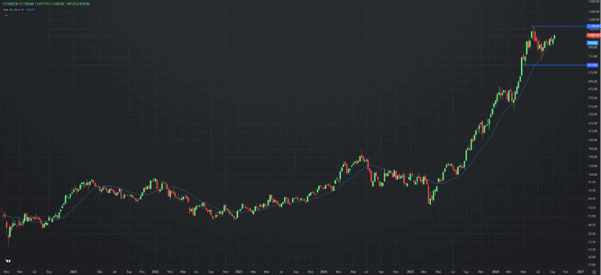
Micron shares rose 6.6% last week to $1,082. This puts the record high of $1,254, set in June, back within reach, the stock is now only 14% below that level. From late June to late July, the share price temporarily plunged 44% to $705. The 20-week moving average prevented a steeper decline and currently stands at $949. For the long-term uptrend, the low of $652 remains the key support level. Wednesday’s quarterly results could determine whether the stock breaks out to a new record high or suffers another short-term pullback.
Nike: Down 80%, Now the Earnings Have to Deliver
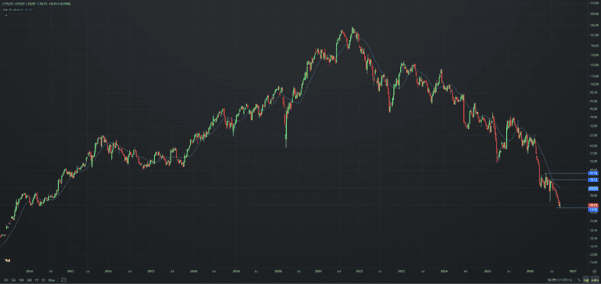
Nike shares stabilised last week, gaining a modest 0.5% to $35.75. Before that, however, the stock had fallen to its lowest level since 2014. The downtrend has been in place for years. Since reaching a record high of $167 in 2021, the stock has lost around 80% of its value. Thursday’s quarterly results now offer an opportunity for a recovery. An initial positive signal would be a move back above the 20-week moving average at $41.57. The stock would then need to break through the key resistance levels at $45 and $47.70. Until then, it remains technically vulnerable to further losses.
Less Leverage, More Demand
Bitcoin starts the week with a stronger internal setup, but the next move still needs confirmation.
BTC is trading around $84.5K after a solid week, but the most important signal is not the price move itself. ETF demand remains positive, spot activity has improved, on-chain conditions are stronger and leverage has been reduced rather than rebuilt aggressively.
That makes the current rally healthier than one driven mainly by derivatives.
ETF flows remain one of the clearest signals. Bitcoin spot ETFs attracted around $2.39 billion last week, and inflows continued even as price pulled back from the highs. That suggests underlying demand is still present and the move is not relying only on short covering.
On-chain data also supports that view. Bitcoin is now trading comfortably above the True market mean and the Short-term holder cost basis, meaning recent buyers are back in profit. Profit-taking remains contained, spot activity has recovered from the August lows and demand is still absorbing the supply coming to market. SOPR has also moved back above 1, which is consistent with investors taking profits without creating enough selling pressure to weaken the structure.
The derivatives market remains relatively clean. Funding is close to neutral and open interest has fallen around 15–16% from recent highs. Price is higher, but leverage is lower, which reduces the risk of the move being driven by crowded long positioning.
Options are also worth watching. Implied volatility has fallen to around 38, with the market pricing roughly an 11% move over the next 30 days. Bitcoin is therefore showing stronger underlying demand while the options market is still pricing a relatively calm environment. That gap could become important if fresh capital continues to enter.
The main risk remains macro. The US 10-year Treasury yield is around 5.2% and bond-market volatility remains elevated. Bitcoin has shown resilience despite that backdrop, but a further rise in yields would remain a clear headwind. If yields stabilise or ease while ETF flows and spot demand stay positive, the setup would improve further.
Sentiment has moved into Greed territory, but there are still no clear signs of broad euphoria. SOL continues to show the strongest relative momentum, ETH is recovering, and DOGE is outperforming without yet showing the leverage normally associated with retail excess.
For the week ahead, the framework is clear. Bitcoin needs to hold the $83K–84K area, ETF and spot demand need to remain supportive, and the on-chain improvement needs to persist. If those signals stay aligned and the macro backdrop does not deteriorate, the market can continue to build from here.