



In financial terms, compounding is often referred to as the eighth wonder of the world. This is due to the profound impact it has on investments and the ability to turn modest savings into substantial wealth over time.
Achieving your investment goals relies on more than just picking the right investments. It also depends on how you manage your investment positions with the assets in your portfolio. Utilising the power of compounding can exponentially boost your returns over time. Once you understand its impact, you may consider adjusting your portfolio to maximise its long-term compounding potential.
This article explores everything you need to know about compounding and why many people consider it the secret key to successful investing.
Understanding compounding
Compounding is a powerful investment technique that involves reinvesting your profits from an initial investment into the same investment to let your returns earn more returns. Simply put, compounding lets you transform your previous returns into additional investment capital, creating a “snowball” effect that can lead to much bigger growth in the long run.
A virtuous circle forms where your capital increases in size, which increases the income you receive, which once again increases the capital, but by an even greater amount, and so on.

The basics of compounding
Compounding means earning returns not just on your original investment, but also on the returns you’ve already earned. Although its long-term impact can be powerful, the concept itself is straightforward.
Investors often use the compounding approach by reinvesting stock dividends, bond coupons, or capital gains on liquidated positions. But compounding isn’t limited to stocks and bonds—savings accounts also work this way. When interest is left in the account, it’s added to the balance, and future interest is then calculated on this new, higher total.
It is important to note that not all investment income is automatically reinvested. Enjoying the benefits of compounding might involve taking action to manually reinvest any income. For instance, certain stock dividends may (as a default) be paid out to investors in the form of cash, rather than reinvested into their holdings. In this instance, an investor would need to contact their broker and opt to change the way that they receive dividends.
Tip: Dividend reinvestment plans (DRIPs) are schemes specifically designed to support investors who want to adopt a compounding approach.
Compound interest vs simple interest
The terms “simple interest” and “compound interest” refer to two different ways of managing any investment income you might receive. While both forms of interest begin as credit issued to your account, the approach you take in managing this credit can have a significant impact on your overall investment returns.
Consider an example:
Take a savings account holding $100. If the interest on the account is paid annually at a rate of 5%, after 12 months, $5 will be paid out to the account holder.
In this scenario, if the simple interest approach is adopted:
The $5 isn’t reinvested, and the account balance remains at $100, so an annual interest payment of $5 will be issued in all subsequent years. After 10 years, the account balance will be $100.
However, if the compound interest approach is adopted:
The $5 is reinvested, increasing the account balance to $105. The following year, the interest benefits from a compounding effect, resulting in a payment of $5.25 ($105 x 5%). If reinvested another time, this additional $5.25 further boosts the account to $110.25, and in year three, the account benefits from even higher interest ($110.25 x 5%). This pattern continues for as long as the position is held. After 10 years, the account balance will be $164.70.
Tip: A compound interest calculator can help to visualise how an investment can compound exponentially over time.
The impact of compounding on investments
Adopting a compounding approach by reinvesting any investment income will increase the size of the capital you have invested. This creates a cycle that can be particularly beneficial to long-term investors, such as those who are planning for retirement or adopting a FIRE investing approach.
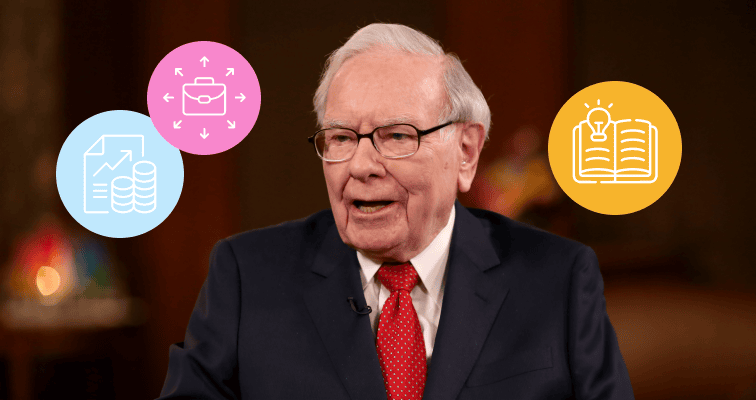
Warren Buffett’s approach to compounding
Famed investor Warren Buffett is one of the greatest exponents of the benefits of compounding.
“Our favourite holding period is forever.”
Warren Buffett, Berkshire Hathaway Letters to Shareholders.
While managing a diverse, but fairly standard, portfolio concentrated on household names and blue-chip stocks such as Coca-Cola ($KO) and Bank of America ($BAC), Buffett built his personal wealth to an estimated $132.8bn. Interestingly, 99% of Buffett’s total wealth was generated after he turned 50.
The secret to his strategy? His decision to adopt a compounding approach to the returns made in his earlier years.
The way that Buffett grew his personal wealth is an example of how exponential returns can result in life-changing gains for investors who take a long-term approach.
Factors that impact the effectiveness of compounding
Compounding is a long-term approach, so it is crucial to continually monitor how real-world events influence the ongoing performance of your portfolio. To maximise your compounding returns, it is important to consider the risk factors that might impact the effectiveness of your strategy.
Tip: Most index performance statistics that detail long-term growth in stock market values assume that compounding applies to reinvested dividends.
| Factor | Impact |
|---|---|
| Market prices | Compounding relies on the value of the assets you hold increasing. Nothing is ever guaranteed in the markets because macroeconomic factors play a crucial role. But the long-term trend in stock markets has historically been favourable to the compounding approach. |
| Instruments | Not all financial instruments generate a regular income, and those that do now might not do so in the future. Dividends, for example, are paid at the discretion of a company’s management team and adjust over time according to the business’s performance. |
| Personal circumstances | A compounding strategy needs to be the best investment approach for your personal aims. If your priority is receiving a regular income stream or liquidating assets to finance your lifestyle, then compounding may not be the optimal strategy for you. |
| Taxation | Another factor to consider is how taxation will impact your investments. Tax terms and conditions differ across different regions, so it is important to consider the relative tax rates on, for example, receiving dividends as cash or stock. You may also want to factor in capital gains tax (CGT). Reinvesting income rather than crystallising a capital gain now might be beneficial at some point in the future. For example, when you retire, you expect to have a lower personal tax rate. |
| Costs | Holding positions at a broker will incur some costs. Time spent on ensuring that your preferred broker has competitive T&Cs can make a material difference to your long-term returns. You will also want to ensure that it offers markets in your target instruments and can be trusted. |
Strategies to maximise compounding
To make the most of compounding, it is essential to take a long-term view. This approach requires patience, especially once your capital is fully invested. Spreading out your initial investments over time can help determine your average purchase price. This way, you’re more likely to align with long-term market trends rather than risking a large investment at the top of a short-term bubble.
Also, maintaining stability and consistency is key to compound investing. By keeping a cash buffer, you can cover unexpected short-term expenses without being forced to sell your investments prematurely.
Tip: Regular depositing into an investment account can help track a long-term market rise and mitigate against short-term price volatility.
Once you’ve established your strategy, choose assets that support a compounding approach. Popular options for compound investors include dividend stocks, bonds, money market funds, and real estate investment trusts (REITS).
It is important to remember that the fundamental principles of investing still apply. Select assets that appreciate in value, and diversify across sectors, regions and asset types to manage risk and even out returns.
Compounding operates on the power of exponential growth. The longer you hold your positions, the greater the potential for significant returns as the snowballing effect gains momentum.

Final thoughts
While Albert Einstein is often credited with describing compounding as the eighth wonder of the world, the good news is that you don’t need to be a scientist to understand and incorporate the approach into your investment strategy.
Investing with a degree of discipline and following simple and effective guidelines can help you to take advantage of the compounding effect on your way to achieving financial independence.
Visit the etoro Academy to learn more about the compounding effect.
Quiz
FAQs
- How does compounding contribute to investment growth?
-
Compounding results in your total exposure to investments being maximised. As short-term income is reinvested, the next time income, such as dividends, is paid, you’ll receive a larger payment than if you hadn’t reinvested. As compounding generates exponential returns, it can be particularly beneficial if your investments are held long-term.
- What factors can affect the rate of compounding?
-
The formula used to explain compounding won’t change over time, but the size of the variables involved almost certainly will. The amounts of regular income paid by assets in your portfolio may change due to macroeconomic factors, the underlying price of the assets you hold will vary over time, and you may decide to withdraw income to meet short-term demands.
- How can investors maximise the benefits of compounding?
-
Compound investing relies on discipline and patience. It also requires your initial asset selection to be well thought out, and there is a need to monitor positions on an ongoing basis and, where necessary, rebalance your portfolio.
- Who can use compounding in investing?
-
Any kind of investor can leverage the power of compounding and benefit from its returns. Whether you’re an individual investor, retirement saver, or a financial institution, reinvesting profits can be a good long-term strategy.
- How long does it take to see the real benefits of compounding?
-
The benefits of compounding are often evident over the long term. Typically, investors start to see the “snowball effect” become significant after 10–15 years.
This information is for educational purposes only and should not be taken as investment advice, personal recommendation, or an offer of, or solicitation to, buy or sell any financial instruments.
This material has been prepared without regard to any particular investment objectives or financial situation and has not been prepared in accordance with the legal and regulatory requirements to promote independent research. Not all of the financial instruments and services referred to are offered by etoro and any references to past performance of a financial instrument, index, or a packaged investment product are not, and should not be taken as, a reliable indicator of future results.
etoro makes no representation and assumes no liability as to the accuracy or completeness of the content of this guide. Make sure you understand the risks involved in trading before committing any capital. Never risk more than you are prepared to lose.