


Chatbots are getting smarter, and their appetite for chips, electricity and data centres is growing even faster.
For investors, the opportunity is widening from the companies developing AI to those supplying the chips, memory, electricity and data-centre capacity behind it. We think this creates room to diversify AI exposure across sectors and regions, with semiconductors and power infrastructure offering the strongest combination of earnings visibility and structural demand. This week’s individual investment ideas draw on Morgan Stanley’s report, Playing the AI Infrastructure Dip: Where to Invest and Where We See Risk.
AI’s next bottleneck has a plug
AI companies can order more chips, but they cannot create an electricity grid overnight.
Data centres require enormous amounts of reliable power, while connections to the grid can take several years. That makes electricity availability one of the most valuable parts of the AI supply chain.
Bloom Energy ($BE) offers exposure to this constraint through fuel-cell systems that can generate electricity directly at data-centre sites. Siemens Energy ($ENR.DE) and Schneider Electric ($SU.PA) provide broader exposure through turbines, electrical systems and equipment.
We think power infrastructure can complement existing technology holdings. It allows investors to participate in AI spending through companies whose revenues come from physical investment and equipment orders, reducing dependence on advertising, cloud subscriptions and chatbot revenues.
Bitcoin miners find a second job
Some cryptocurrency miners already control assets that AI developers urgently need: land, electrical equipment and large power connections.
The report highlights Hut 8 ($HUT), Cipher Mining, TeraWulf ($WULF), Riot Platforms ($RIOT) and Applied Digital ($APLD) as companies that could convert parts of their mining infrastructure into AI data centres. Long-term contracts with cloud providers could give them a more stable source of revenue and change how investors value their assets.
We would treat this as a higher-risk satellite position rather than a core AI holding. Converting a mining site requires substantial financing, new equipment and suitable customers. Access to electricity creates an advantage, but a profitable AI contract is far from guaranteed.
Memory could be the next shortage
The expansion of AI is increasing demand for advanced memory alongside demand for processors. Micron ($MU) is the clearest US investment idea here, based on expectations that memory supply could become even tighter in 2027 and 2028.
Nvidia ($NVDA) remains the report’s preferred US semiconductor stock, while Broadcom ($AVGO) offers exposure to the custom chips designed for large technology companies. TSMC and ASML provide broader exposure because their manufacturing capacity and equipment are required across the industry.
We think semiconductors remain one of the cleaner ways to invest in AI. Chipmakers benefit from continued infrastructure spending, while parts of the software industry face rising competition and pressure on established pricing models. Investors should still expect volatility after the sector’s strong gains.
China’s efficiency surprise
Cheaper Chinese AI models have raised concerns that the industry may need fewer chips. Lower costs could instead make AI affordable for more consumers and businesses, increasing total demand for computing capacity.
Alibaba ($BABA) and Tencent ($0700.HK) are the report’s preferred large Chinese exposures. Their improving AI capabilities may offer a less expensive route into the theme than parts of the US market.
We think selected Chinese and Asian technology companies can add regional diversification, particularly if the dollar weakens and emerging markets continue attracting capital. Policy intervention and geopolitical restrictions remain important risks.
Investment Takeaway: Investors can keep exposure to AI while spreading it across semiconductors, power equipment, data-centre infrastructure and selected Asian companies. The strongest opportunities may increasingly come from solving AI’s physical constraints rather than adding more exposure to the same US technology giants.
Yen Strikes Back: Is USD/JPY Facing a Trend Reversal?
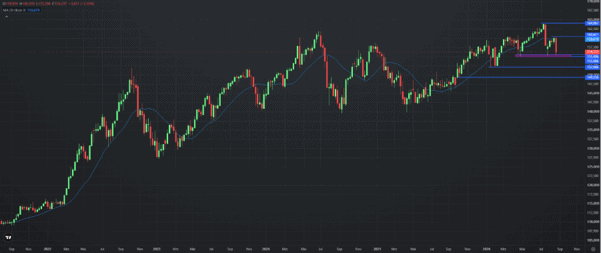
USD/JPY fell sharply last week. The currency pair lost 2.4% and ended the week at 156.20. This has extended the decline from the July high to almost 5%. Back then, USD/JPY climbed to just below 164, reaching its highest level since the 1980s. The short-term technical picture has therefore deteriorated. With the move below the 20-week moving average, the short-term upward momentum has been broken for now. However, the well-established support zone between 155.50 and 155.00 has so far prevented a deeper decline. This was where the last major upward move began in May. As long as this area is not sustainably broken, the long-term uptrend remains intact.
The area around 155 is therefore the key level. If support holds, the pair could initially stabilize. For a more sustainable recovery, USD/JPY would then need to reclaim the 20-week moving average at 159.70. A move above the high at 160 would further improve the short-term technical picture and bring the July high back into focus. If the pair falls sustainably below 155, however, the existing upward structure could break and a technical trend reversal could begin. The next important support would be around 152. A break below this level would further increase downside risk and open the way toward 149.40.
ECB Ahead of the Rate Decision: The Real Risk Comes After
The ECB rate hike on Thursday is almost fully priced into markets. The greater uncertainty lies in the future path of interest rates. The ECB is deliberately avoiding committing to a fixed path and instead decides on a meeting-by-meeting basis. Attention will therefore be focused on the signals Lagarde sends for the period after September and whether the ECB keeps the door open to further rate hikes or signals a potential pause.
Inflation remains the key problem. At 3.3%, it is well above the ECB’s 2% target. However, a significant part of the recent increase has been driven by higher energy prices – an external price shock that the central bank can hardly influence directly through higher interest rates.
The main risk lies in potential second-round effects. As long as higher energy prices do not spread more strongly to wages, services and other prices, underlying inflationary pressure remains limited. However, if price pressures become more entrenched across these areas, the ECB could be forced to raise interest rates further.
Europe’s Equity Rally Is Losing Momentum
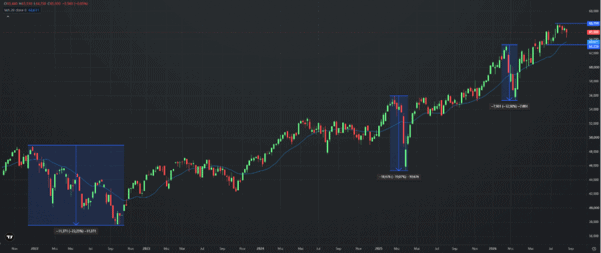
With the ECB’s interest rate decision due on Thursday, attention is increasingly turning to European equities. The STOXX Europe 600 lost 0.9% last week and closed at €65. This marked the index’s third losing week in the past four. However, it remains less than 2% below its record high. Investors have become more cautious recently, but there has been no significant profit-taking so far. The most important support is the July low at €63.30. A sustained break below this level would weaken the short-term technical picture.
Pullbacks of 3% to 5% are normal even within intact uptrends. Corrections of 10% or more, however, are significantly less common and are often accompanied by major fundamental headwinds (see blue rectangles). As long as support at €63.30 holds, a continuation of the broader uptrend toward new record highs remains the more likely technical scenario. The 20-week moving average could provide support during a deeper pullback. However, if the index falls below the moving average and subsequently breaks the €63.30 support level, a significantly stronger downward move could follow.
Bitcoin improves, but $83,000 has the final say
Bitcoin is once again approaching a decisive point amid different narratives. Institutional inflows, reduced selling pressure and improvements in some on-chain metrics point to a more favorable structure. However, the confirmation that would separate a rebound from a new bullish phase is still missing and, in principle, requires a sustained recovery of the $82,000–83,000 area.
This past week, despite employment data that reduced the likelihood of rate cuts and pushed bitcoin down to $76,600, the price recovered quickly with the arrival of certain inflows. The relevant signal is that the market is proving capable of absorbing negative news without breaking its support levels and we continue to see improving institutional demand, with US ETFs recording close to $1 billion in total weekly inflows.
On-chain metrics partially support this improvement. Short-term investors are once again selling, on average, at a profit and a significant share of the supply remains in the hands of investors considered to be long-term holders. The combined reading suggests reduced selling pressure, although accumulation is not uniform across all investor groups.
The market also faces several relevant catalysts. On September 9, the US Treasury’s expanded buybacks of long-term debt begin, at no less than $4 billion per operation. These operations aim to improve liquidity in the bond market and should not be confused with a monetary expansion program but they must be interpreted correctly.
The Producer Price Index will be published on September 10 and the CPI on September 11. An initial vote on the CLARITY Act is scheduled in the Senate on September 15, although the legislative calendar may be subject to change. The Federal Reserve’s decision will arrive on September 16, accompanied by new economic projections.
In just a few days, bitcoin will receive signals on four fundamental variables: liquidity, inflation, regulation and interest rates.
From a technical perspective, breaking above $82,000–83,000 with volume and continued institutional inflows would strengthen the scenario of an advance toward $90,000. The $100,000 level would represent a subsequent psychological reference, not a guaranteed target.
The $79,500–80,000 area acts as the immediate pivot. Below that, $76,500–77,000 represents the main tactical support. Losing it would increase the risk of a correction toward $70,000–73,000.
The central scenario remains a consolidation between $76,500 and $83,000. The structure is improving, but the thesis of a major third bullish wave still requires confirmation. Bitcoin is approaching an important point. For now, $83,000 continues to have the final say