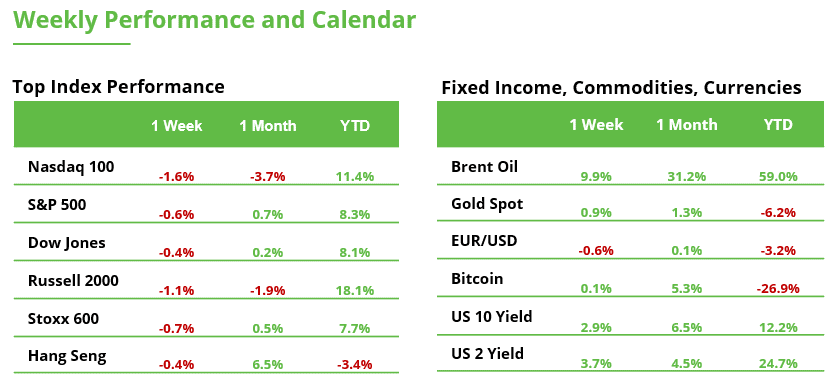



Markets have entered a more difficult phase. Geopolitical tensions have pushed oil prices higher, keeping inflation risks alive and reinforcing expectations that interest rates could stay higher for longer. At the same time, strong corporate earnings continue to support the longer-term outlook for equities. The disconnect between resilient fundamentals and choppy markets suggests the bigger challenge for investors is not the economy, but market positioning.
Positioning, Not Fundamentals, Is Driving Market Volatility
We think that the bigger risk over the next few months is not weakening earnings but investor positioning.
A broad deleveraging cycle is still underway across hedge funds, leveraged ETFs, retail options trading and margin accounts. It could take another three to four months before leverage returns to more normal levels.
While assets in leveraged memory-stock ETFs have already fallen 34% from their June peak, they remain elevated relative to the size of the underlying market. Retail call option buying has also cooled from nearly 14 million contracts in early June but remains above the levels that marked previous market bottoms.
Investment Takeaway: The implication is that technology and semiconductor stocks could continue experiencing sharp swings even if company fundamentals remain healthy.
We therefore caution investors not to confuse volatility driven by positioning with a deterioration in the AI story.
Earnings Strength Is Broadening
The encouraging news is that corporate earnings remain far stronger than many expected.
Almost one quarter of S&P 500 companies have reported, with 87% beating profit expectations. Earnings are growing 23% from a year ago, while revenue has increased 11%.
Importantly, the strength extends well beyond technology. Nine of the eleven sectors reporting so far have delivered double-digit earnings growth. Financials have emerged as the largest contributor to earnings growth, supported by strong trading and investment banking revenues, suggesting the recent rotation into banks may have further room to run.
Europe Is Quietly Improving
Europe has largely been overlooked by investors, but the earnings picture is becoming more encouraging.
Companies reporting so far have delivered 22% earnings growth. Even excluding the energy sector, profits are still up 9%. At the same time, Eurozone earnings revisions have fully caught up with the US for the first time since early 2025.
That suggests the earnings recovery is becoming broader than many investors appreciate and could support selective opportunities in European equities if the trend continues.
Retail Investors Remain the Market’s Anchor
Retail investors remain the market’s biggest source of buying power, with equity inflows running at an annualised pace of more than $1 trillion. Even after accounting for institutional selling and increased equity issuance, consensus expect roughly $200 billion of net equity demand during the second half of the year.
Investment Takeaway: We continue to think that the longer-term case for equities remains intact, but leadership is evolving. Markets are becoming less interested in companies that simply promise AI growth and more focused on those already converting investment into revenue and earnings. Alphabet provided one of the clearest examples this earnings season. Cloud revenue surged 82% year on year, while the company raised its 2026 capital spending guidance by another $15 billion and signalled another increase next year. That combination of accelerating investment and rapidly growing revenue suggests AI spending is beginning to translate into commercial returns. At the same time, the ongoing deleveraging process means patience may be rewarded, with bouts of volatility creating opportunities for long-term investors rather than signalling the end of the bull market.
Earnings Season: Can Big Tech Save the Rally?
Amazon and Apple are set to report quarterly earnings this Thursday. Despite their very different business models, they currently have two important things in common. Their results will provide the market with a reality check on consumer demand and the true progress of the AI story.
Amazon: Third Failed Breakout
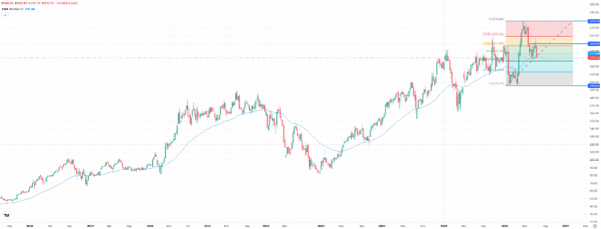
Amazon shares fell around 6% last week, closing at $232.10. The decline followed a third failed breakout attempt at the short-term resistance level of $250. The stock also closed below its 20-week moving average at $232.40, increasing the risk of further short-term weakness. The long-term uptrend, however, remains intact. As long as the key February low at $196 holds, the broader technical picture continues to support the potential for new all-time highs. That level also marked the beginning of the latest major rally, which carried the stock up to $278. For long-term investors, the recent pullback makes the stock more interesting again. Amazon has now reached the area between the 50% and 61.8% Fibonacci retracement, a zone that often acts as an important support level. To improve the short-term technical picture and increase the chances of the uptrend resuming, Amazon needs to break above the $250 resistance level.
Apple Stock: Ready for the Next Breakout?
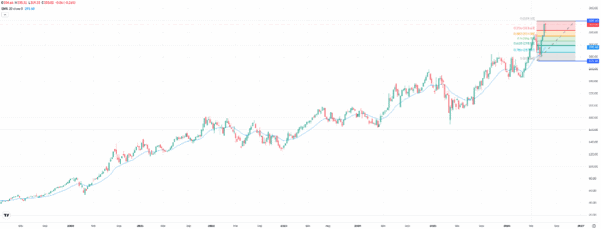
Apple’s technical picture looks considerably stronger. Although the stock briefly dropped more than 4% last week, buyers quickly stepped in and bought the dip. By the end of the week, Apple was trading close to its record high of $333. Investors appear to be approaching the upcoming earnings release with optimism. That said, the rally has already been underway for several weeks. Investors buying now would be entering after a substantial rally. The latest upward move began at the June low of $273 and carried the stock to $339. For existing shareholders and short-term traders, the focus will likely be on confirming the current uptrend. Investors still looking for an entry point may prefer to wait for a pullback. Here, too, Fibonacci retracement levels can provide useful guidance. Pullbacks to the 50% Fibonacci retracement or lower often offer more better entry points. In addition, the 20-week moving average, currently around $295, could provide further support during a deeper correction.
Markets are still waiting for confirmation
Crypto markets enter a pivotal week with one clear message: the evidence remains mixed, and conviction is still limited.
Bitcoin has begun to outperform the Nasdaq during July, suggesting asset-specific demand rather than a broad improvement in risk appetite. However, this encouraging signal is being offset by an increasingly restrictive macro backdrop, with markets pricing a higher-for-longer Federal Reserve.
Institutional flows reinforce that cautious picture. Bitcoin ETFs have interrupted their recent streak of inflows, while Ethereum ETFs continue to attract fresh capital, pointing to selective institutional rotation rather than the start of a broad-based recovery.
Interestingly, the derivatives market is beginning to tell a slightly more constructive story. According to the latest data from Glassnode, Bitcoin’s options market is showing an improvement in investor sentiment. The put/call ratio has fallen sharply, suggesting that downside hedges are gradually being unwound as call options gain market share. At the same time, short-term implied volatility remains compressed, indicating that traders are not expecting major price shocks in the immediate future, although longer-dated contracts continue to reflect a degree of caution. In other words, part of the fear that dominated recent weeks is beginning to fade, but the market has not yet fully embraced a clearly bullish outlook.
On-chain data continues to support that balanced interpretation. Network activity remains subdued, spot trading volumes are still well below previous bull-market levels, and key cycle indicators have yet to confirm a sustainable uptrend. The market may be building a bottom, but it has not yet proved that a new cycle has begun.
This week’s FOMC meeting is therefore the key catalyst. Markets have already priced in a relatively hawkish Fed, meaning the asymmetric risk now lies in the outcome: a dovish surprise could trigger a relief rally, while a more restrictive message would likely extend pressure across digital assets.
What investors should watch
- Whether Bitcoin ETF flows return to positive territory.
- Whether Ethereum ETF inflows continue for a second consecutive week.
- Whether the improving sentiment in the options market is confirmed by stronger spot demand.
- The Fed’s message and the reaction in Treasury yields and the US dollar.
- A confirmed Bitcoin breakout supported by higher trading volume.
For now, the investment approach remains unchanged. Maintaining existing positions appears reasonable, but adding new exposure before confirmation still offers an unattractive risk-reward profile. Sentiment is improving, institutional flows are becoming more selective, and derivatives positioning is turning less defensive. Even so, none of these signals, in isolation, is enough to confirm the start of a new bull market. In today’s environment, patience remains one of the most valuable assets an investor can hold.