


Crypto regulation is back in the Washington spotlight, and investors should watch closely.
Republicans and Democrats are trying to reach a deal on the Clarity Act before the election. The bill matters because it could finally draw clearer lines around digital assets: how tokens are classified, which regulators oversee them, and how parts of decentralised finance, or DeFi, are treated.
For markets, the key word is clarity. Clearer rules could reduce uncertainty, attract more institutional capital, and make it easier for banks, brokers, exchanges, and asset managers to build crypto-related products. But as always with regulation, the details matter.
Yield is the sticking point
One of the biggest issues is yield.
Crypto users like the idea of earning rewards or income on digital assets. Banks, however, worry that yield-bearing stablecoins or crypto products could start to look like savings accounts. This is important because banks rely on deposits to fund lending. If stablecoins can offer bank-like yield with lighter regulation, banks may face more competition for customer cash.
One important development: banks and crypto firms appear to have made progress on yield products. This may remove one of the main obstacles to the bill moving forward.
If lawmakers can agree on yield, the odds of a broader crypto framework improve. That would be supportive for crypto infrastructure, exchanges, stablecoin businesses and financial firms positioned to operate under clearer rules.
Banks: threat, opportunity, or both?
The Clarity Act is not just a crypto story. It is also a financials story.
Banks are affected because crypto increasingly overlaps with traditional banking activities: payments, deposits, custody, trading, settlement and yield. Stablecoins are especially important because they can function like digital dollars moving outside the traditional banking system.
That creates both risk and opportunity.
The risk is that crypto firms gain clearer permission to compete with banks in payments and savings-like products. Smaller banks could be more exposed if deposits become more mobile.
The opportunity is that large banks and brokers may eventually benefit from regulatory clarity. If the rules are clearer, they may become more comfortable offering crypto custody, tokenisation, stablecoin services, trading infrastructure or crypto-linked products. In that scenario, the winners are likely to be firms with scale, strong compliance systems and trusted customer relationships.
Exchanges could get a clearer runway
For crypto platforms and exchanges, regulatory clarity would likely be supportive.
Right now, crypto sits in a grey area. Some tokens may be treated like securities, which fall under the SEC. Others may be treated more like commodities, which fall under the CFTC. A clearer split between the SEC and CFTC could reduce uncertainty over which tokens can trade, where they can trade, and under what rules. That could help listed crypto-related equities, exchanges, market makers, custodians, and payment firms.
But clarity does not automatically mean lighter regulation. The bill could also bring stricter oversight, especially around DeFi, stablecoins, ethics, and investor protection.
So the market reaction may depend on whether investors see the final version as a growth unlock or a new compliance burden.
Bitcoin may benefit, but smaller tokens could move more
For Bitcoin and major crypto assets, the Clarity Act would not change the investment case overnight.
Bitcoin is already increasingly treated as a macro asset, shaped by liquidity, ETF flows, risk appetite, and currency-debasement narratives. But clearer rules could still improve institutional confidence and broaden access.
For smaller tokens, the impact could be bigger. Classification matters. If a token is treated as a security, it may face tougher rules on where and how it can trade. If it is treated more like a commodity, access may become easier. That means altcoins and crypto platforms could be more sensitive to the final text than Bitcoin itself.
The politics are still complicated
The bill is not over the line yet.
Senate Banking, Senate Agriculture, and the House version still differ on key definitions and enforcement powers. Ethics concerns, DeFi rules, SEC/CFTC authority, and Senate vote thresholds remain major hurdles.
Betting odds put the chance of the Clarity Act being signed into law in 2026 at 64%. That suggests markets see a better-than-even chance of progress, but not certainty.
Investment takeaway: The key shift is that crypto is increasingly moving from a speculative asset class to financial infrastructure. Once regulation becomes clearer, the debate is less about whether institutions participate, and more about which institutions capture the new revenue layers emerging around tokenization, stablecoins, custody, and on-chain finance. This should be supportive for crypto infrastructure, exchanges, custodians, and large financial firms with strong compliance capabilities, while creating more competition for banks in deposits and payments.
Bitcoin Rally Continues – But the Biggest Hurdle Is Still Ahead
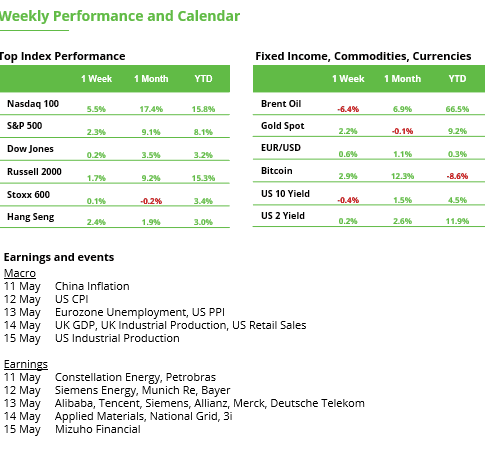
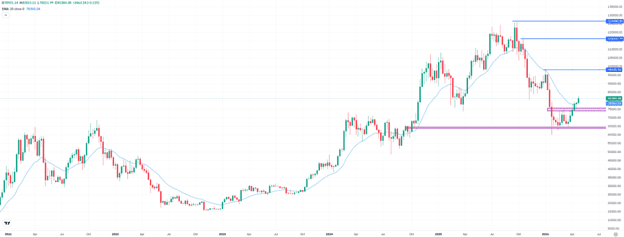
Bitcoin gained around 3% last week, climbing to $81,000. This marked the third consecutive weekly close above the 20-week moving average and the sixth winning week in a row overall. Since the January low, Bitcoin has now recovered by around 36%. However, the most difficult part may still lie ahead. For the current recovery to evolve into a new long-term uptrend, Bitcoin first needs to break above the January high near $98,000. That level marked the starting point of the last major sell-off. As a result, sellers are likely to defend this area aggressively or attempt to pressure the market beforehand in order to maintain the broader downtrend structure.
As long as Bitcoin remains above the 20-week moving average at around $78,000, the chances for another move toward resistance remain intact. If stronger selling pressure emerges in the short-term, investors should watch the zone between 74,000 and 75,500 US dollars closely. This area has seen numerous reactions since January and, following the recent breakout higher, is now acting as an important support zone.
Alibaba Ahead of Earnings: Can the Stock Break Back Above the 20-Day Moving Average?
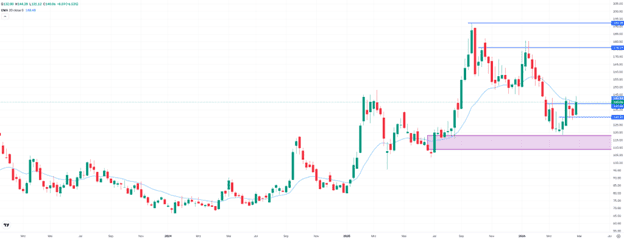
Alibaba shares gained around 6% last week, closing at $140. Even so, this marked the second failed attempt within four weeks to reclaim the 20-week moving average on a closing basis. Just five weeks ago, the stock was trading significantly lower and temporarily dropped to $118. That move brought the price into the upper boundary of a Fair Value Gap from last summer between $109 and $118. The subsequent rebound pushed the stock back above the important resistance level at $139. As a result, the technical picture has improved noticeably in recent weeks. From a chart perspective, this could open the door for a further recovery toward $176 and later potentially $192.
In the short-term, however, the stock first needs to reclaim the moving average in a sustainable way. Q1 earnings and the updated guidance on Wednesday could provide the next major directional catalyst. An important support zone is currently located around $130. This area has already been defended successfully twice. Should this level break, the yearly low and the previously mentioned Fair Value Gap would likely come back into focus.
Crypto’s Institutional Shift: From Bitcoin Recovery to Financial Infrastructure
The crypto market is beginning to show a meaningful divergence compared to previous cycles.
Bitcoin’s recent recovery is not spreading evenly across the broader ecosystem. While flows into institutional BTC-linked vehicles continue to rise, Ethereum and most altcoins still show significantly weaker participation. The pattern suggests a market that remains in the early stages of capital reallocation, closer to selective adoption than to a broad speculative expansion.
Several converging factors appear to be driving this shift.
First, institutional perception of Bitcoin continues to evolve. Since 2022, Bitcoin’s realized volatility has declined structurally, gradually converging toward levels seen in large-cap technology equities (historically below 40% annualized volatility). This has made BTC easier to integrate into traditional asset allocation and risk management frameworks.
At the same time, the regulatory backdrop in the United States is becoming increasingly relevant to the sector’s investment thesis. The primary focus is now the so-called Clarity Act, particularly regarding the treatment of dollar-backed stablecoins.
The key element of the recent political compromise lies in the treatment of yield mechanisms. Under the emerging framework, issuers would be allowed to offer economic incentives to users through loyalty programs or platform-based rewards, rather than classifying them as direct interest payments. This distinction is significant because it removes one of the main regulatory and political obstacles that had stalled the legislation.
Markets reacted immediately. Implied probabilities of approval before year-end moved from roughly 40% to nearly 70% within hours. The broader implication matters: this is not simply about crypto regulation, but about creating a clearer operational framework for stablecoins, tokenization, and on-chain settlement within the U.S. financial system.
Meanwhile, adoption metrics continue to accelerate. Stablecoin market capitalization has surpassed $300 billion, while the tokenized real-world asset (RWA) market is approaching $31 billion, with more than 767,000 users currently holding some form of tokenized asset.
Taken together, these developments point toward a gradual shift in the sector’s narrative. The focus appears to be moving away from purely speculative models toward digital financial infrastructure built around payments, settlement, tokenization, and digital monetary reserves.
From a technical perspective, the $82,000 level has acted as the first resistance zone within the current bullish impulse. However, it is only above $84,000 that a new upward leg becomes more likely, potentially driven by forced deleveraging from the portion of the market still positioned around the traditional Bitcoin cycle framework. On the downside, $78,000 and $75,000 remain the first relevant support levels. A break below the latter would open the path toward the $69,000–70,000 range.