



Shares of Home Depot have struggled in recent years, as interest rates delay big renovation projects. The Daily Breakdown takes a deep dive.
Interested in more Deep Dive content? Check out our latest research.
Deep Dive
Home Depot is the world’s largest home improvement retailer. The company serves both DIY customers and professionals, while also offering installation services and equipment rentals. The company now commands a $300 billion market cap, making it one of the 40 largest companies in the S&P 500. However, the stock has struggled, falling about 12% so far this year and more than 30% from its November 2024 peak.
For better or worse, Home Depot’s business — and sentiment around HD stock — is heavily influenced by interest rates. When rates are high or moving higher, more homeowners tend to delay large renovation projects as financing costs rise. When rates fall or remain low, consumers are more likely to renovate, creating a potential tailwind for Home Depot.
Here’s what CEO Ted Decker had to say at the company’s most recent Investor Day when it came to consumers and interest rates: “The elevated interest rate and mortgage rate environment since 2023 has stifled housing turnover…which has significantly reduced demand for projects associated with buying and selling a home.”
More recently, he noted, “Customers are telling us that they’re not investing in large projects, and that has everything to do with consumer confidence and sentiment, jobs picture, overall price levels, and affordability in the economy.”
Rising Dividend Yield, Stifled Earnings Growth
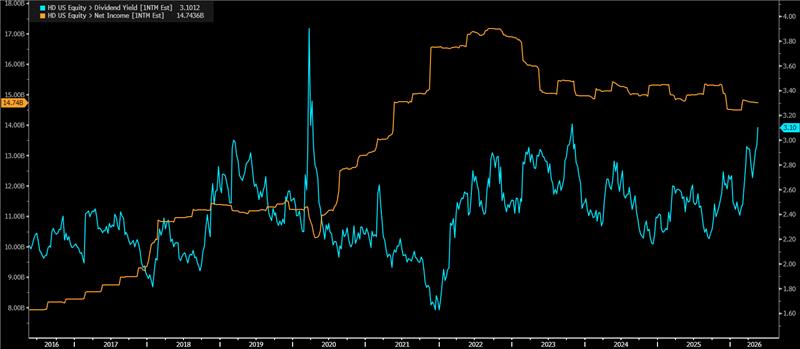
Notice how the company’s net income (in orange) spiked from 2020 through 2022 — during the housing boom — but has plateaued over the past few years. Conversely though, notice how the dividend yield (in blue) has moved higher, now at a multi-year high and above 3%.
According to Bloomberg, analysts project the following:
- Earnings Growth: -3.6% in 2026, 2.4% in 2027, and 8% in 2028
- Revenue Growth: 3.3% in 2026, 4% in 2027, and 4.2% in 2028
Analysts currently have a consensus price target of ~$412 on HD stock, implying about 36% upside to today’s stock price.
Want to receive these insights straight to your inbox?
Diving Deeper — Valuation
While many long-term investors may have faith that Home Depot eventually returns to a stronger growth environment, it does face one key issue right now: Valuation.
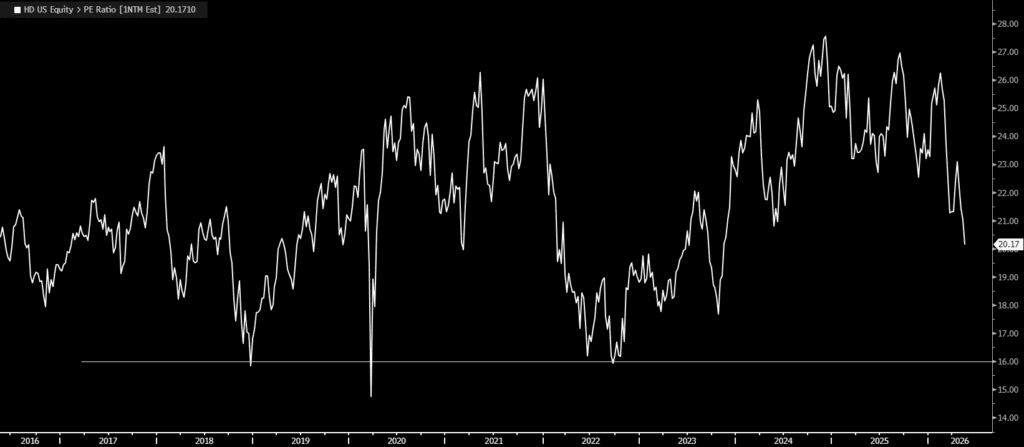
If a stock price falls while profits are stable or rising, the valuation declines too, potentially making the stock more attractive for long-term investors. The challenge with Home Depot is that profits have also declined, so while the valuation has come down over the last year, it has not compressed as much as some investors may have hoped.
Over the last decade, 16 times forward earnings has generally acted as a trough for Home Depot, while 25 to 26 times earnings has acted as a ceiling. Now trading at roughly 20 times, HD sits in the middle of that historical range, even though the stock recently hit a one-year low.
Risks
Home Depot’s business is tied to more than just revenue and profits. It is highly consumer-oriented and often connected to consumers’ most valuable asset: their home. As a result, interest rates, mortgage rates, housing turnover, and consumer sentiment all play a major role in the company’s performance. From that perspective, the health of the US economy is critical, and while Home Depot has worked to make its supply chain less vulnerable to tariff-related disruptions, economic policy remains a potential risk.
The Bottom Line
Home Depot remains one of the market’s largest and most established retailers, reinforcing investors’ long-term confidence. However, interest rates and housing activity may very well drive the short-term narrative, while the stock’s valuation is not yet at historical trough levels. That could keep investors away from HD until the firm returns to more prosperous growth or pulls back to a more attractive valuation.
Disclaimer:
Please note that due to market volatility, some of the prices may have already been reached and scenarios played out.