


One way to reconcile today’s mixed consumer signals is through the lens of a K-shaped consumer. Headline spending remains resilient, but equity performance suggests investors are increasingly distinguishing between affluent households and more rate-sensitive consumers.
On the stronger side are asset owners, frequent travellers, and higher-income households benefiting from rising stock prices and wealth effects. That helps explain why airlines such as Delta and hotel and resort REITs continue to outperform. Consumers are still flying, booking vacations, attending events, and spending on experiences, indicating that discretionary demand has not disappeared.
But beneath the surface, spending appears more selective.
If consumer demand were broadening across income groups, investors would likely expect stronger relative performance from stocks more exposed to lower-income and credit-sensitive households, such as Dollar General, Capital One, or Synchrony Financial. Instead, these names remain important barometers of pressure from higher borrowing costs, rising delinquencies, fuel inflation, and stretched household budgets.
The market may therefore be signalling an important distinction: the consumer is not necessarily weak, but consumer spending is no longer broadening evenly. Travel and experience-related spending remain robust, while lower-income households, revolving credit users, and rate-sensitive consumers face more pressure. In that sense, today’s consumer story is less about aggregate strength and more about widening dispersion.
Everyone Owns AI Now. The Question Is What Else You Own.
Artificial intelligence remains the market’s favourite trade. Since the S&P 500’s March low, technology ETFs have attracted roughly $22 billion of inflows, dwarfing every other sector.
The result? Investors are piling into the same theme, often through different wrappers.
While the long-term investment case for AI remains compelling, the next phase of investing may be about finding what can complement it.
You may already own more AI than you think
Many investors assume they’re diversified because they own multiple ETFs. Not necessarily.
Many ‘diversified’ ETFs now have substantial technology exposure:
Examples:
Investment Takeaway: Before adding another AI position, it may be worth looking through your existing holdings. If you already own broad US equities, growth stocks or technology-heavy funds, your AI allocation could be much larger than you think. Adding multiple AI-themed portfolios may create concentration rather than diversification.
Diversification is becoming more valuable
Do not abandon AI, but pair it with areas that have lower correlation to tech, such as:
- Low-volatility strategies that historically hold up better when crowded growth trades unwind ($SPLV, $Core-Stability)
- Dividend strategies which have lower tech exposure, lower correlation to AI trades, and more defensive cash-flow characteristics. If Nvidia or AI infrastructure spending slows, dividend portfolios tend to be driven more by earnings and cash distributions than momentum ($NOBL, $HDV, $SCHD, $VIG)
- Value strategies that have meaningfully lower tech concentration. Value tends to outperform when market leadership broadens beyond mega-cap tech (dividend and value-focused funds, $ValueGurus)
- Infrastructure-related funds. AI’s growth requires data centres, electricity, transmission networks and cooling systems regardless of which AI company comes out on top. ($PAVE)
- Managed futures, alternative strategies. ($DBMF, $KMLM)
These can help maintain exposure to the market’s strongest trend while introducing alternative sources of return.
Bitcoin Doesn’t Need Fewer Sellers. It Needs More Buyers.
While much of the market remains focused on the Fed, inflation, or geopolitics, there is a much simpler explanation for what is happening in bitcoin today.
Sellers are disappearing… but buyers are not showing up either.
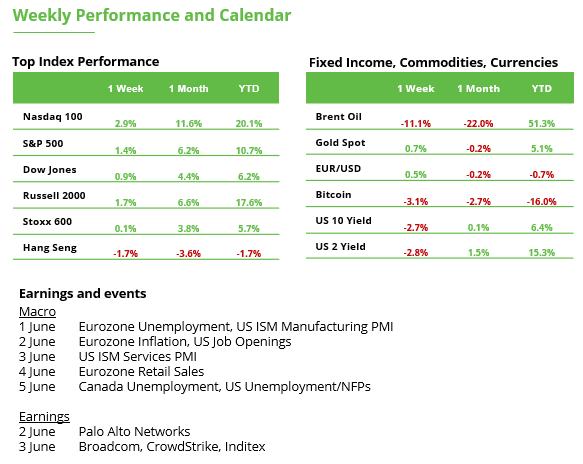
Bitcoin is currently trading around $74,000, roughly 10% below its recent highs. At the same time, spot bitcoin ETFs have recorded ten consecutive trading days of net outflows, with approximately $3 billion withdrawn during that period. Even more notable, BlackRock’s IBIT recently posted its second-largest daily redemption since launch.
Long-term holders continue to accumulate and selling pressure has cooled significantly. In theory, that should be bullish. The problem is that institutional demand, reflected in the 100-1,000 BTC wallet cohort largely associated with ETFs and corporate treasuries, has been flat since February.
The result is a market with insufficient supply to trigger a major breakdown, but also insufficient demand to fuel a sustained rally.
This dynamic is also visible in on-chain data. The Realized Profit/Loss ratio remains around 1.56, well below the 2-5 range that has historically accompanied the beginning of strong and sustained bull market advances.
To us, this does not look like a market for chasing rebounds or aggressively increasing risk. It looks more like a period of accumulation and base-building.
The $69,000-$70,000 area remains the key level buyers are trying to defend. As long as it holds, consolidation remains the most likely scenario. But a decisive break below $65,000 could increase the risk of forced selling from corporate treasuries that accumulated Bitcoin at higher prices.
The lesson for investors is simple: sometimes markets do not fall because there are too many Sellers. They fall because buyers stop showing up.