



Telecom companies help to keep the world connected. Learn more about what the telecom sector encompasses and how it has performed in recent years.
As digital communication becomes increasingly central to daily life, understanding telecom stocks has become more important than ever for investors looking to capitalise on this essential sector.
Find out what is considered a telecom stock, some of the more popular companies in this space, how telecom stocks have performed in recent years, and what to look for when deciding which telecom stock to buy.

What Are Telecom Stocks?
Telecom stocks are companies that provide the means for people to communicate digitally. This includes the infrastructure on which communication is built as well as any required software and hardware.
Some examples of telecom stock companies are internet service providers, phone service providers, cell and radio tower owners and operators, and those responsible for cabling and other technology related to digital communication.
Telecom companies typically generate revenue through subscription services, data plans, equipment sales, and infrastructure leasing agreements.

What are some Popular Global Telecom Stocks?
There are many telecom stocks to choose from. They cover a variety of industries and have various business models which represent different kinds of investment opportunities. Some popular stocks operating in the telecom space include:
Zoom Video Communications Inc. (ZM)
Zoom has pivoted from its standalone video tool into an AI-first collaboration ecosystem. It is expanding to address the complexities of modern hybrid work through automated administrative workflows and physical space management.
The company remains the dominant force in the industry, maintaining over 55% of the global video conferencing market share, even as it faces intense competition from bundled services like Microsoft Teams. At the same time it is expanding its total addressable market (TAM) into high-security sectors, including major US Department of Defense contracts.
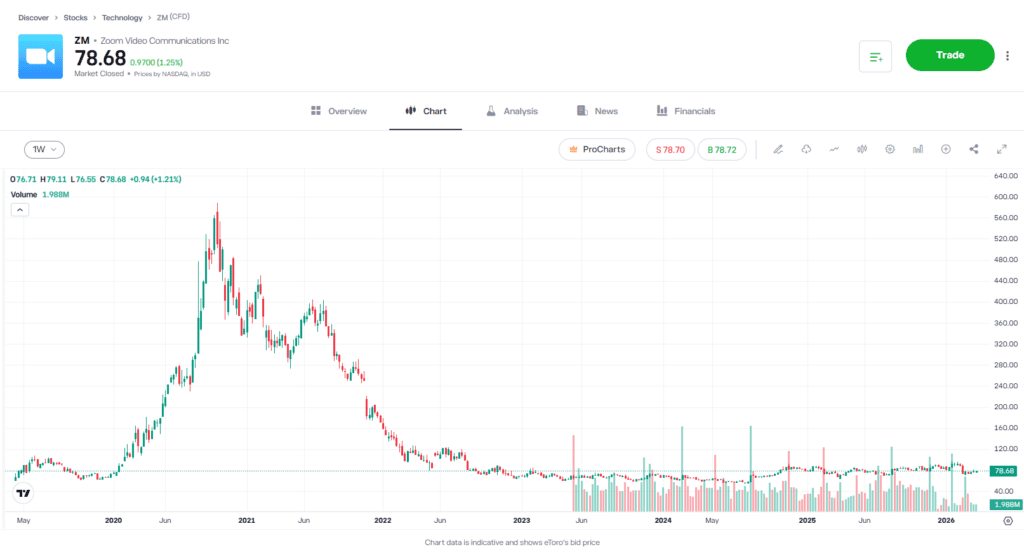
While Zoom stock continues to experience moderate volatility, the company has bolstered its financial floor through a debt-free balance sheet and a massive cash pile used for strategic investments, notably its significant stake in the AI research firm Anthropic.
This “hidden asset” strategy, combined with a forward P/E ratio that often trades at a discount to other SaaS peers, positions the company as a value-oriented play in the high-growth AI infrastructure space.
Past performance is not an indication of future results.
T-Mobile US Inc. (TMUS)
The focus of the US wireless market has shifted from 5G construction to “harvesting” the rewards of network maturity. As part of this, T-Mobile has transitioned from being an aggressive disruptor into a cash-generating leader that prioritises shareholder returns with a strong technical edge.
T-Mobile experienced a surge in subscriber growth through late 2025, reaching a record high of approximately 140 million customer connections. As of February 2026, T-Mobile holds the title for the highest global 5G availability and was ranked #1 for network quality by J.D. Power, effectively challenging the “reliability” crown long held by Verizon.
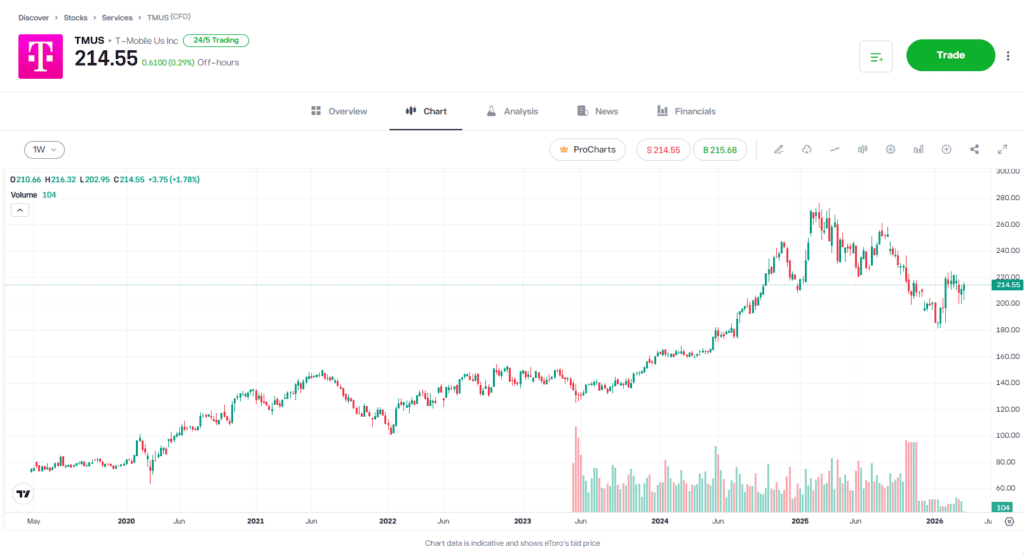
The company has successfully moved beyond the 2020 Sprint merger integration, pivoting its capital toward massive shareholder buybacks and a growing dividend, which was recently increased by 16%.
The stock has seen a period of consolidation following its rapid growth phase, But the company’s launch of 5G-Advanced features like “dynamic network slicing” in early 2026 ensures it remains the preferred platform for next-generation AI-driven mobile applications and autonomous systems.
Past performance is not an indication of future results.
Comcast Corporation (CMCSA)
Comcast has pivoted its strategy to focus on convergence–seamlessly bundling multi-gigabit broadband with high-growth mobile and streaming services to defend its market share.
A series of bold strategic moves in late 2025 and early 2026 included the tax-free spin-off of Versant Media Group (its cable networks) to focus on premium live sports and streaming. This strategy formed a response to changes in the telecommunications and entertainment landscapes and the shift toward “intelligent” content delivery.
The company’s Janus initiative has virtualised its core network, allowing for AI-powered self-healing and symmetrical multi-gigabit speeds across its entire footprint. By February 2026, Peacock had reached a critical scale with 44 million paid subscribers, bolstered by the debut of the NBA on NBC and the launch of RealTime4K streaming during Super Bowl LX.
Tip: When evaluating telecom stocks, consider how well-diversified their revenue streams are across different services and geographic regions.
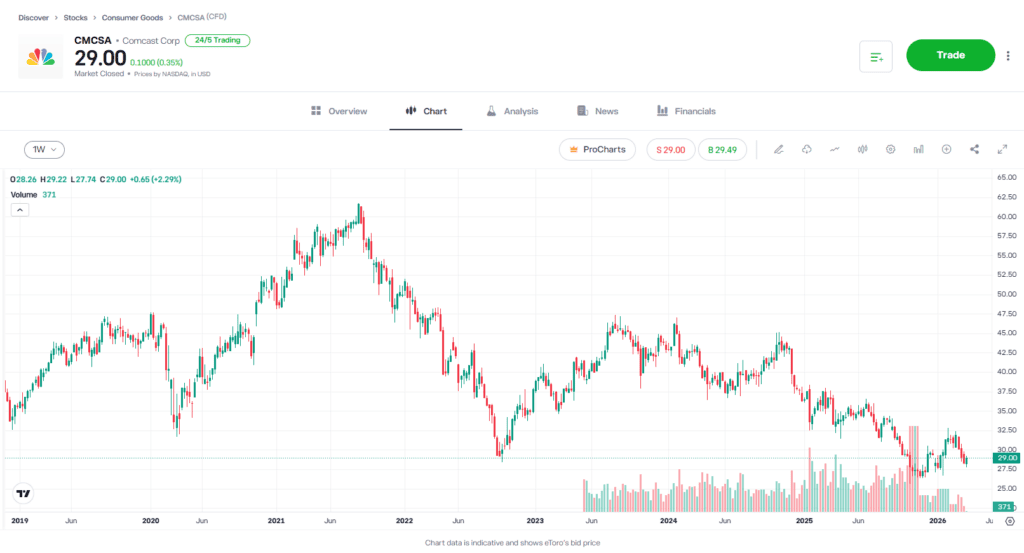
While Comcast stock has navigated a period of broadband “churn” due to fixed wireless competition, the company has stabilised its earnings through its record-breaking wireless segment, which now surpasses 9.3 million lines.
The churn rate is also being addressed by the company’s decision to simplify its national broadband pricing with 5-year guarantees, while the opening of Epic Universe in Orlando in mid-2025 has provided a significant boost to its theme park revenue.
Past performance is not an indication of future results.
American Tower Corp. (AMT)
American Tower Corp. remains a global leader in cell tower operations, with a presence in major markets including the US, Brazil, India, and across Africa. However, the convergence of 5G densification and AI-driven data processing has redefined American Tower’s strategic role.
As of early 2026, the company has evolved from a traditional “tower company” into a hybrid infrastructure giant, leveraging its CoreSite data centres to provide the low-latency “edge” computing necessary for real-time AI applications.
As a REIT, American Tower continues to provide stable, income-focused returns, with its quarterly dividend reaching $1.70 per share in early 2026.
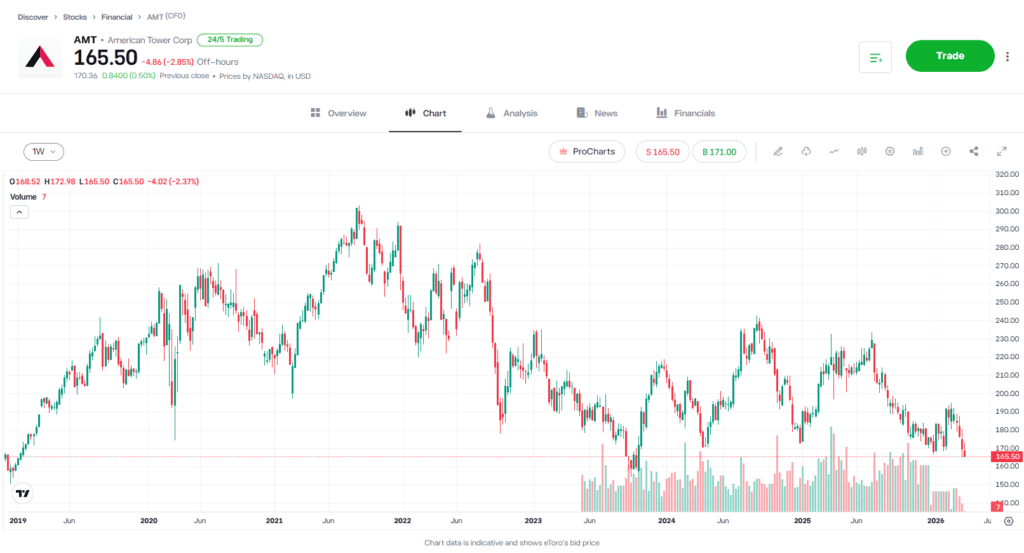
Despite a slight U.S. churn headwind from past carrier consolidation, the company’s focus on 5G-Advanced upgrades–which require more equipment and higher rent per tower, provides a predictable long-term growth runway. The stock is increasingly viewed as a defensive AI play, offering exposure to the data revolution without the extreme volatility of pure-play tech firms.
Past performance is not an indication of future results.
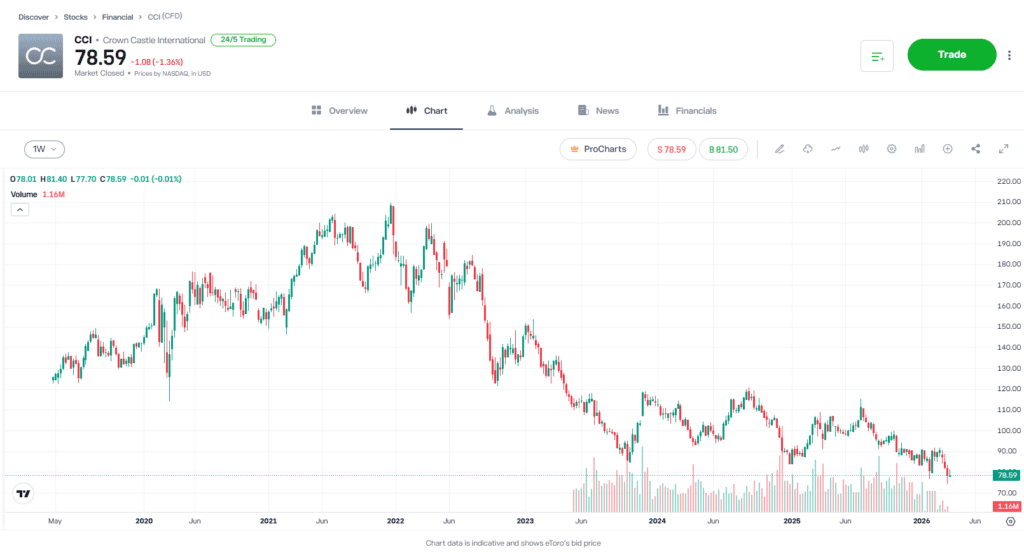
Crown Castle International Corp.(CCI)
The landscape for digital infrastructure is shifting toward operational simplicity and specialised assets. In response to this, Crown Castle is undergoing a major transformation, moving from a diversified fibre-and-tower provider to a pure-play U.S. tower operator to unlock shareholder value.
Crown Castle is in the final stages of a strategic pivot, having signed a definitive agreement to sell its entire small cell and fibre business to EQT and Zayo for $8.5 billion. This transaction marks a decisive exit from the urban fibre-dense strategy that once defined the company. It also provides room for Crown Castle to focus exclusively on its portfolio of approximately 40,000 U.S. cell towers and significantly reducing its corporate workforce by 20% to streamline its cost structure.
As a REIT since 2014, the company remains a cornerstone for income-focused portfolios, though its dividend policy has entered a maintenance phase. In February 2026, management reaffirmed an annualised dividend of $4.25 per share, intending to hold this level steady until the payout ratio aligns with its new, leaner financial model.
Past performance is not an indication of future results.
How have Telecom Stocks Fared in Recent Years?
The telecommunications sector has demonstrated remarkable resilience and growth in recent years. The sector benefitting from increased demand for connectivity as remote work, online education, and digital entertainment became essential parts of daily life.
The widespread adoption of 5G technology has created new revenue opportunities for carriers and infrastructure providers alike. Additionally, the rise of Internet of Things (IoT) devices, from smart home systems to connected vehicles, has increased demand for robust telecommunications networks.
Tip: Global telecom services revenue reached £1.4 trillion in 2024, with analyst projections suggesting continued growth through 2027.
However, the sector faces challenges including intense competition, high capital expenditure requirements for network upgrades, and regulatory pressures in various markets.
Companies that have successfully balanced infrastructure investment with operational efficiency have generally outperformed their peers. The shift towards edge computing and the increasing importance of cybersecurity services have also created new growth avenues for forward-thinking companies.

What Should You Look for in Telecom Stocks?
When evaluating telecom stocks for your portfolio, several key factors can help guide your investment decisions. Understanding these elements can help you identify companies with strong growth potential and sustainable business models.
Cash flow stands as perhaps the most critical metric for telecom companies. Strong cash flow enables companies to maintain and upgrade their infrastructure, pursue strategic acquisitions, and return value to shareholders through dividends.
Tip: Look for companies with the consistent free cash flow generation and manageable debt levels needed to finance capital investment.
Competitive positioning matters enormously in the telecoms sector. Consider factors such as market share, network quality, customer satisfaction ratings, and spectrum holdings. Companies with strong brand recognition and low customer churn rates often demonstrate more stable revenue streams.
The regulatory environment plays a crucial role in telecom stock performance. Stay informed about spectrum auctions, merger and acquisition activity, and changing regulations in key markets. Companies operating in markets with stable regulatory frameworks and supportive government policies for infrastructure development may offer more predictable returns.
Tip: Pay attention to a telecom company’s capital allocation strategy – how companies balance network investment with shareholder returns.
Final thoughts
The telecom sector is transitioning from a period of heavy infrastructure build-out to a high-stakes race for monetization and intelligence. The successful companies are no longer “just utilities” but AI-native platforms offering exposure from global enterprise workflows to industrial robotics.
The key to navigating this sector lies in identifying the “harvest leaders”–those companies with the free cash flow to reward shareholders while simultaneously funding the next leap into 6G and sovereign AI clouds. Stock selection involves balancing traditional metrics like churn and dividend yield with a forward-looking eye on network virtualization and strategic AI partnerships.
Visit the etoro Academy to learn more about investing in specific sectors.
Frequently Asked Questions
- How do interest rates affect the dividend stability of telecom stocks?
-
Telecom companies are notoriously capital intensive and typically carry significant debt to fund network upgrades. If central banks hold rates at relatively high levels, companies with weaker balance sheets are put under pressure. If a company’s dividend payout ratio exceeds 80% while interest costs are high or rising, there is a higher risk of a dividend cut to preserve cash for operations.
- How has AI changed the financial outlook for telecom stocks?
-
AI has moved from a buzzword to a primary driver of operational efficiency. Telecom leaders are utilising “Agentic AI”– autonomous systems that can self-heal networks and troubleshoot outages without human intervention.
The use of AI tools had reduced the Mean Time to Repair (MTTR) for outages by 30% to 70% in early 2026. Companies are also launching “AI-native” features, such as hyper-personalised data plans and automated enterprise workflows, which analysts estimate could increase messaging revenue for early adopters.
- What are the biggest risks facing telecom investors right now?
-
Despite steady growth, the sector faces three primary hurdles that investors should monitor. The first is regulatory scrutiny with non-compliance being associated with significant penalties. Then there are continued infrastructure costs associated with Fibre-to-the-Home (FTTH) and satellite-to-cell integrations. Finally there are geopolitical tensions to consider. Fragile supply chains for the high-end AI chips required for modern telecom “edge” computing remain a concern, with trade restrictions potentially impacting hardware availability.
- Is “Satellite-to-Cell” a threat to traditional tower companies?
-
Satellite-to-cell technology poses a long-term, structural threat to traditional tower companies by potentially reducing the need for new, rural tower infrastructure, potentially limiting future leasing revenue growth. In the near-term, satellite-to-cell cannot match the density and bandwidth of terrestrial towers which is a key point considering the continued growth in demand for mobile data.
- What is “Converged Connectivity,” and why is it a 2026 buzzword?
-
Most major players (like Comcast and T-Mobile) now offer converged bundles that combine 5G-Advanced mobile, high-speed fibre, and streaming. Bundled customers have a significantly lower churn rate (they are less likely to cancel) and by locking a customer into three services instead of one, telecom companies can afford to offer “price locks” that stabilise their revenue in a volatile economy.
This information is for educational purposes only and should not be taken as investment advice, personal recommendation, or an offer of, or solicitation to, buy or sell any financial instruments.
This material has been prepared without regard to any particular investment objectives or financial situation and has not been prepared in accordance with the legal and regulatory requirements to promote independent research.
Not all of the financial instruments and services referred to are offered by etoro and any references to past performance of a financial instrument, index, or a packaged investment product are not, and should not be taken as, a reliable indicator of future results. The availability of all the above-mentioned products and services may vary by jurisdiction and country.
etoro makes no representation and assumes no liability as to the accuracy or completeness of the content of this guide. Make sure you understand the risks involved in trading before committing any capital. Never risk more than you are prepared to lose.