



Investors looking toward 2026 face a unique macroeconomic landscape where the energy transition, geopolitical realignments, and shifting interest rate cycles are redefining the commodities market.
Historically used as a hedge against inflation and a tool for portfolio diversification, commodities now play a central role in the global shift toward electrification and sustainable energy.
Whether you are interested in the timeless stability of precious metals or the high-growth potential of industrial materials like Copper and Uranium, understanding the underlying supply-and-demand mechanics is essential for any investor.
Gold
Past performance is not an indication of future results.
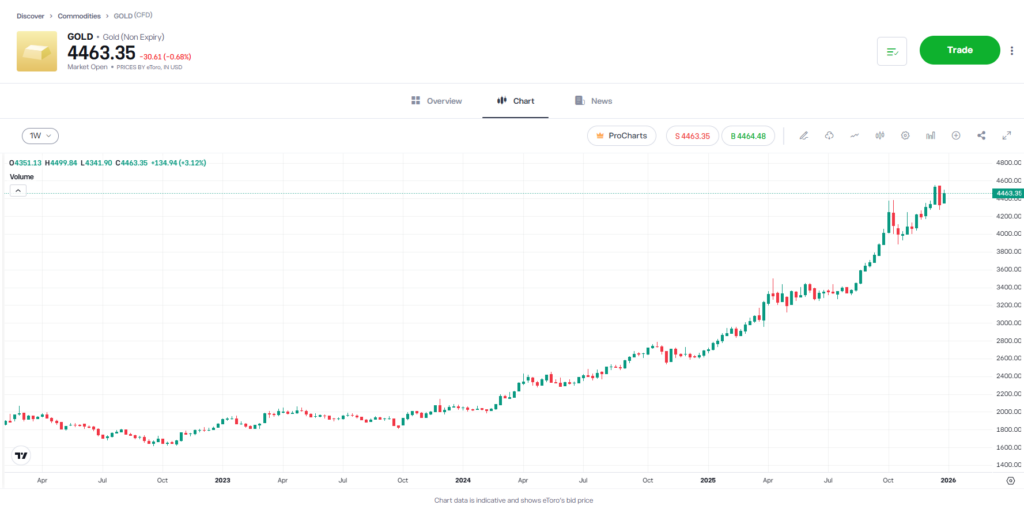
Gold remains the premier safe-haven asset for investors in 2026, continuing its long-standing role as a store of value during times of global economic and geopolitical uncertainty.
- Demand is being bolstered by central bank purchases, as many emerging market nations look to diversify their reserves away from traditional fiat currencies.
- Historically, Gold has maintained an inverse relationship with real interest rates; as global central banks normalise rates in 2026, the opportunity cost of holding non-yielding Gold may shift.
- Global supply remains relatively constrained, with mining production struggling to keep pace with the structural demand from both retail investors and industrial applications.
- The rise of geopolitical tensions in various trade blocs continues to support a high “premium” on the price of Gold compared to historical averages.
- Investors often use Gold as an inflation-hedging tool, as it tends to maintain purchasing power over long periods when currency values fluctuate.
- A primary risk for Gold in 2026 is a potential strengthening of the US Dollar, which can make the metal more expensive for international buyers and put downward pressure on prices.
Your capital is at risk. Not investment advice
Copper
Past performance is not an indication of future results.
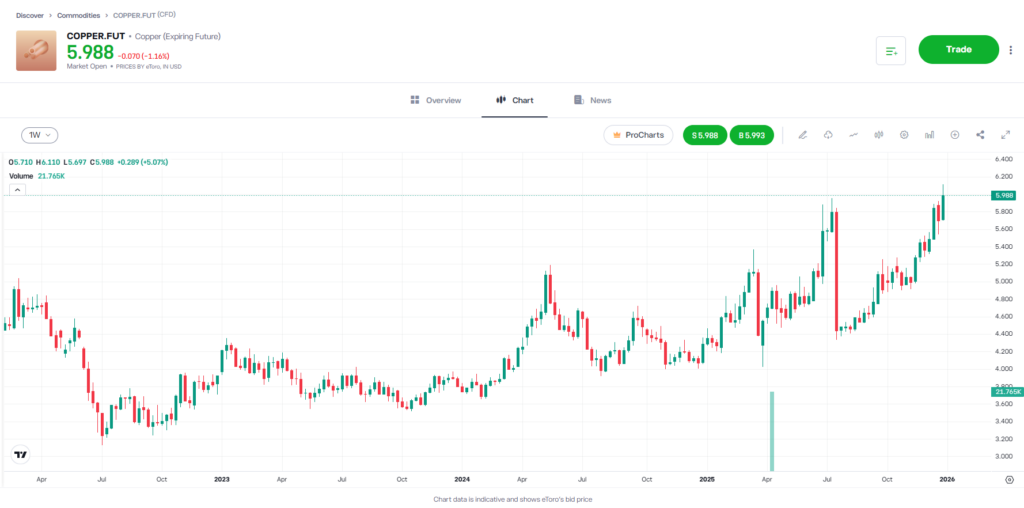
Copper is widely regarded as the “metal of electrification”, and in 2026, it is a critical component for the global transition to renewable energy and electric vehicles (EVs).
- Analysts predict a significant supply deficit by 2026, as existing mines age and the lack of new “greenfield” projects limits the amount of refined copper available.
- The growth of AI data centres is a new and powerful driver of demand, as these facilities require massive amounts of copper cabling and power infrastructure.
- China’s industrial recovery remains a key factor to watch, as the nation continues to be the world’s largest consumer of refined copper for construction and electronics.
- Copper is often viewed as a leading economic indicator (frequently called “Dr. Copper”), with price movements reflecting the overall health of global manufacturing.
- Environmental and regulatory hurdles in major producing regions like Chile and Peru may continue to disrupt supply chains throughout the year.
- While demand is structural, the primary risk involves a global slowdown in EV adoption or a recession that stalls large-scale infrastructure projects.
Your capital is at risk. Not investment advice
Uranium
Past performance is not an indication of future results.
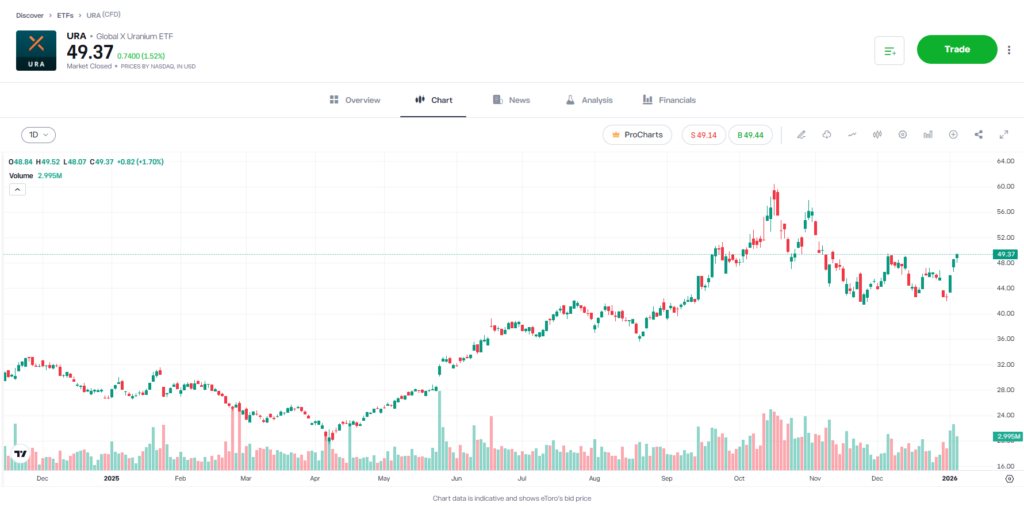
Uranium has emerged as a high-conviction commodity in 2026 due to the global resurgence of nuclear power as a clean, reliable source of baseload energy.
- Big Tech companies are increasingly signing long-term power agreements with nuclear providers to satisfy the immense energy needs of their AI operations.
- The market is experiencing a structural supply gap, with production from major miners like Kazatomprom remaining lower than total global reactor requirements.
- Government policies in the UK and Europe are shifting toward energy sovereignty, leading to life extensions for existing reactors and investments in Small Modular Reactors (SMRs).
- Unlike other commodities, trading in uranium in mineral form is restricted but investment vehicles such as the Global X Uranium ETF (URA) offer a way to gain exposure to a broad range of companies engaged in uranium mining and nuclear components production.
- Risks for 2026 include geopolitical sanctions on enriched uranium exports from Russia, which could further tighten the available global supply. Investors must also be mindful of the regulatory risks and public sentiment regarding nuclear safety, which can change rapidly following unforeseen events.
Your capital is at risk. Not investment advice
Silver
Past performance is not an indication of future results.
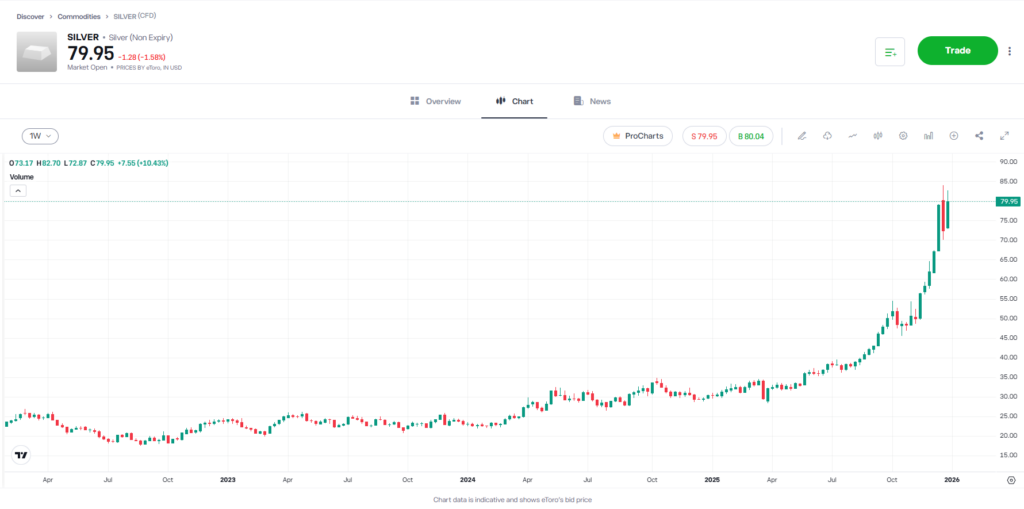
Silver offers a dual appeal in 2026, functioning both as a precious metal safe-haven and a vital industrial material for modern technology.
- The solar power industry is now a massive consumer of silver, with the metal being essential for the conductant paste used in photovoltaic cells.
- Technological advancements in 5G infrastructure and automotive electronics are expected to sustain high industrial demand through the latter half of the decade.
- Investors should note that a large portion of silver is produced as a by-product of lead, zinc, and copper mining, making its supply sensitive to those markets.
- A significant risk for silver is its sensitivity to industrial production data; a slowdown in global manufacturing could offset its gains as a safe-haven asset and partly explains why silver often exhibits higher volatility than gold. Also, just like gold, silver prices are significantly impacted by US interest rates and the US dollar outlook.
Your capital is at risk. Not investment advice
Natural Gas
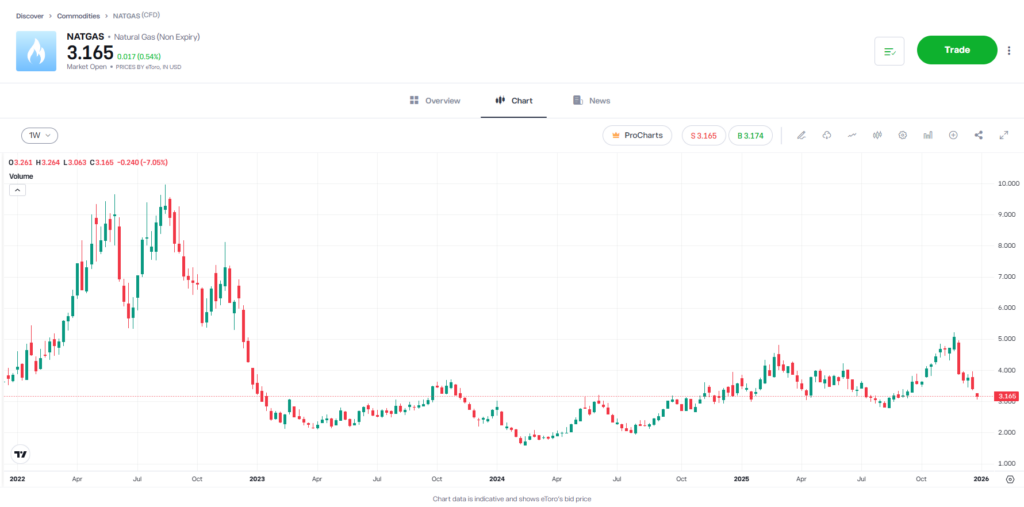
Past performance is not an indication of future results.
Natural Gas remains the essential “bridge fuel” in 2026, balancing the intermittency of renewables while providing lower emissions than coal.
- The expansion of Liquefied Natural Gas (LNG) export terminals in the US and Qatar is creating a more interconnected global gas market.
- European energy security continues to be a major theme, with the continent relying heavily on LNG imports to replace legacy pipeline supplies.
- Weather patterns remain the most significant short-term price catalyst, as extreme winter cold or summer heatwaves can cause rapid demand spikes.
- The rise of hydrogen production projects, which often use natural gas as a feedstock, is a developing long-term demand driver for the sector.
- Transition risks involve carbon pricing and stricter methane emission regulations, which could increase the operational costs for producers in 2026 and oversupply during mild seasons can lead to significant price collapses.
Your capital is at risk. Not investment advice
Platinum
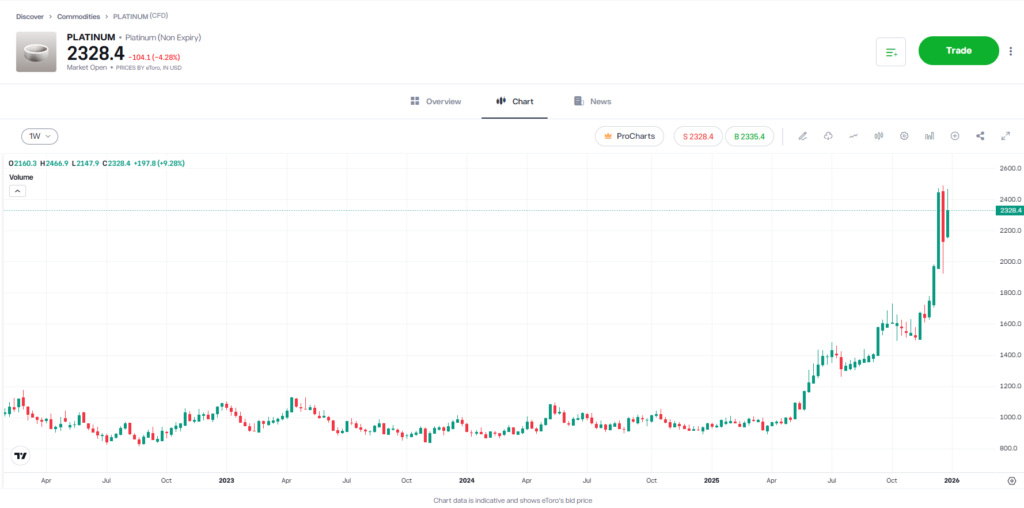
Past performance is not an indication of future results.
Platinum is entering 2026 with a focus on the hydrogen economy, where it is used as a catalyst in electrolysers to produce green hydrogen.
- Traditionally tied to the automotive industry, platinum is seeing a demand shift from diesel autocatalysts to more diverse industrial and chemical uses.
- The metal is currently in a multi-year supply deficit, largely due to operational challenges and power shortages in South Africa, which produces 70% of global supply.
- Platinum is often considered undervalued relative to Palladium, leading some manufacturers to substitute the metal in petrol-engine exhaust systems.
- As a precious metal, platinum also attracts investor interest during periods of currency weakness, though it typically lacks the liquidity of gold.
- Investment demand for platinum bars and coins has shown resilience as retail investors look for diversification beyond the more common precious metals.
- The primary risk is the acceleration of Battery Electric Vehicles (BEVs), which do not require autocatalysts, potentially eroding a large portion of legacy demand.
Your capital is at risk. Not investment advice
Final thoughts
The commodities sector in 2026 is no longer just about tracking “inflation”—it is about tracking the global energy and technology transformation. From the nuclear fuel cycle supporting AI to the copper required for a greener grid, these assets are the raw materials of the future economy.
However, commodity trading involves unique risks, including high volatility, storage costs, and heavy sensitivity to geopolitical events. Individual investors should ensure that any commodity exposure is part of a well-researched, diversified portfolio and aligns with their personal risk tolerance and long-term goals.
Learn more about commodities and other asset classes at the eToro Academy.
This information is for educational purposes only and should not be taken as investment advice, personal recommendation, or an offer of, or solicitation to, buy or sell any financial instruments.
This material has been prepared without regard to any particular investment objectives or financial situation and has not been prepared in accordance with the legal and regulatory requirements to promote independent research.
Not all of the financial instruments and services referred to are offered by eToro and any references to past performance of a financial instrument, index, or a packaged investment product are not, and should not be taken as, a reliable indicator of future results. The availability of all the above-mentioned products and services may vary by jurisdiction and country.
eToro makes no representation and assumes no liability as to the accuracy or completeness of the content of this guide. Make sure you understand the risks involved in trading before committing any capital. Never risk more than you are prepared to lose.