






Investing in this market is challenging, I get it. Navigating the kind of uncertainty we’re seeing, with markets whipsawing day to day, is no easy feat. Volatility is the price of entry right now, and investors who understand that will be far better positioned than those who try to time their way around it.
Markets hate uncertainty, and right now we’re getting it from every direction. The ASX lost almost $90 billion in a single session last week before bouncing back sharply the next day. On the ASX, there’s been a huge gap between the best and worst performing sectors over the past month, with energy up nearly 10% while consumer discretionary stocks have fallen almost 13%. That kind of divergence tells you this is a market where what you own matters.
I’ve spent the past two weeks across media in Australia, Singapore, and the Middle East, and the message I keep coming back to is this: boring can be brilliant. While the flashier parts of the market have been thrown around by every headline, defensive, dividend-paying companies have been doing exactly what they’re supposed to do. They’re not making headlines, but they’re making money for their shareholders.
For investors, it’s about cutting through the noise, filtering through the market reaction and finding the opportunities that will appear in this market. This week, I look at two stocks that can help to weather the storm. These businesses operate in sectors that people continue to use no matter what. They have global scale or local supply chains, and possess the kind of brand strength that makes them less vulnerable to external shocks. When looking for stocks to buy in volatile markets, dividend payers also offer something precious: stability. They are typically mature, financially sound, and continue to reward shareholders even when markets pull back.
- The global backdrop might be uncertain, but investing in quality businesses with resilient earnings can be the smartest move in shaky times.
- Dividend-paying stocks are regaining appeal. They offer regular income, solid cash flows and a degree of stability when broader market volatility picks up.
- These aren’t high-flying tech names, but they’re dependable companies, perfect for investors who want returns without riding the rollercoaster.
Explore Dividend Stocks on eToro
Coca Cola (KO) stock and how to invest in it
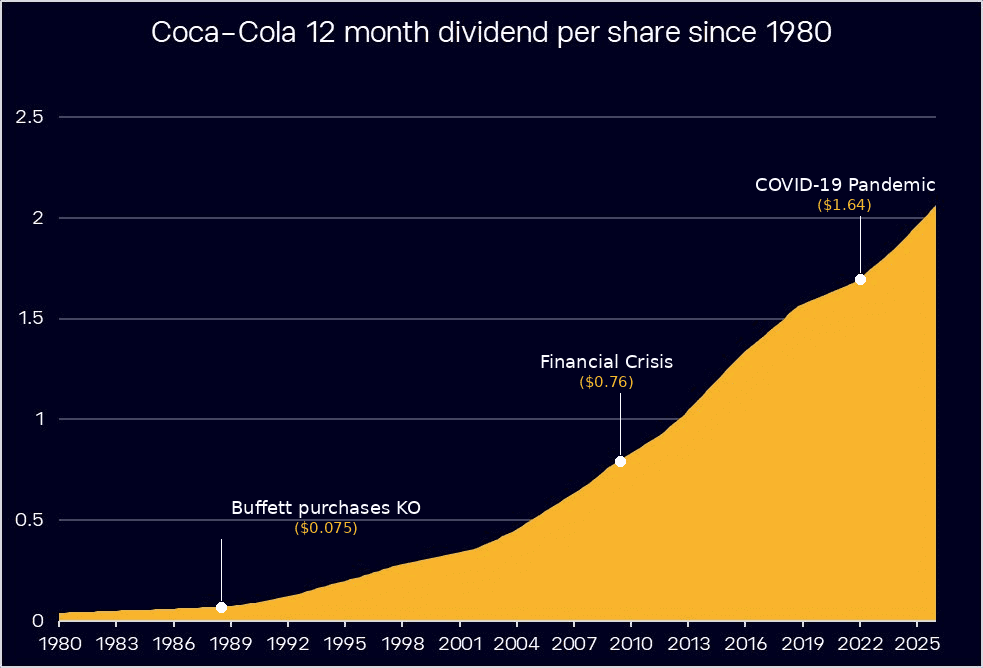
Coca-Cola, we all know it even if we don’t all drink it. Coca-Cola is a company that has been through it all: wars, recessions, pandemics, and now geopolitical crises, too. Shares are up around 9.5% year-to-date, comfortably outperforming the S&P 500, and the business continues to demonstrate the kind of resilience that has made it a cornerstone holding for generations of investors, including Warren Buffett, who has owned the stock since 1988.
He famously stated, “When we own portions of outstanding businesses with outstanding managements, our favourite holding period is forever,” which he applied to Coca-Cola, indicating his long-term investment strategy and belief in the company’s strength.
Its strength lies in the global scale of its operations and the local nature of its production. While it sells in over 200 countries, much of its manufacturing and bottling happens locally, insulating it from cross-border disruptions and supply chain shocks. Coke’s products are staples. Whether the economy is booming or contracting, consumers tend to keep buying soft drinks, making demand relatively stable and perfect for investors looking to ride out volatility. This isn’t to say that Coca-Cola doesn’t go through tough periods, but it’s an investment that investors have been able to rely on over the years.
The business commands around 45% of the carbonated soft drink market and owns five of the world’s top 10 beverage brands, including Sprite and Fanta, which gives it a competitive edge that’s almost impossible to replicate. Fourth-quarter 2025 results were strong, with organic revenue growing 5% year-over-year, and management has guided for 4% to 5% organic revenue growth in 2026 alongside 5% to 6% comparable earnings-per-share growth. Free cash flow is expected to climb to around USD$12.2 billion this year, up about 7%.
Does Coca-Cola pay dividends?
What’s impressive about Coca-Cola is its dividend. The company has increased its dividend for 63 consecutive years, making it a Dividend King. The current yield sits around 2.7%, backed by a conservative payout ratio of about 67%. This isn’t a company where you worry about whether the dividend is sustainable. It’s a company where you collect your dividend, reinvest it, and let compounding do the work over decades.
According to Bloomberg’s Analyst Recommendations, Coca-Cola has 23 buy ratings, 4 holds, and 0 sells, with an average price target of USD$84.32. So far in 2026, shares are up 9.5% (including dividends), while the S&P 500 has fallen by -3.2%
Fun Fact: Coca-Cola is one of the most universally recognised brands in the world. It’s estimated that 94% of the global population can identify its logo, and it’s sold in every country on Earth except two: North Korea and Cuba.
* Past performance is not an indication of future results.
View Coca Cola
McDonalds (MCD) stock and how to invest in it
Whether you call it Macca’s, Mickey D’s, or just McDonald’s, there’s no denying it’s one of the most recognised brands on the planet. Shares are up around 4% year-to-date while the broader S&P 500 has been negative. In a market rattled by geopolitical uncertainty and rising inflation fears, McDonald’s, just like Coca-Cola, offers something increasingly rare: predictability.
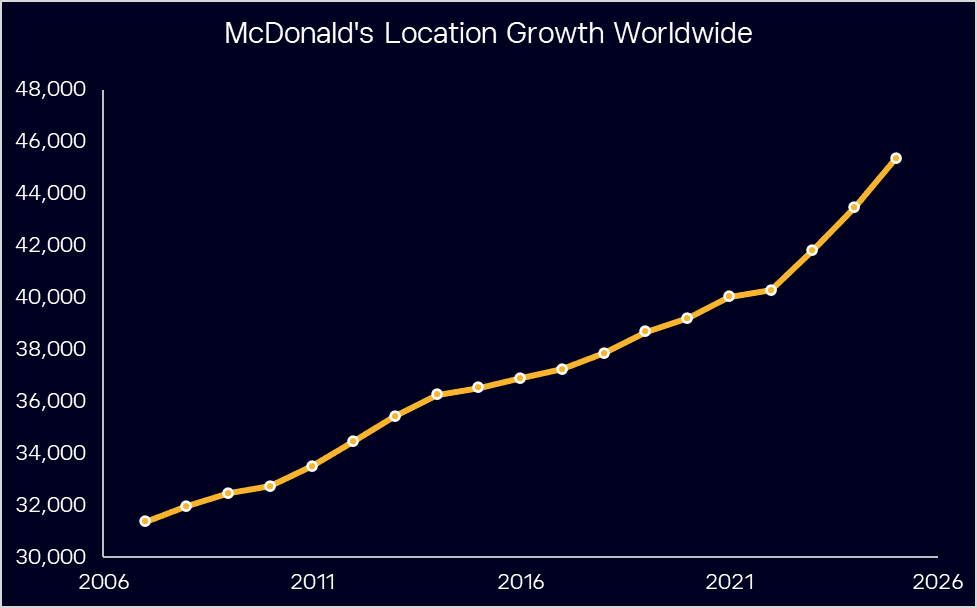
The business model is what makes McDonald’s so resilient. About 95% of its 43,000-plus locations are run by independent franchisees, meaning local operators handle the day-to-day costs while McDonald’s collects franchise fees and rent. It’s often said McDonald’s is a real estate company that just happens to sell burgers, and with USD$43 billion in land and property on its books, it’s not far from the truth. Since 2007, McDonalds has grown its stores across the world every year, regardless of what’s happening in the world. Operating margins sit around 45%, which are tech-like numbers for a restaurant business, and that’s because over 60% of revenue comes from franchise fees and rent rather than selling food directly.
That franchise model is also what makes it relatively insulated from the kind of supply chain and inflation pressures hitting other parts of the market right now. While airlines are entering bear market territory and consumer discretionary stocks are getting hammered by higher fuel costs, McDonald’s has pricing power and a value proposition that keeps customers coming through the door regardless of the economic backdrop. The company is reportedly preparing to launch USD$3 meal options to keep budget-conscious consumers engaged, which shows you how actively management is adapting to the environment.
Does McDonald’s pay dividends?
McDonald’s has raised its dividend for nearly 50 consecutive years, making it a Dividend Aristocrat. The current yield sits around 2.3%, which isn’t headline-grabbing, but it’s backed by strong free cash flow and a track record that very few companies on the planet can match. For investors, McDonald’s offers a rare combination of yield and long-term growth, delivering annualised returns of around 15% over the past 20 years.
Like any business, there are risks. Rising menu prices could deter traffic, and a more health-conscious consumer alongside weight-loss drugs remain an overhang moving forward, but its push toward digital, delivery, and international growth should support growth.
People keep eating at McDonald’s whether there’s tension in the Middle East or not. That’s the investment case in a sentence.The Golden Arches remain a high-quality cornerstone in any portfolio
According to Bloomberg’s Analyst Recommendations, McDonald’s has 23 buy ratings, 16 holds, and 2 sells, with an average price target of USD$345.97.
Fun Fact: McDonald’s serves around 70 million people every day, nearly triple Australia’s population. And their most popular item? Fries, of course.
* Past performance is not an indication of future results.
View McDonald’s
Investor Takeaway – how defensive, dividend-paying stocks could buffer your portfolio
In a market where oil can swing USD$40 in a session and a deleted social media post can move billions of dollars, the appeal of companies like McDonald’s and Coca-Cola becomes obvious. These aren’t the stocks that will double overnight. They’re the stocks that help you sleep at night.
Both are Dividend Kings or Aristocrats, having raised their dividends for decades. Both have pricing power that protects them during inflationary periods. Both sell products that people consume regardless of what’s happening geopolitically. For Australian investors looking for defensive stocks in a volatile market, both offer a rare combination of stability and income. And both have outperformed the broader market this year while everything else has been thrown around.
A JPMorgan study found that missing just the ten best market days over a twenty-year period would halve your total returns, and seven of those best days occurred within two weeks of the worst days. The lesson is clear: staying invested matters, and owning quality businesses with reliable cash flows and strong balance sheets is the best way to ride out periods like this.
The reality is that markets are going to remain volatile and reactive to every development in the Middle East over the coming weeks. The Strait of Hormuz remains heavily disrupted, central banks globally are being forced to rethink their rate paths, and the outlook changes with every headline. Expect more volatility, more headlines, and more opportunities for patient, long-term investors.
This conflict has not destroyed the investment case for equities. What it has done is make the outlook much more dependent on where oil and inflation land from here. In that environment, the companies that matter most are the ones with earnings you can count on. They may not be the flashiest names in the market, but in turbulent times, they’re the kind of stocks that help keep portfolios steady. And sometimes, boring is brilliant.
*Data Accurate as of 19/03/2026
eToro Service ARSN 637 489 466 operated by eToro Asset Management Limited ABN 51 122 005 396 AFSL 319738 and promoted by eToro AUS Capital Limited ACN 612 791 803 AFSL 491139. Investing in shares via a managed investment scheme does not result in direct ownership of the underlying assets. The scheme has legal ownership, the investor has beneficial ownership, i.e. the shares are held on your behalf. As the scheme has legal ownership, you have no rights in the securities, including voting rights. Shares are non-transferable. Your capital is at risk. Refer to the Product Disclosure Statement and Target Market Determination (PDS and TMD) before transacting. See full disclaimer.