



Despite its increasing popularity, many don’t really understand what Bitcoin is and what purpose it has. We explain how Bitcoin works and how it grew to be the best-known crypto in the world.
Bitcoin was the first decentralised cryptoasset to achieve extensive public acceptance. The primary function of the digital bitcoin held on the Bitcoin blockchain network is to enable peer-to-peer transactions, and Bitcoin’s approach is one which other digital currencies have broadly followed.
Bitcoin is designed to act as a decentralised and digitised alternative to traditional
What Is Bitcoin?
Bitcoin is a decentralised digital currency that uses
Unlike traditional fiat currencies such as pounds or dollars, bitcoin exists entirely online as computer code. Its blockchain forms a public record book that tracks every bitcoin transaction ever made and how much bitcoin each participant on the network holds.
Tip: The two primary functions of any currency are to be a means of exchange and a store of wealth.
Every participant in the network has equal authority, and no single entity can control or manipulate the system. As the world’s first and largest crypto by

How Does Bitcoin Work?
Bitcoin’s operations rely on a network of computers that use
The recordings of transactions on the digital ledger have some key characteristics. They are:
- Immutable – which means that once data is added it cannot be altered.
- Stored in chronological order – all the transactions which have ever taken place in Bitcoin are publicly available.
- Decentalised – Bitcoin and its processes are not controlled by any central authority.
The distributed network of computers, known as nodes, perform the operational tasks which maintain the blockchain. When you send bitcoin, here’s what happens step by step, taking a transaction between Hugo and Sofia as an example:
- Create transaction: Hugo uses a
wallet to create a transaction to send 0.1 BTC to Sofia’s address. - Digital signature: Hugo uses his wallet to sign the transaction with his private key which proves he owns sufficient bitcoin.
- Broadcast: The signed transaction is broadcast to thousands of computers (nodes) across the Bitcoin network
- Mempool: The transaction enters a waiting area called the mempool until a miner picks it up.
- Mining: Miners bundle transactions into blocks and compete to solve complex mathematical puzzles.
- Block confirmation: Once solved, the new block is added to the blockchain and broadcast to the network.
- Final settlement: After multiple confirmations (typically 6), the transaction is considered irreversible, Hugo has sent 0.1 BTC to Sofia.
The entire process typically takes 10-60 minutes, depending on network congestion and transaction fees.

What Is Bitcoin Mining?
Bitcoin mining involves using specialised computers to solve complex mathematical problems which validate transactions on the Bitcoin blockchain and generate new bitcoin.
Reflecting the decentralised nature of Bitcoin, anyone with the necessary hardware and technical knowledge can technically mine Bitcoin. The process results in a number of outcomes which support the operation of the Bitcoin network.
- The mining process secures the decentralised network.
- Validating transactions results in new blocks being formed on the blockchain.
- Miners that are first to solve complex cryptographic puzzles are rewarded with newly issued bitcoin for helping to secure the network.
How does Bitcoin mining really work?
Bitcoin mining involves specialised computers called ASICs (Application-Specific Integrated Circuits) that perform trillions of calculations per second.
The process uses
Mining difficulty automatically adjusts every 2,016 blocks (roughly two weeks) to maintain an average block time of 10 minutes, regardless of how many miners join or leave the network.
Tip: Currently, about 19.5 million bitcoins have been mined, with the last bitcoin expected to be mined around 2140.
What is Bitcoin “halving”?
The bitcoin mining reward undergoes a process called halving once 210,000 new blocks have been created – after the halving, the rewards paid to miners fall by 50%.
Halvings have historically occurred approximately every four years and the process serves two critical functions: securing the network against fraud and controlling the release of new bitcoins into circulation.
- After the April 2024 halving, the reward for mining a new block on the Bitcoin network was reduced from 6.25 BTC to 3.125 BTC.
- A subsequent mining in 2028 will cause a 50% reduction to 1.5625 BTC. This systematic reduction ensures Bitcoin’s scarcity over time.
What Gives Bitcoin its Value?
Each investor will form their own view on the value of bitcoin but its proponents often reference its utility as a payment tool and increasingly as a store of value. The way that its supply is limited to 21 million coins helps create a degree of scarcity and reinforce its worth.
Unlike government currencies that can be printed at will, and precious metals which can be mined, Bitcoin follows a predetermined issuance schedule that cannot be changed.
There are other elements of Bitcoin’s functionality which could be claimed to add value:
- Network Effect and Adoption: As more people, businesses, and institutions adopt Bitcoin, its utility and value increase. In 2021 El Salvador adopted BTC as legal tender.
- Decentralisation and Security: Its decentralised nature provides resistance to censorship and offers users increased financial autonomy.
- Divisibility: Each bitcoin can be divided into 100 million units called satoshis, allowing for micro-transactions.
- Portability: Bitcoin can be sent anywhere in the world within minutes, allowing for cross-border transactions without the need to exchange currencies.
- Fungibility: Every bitcoin has the same value as every other bitcoin, regardless of previous ownership or history. This makes them a fungible asset and a store of value.
| Driver | What it means | Why it matters |
|---|---|---|
| Max supply | 21 million BTC cap | Creates digital scarcity |
| Smallest unit | 1 satoshi = 0.00000001 BTC | Enables micro-payments |
| Confirmations | Network validations | Ensures transaction finality |
| Mining | Secures network, issues new BTC | Maintains decentralisation |
| Halving | Reward cuts every ~4 years | Reduces inflation rate |
Bitcoin Price History and Volatility
Bitcoin was created by an entity referred to under the pseudonym ‘Satoshi Nakamoto’, based on the ideas laid out in the Bitcoin whitepaper of 31 October 2008. The chart below illustrates how its value has fluctuated dramatically as traders and investors form views on its viability.
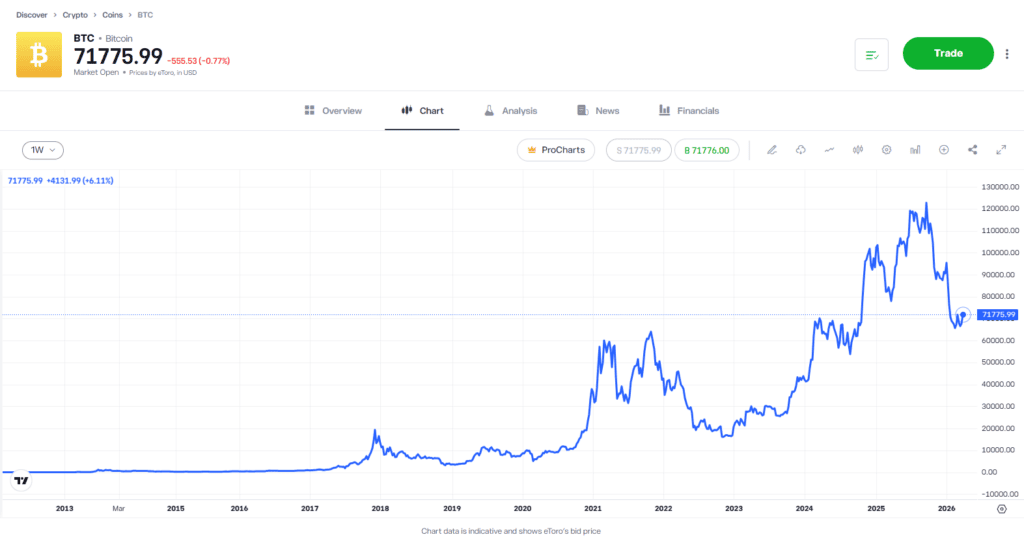
Key milestones which track the development of Bitcoin include:
- 3 January 2009: The first block, known as the Genesis Block, was mined.
- May 2010: The first real-world transaction in (10,000 BTC for two pizzas).
- August 2017: The Bitcoin Cash hard fork took place and resulted in the creation of Bitcoin Cash.
- 2017: First major price peak.
- 2024: Approval of Bitcoin ETFs creates a pathway for further mainstream adoption.

Appreciating the changing profile and adoption of bitcoin is an important part of understanding the reasons behind the dramatic price swings throughout its history which are represented in the chart below.
Bitcoin’s price move from being virtually worthless to a valuation exceeding $100,000 has been driven by investors considering adoption cycles, market sentiment, and macroeconomic factors.
The factors which contribute to Bitcoin’s price volatility include:
- Market Liquidity: Lower liquidity compared to traditional markets means large buy or sell orders can move prices substantially.
- Sentiment and News: Regulatory announcements, institutional adoption news, or macroeconomic events can trigger rapid price movements.
- Halving Cycles: The halving has previously demonstrated significant influence over the price of bitcoin, acting as a catalyst for the formation of new, long-term price trends.
- Macroeconomic Factors: Interest rates, inflation concerns, and global economic uncertainty influence Bitcoin’s attractiveness as an alternative asset.
- Financial Instability: During periods of monetary expansion, Bitcoin has often been viewed as a hedge against currency debasement.
The volatility associated with the bitcoin market presents both opportunities and risks. While some investors have seen substantial returns, others have experienced significant losses. Understanding these dynamics is crucial for anyone considering Bitcoin as part of their financial education.
Final thoughts
Bitcoin represents a fundamental shift in how we think about money. From its origins as a cryptographic experiment to becoming a recognised asset class, Bitcoin has demonstrated the potential for technology to reshape finance.
Its core innovations: decentralisation, fixed supply, and peer-to-peer transactions, challenge traditional monetary systems while creating new possibilities for global value transfer.
Understanding Bitcoin requires grasping both its technical foundations and economic implications. While the technology provides security and scarcity, the sometimes extreme price volatility is a reminder that Bitcoin is a relatively new concept and is undergoing a sometimes dramatic price discovery process.
Visit the eToro Academy to learn more about crypto investing.
FAQs
- What does “confirmation” mean on Bitcoin?
-
A confirmation occurs when a Bitcoin transaction is included in a block and added to the blockchain. Each additional block added afterwards counts as another confirmation. Most exchanges require 3-6 confirmations before considering a transaction final and irreversible.
- Is Bitcoin anonymous or pseudonymous?
-
Bitcoin is pseudonymous, not anonymous. While transactions don’t directly reveal the personal identities of crypto investors, all transactions are publicly visible on the blockchain. Bitcoin addresses act like account numbers that can potentially be linked to real identities through various methods.
- Why is Bitcoin volatile?
-
Bitcoin’s volatility stems from its relatively small market size, speculative trading, regulatory uncertainty, and evolving adoption. Price swings can be triggered by large trades and news events. Shifts in market sentiment have such an influence on the price of bitcoin that specific indices such as the Crypto Fear and Greed Index have evolved to try to measure and reflect the mood of the market.
- What is the difference between “Bitcoin” and “bitcoin”?
-
When the “B” in Bitcoin is capitalised, the word is referring to the concept of Bitcoin technology and associated protocols. When it is not capitalised it refers to the currency itself – to BTC coins.
- What are Altcoins?
-
Altcoins are any crypto other than Bitcoin. They typically offer investors higher levels of risk-return than bitcoin and have smaller market capitalisations.
This information is for educational purposes only and should not be taken as investment advice, personal recommendation, or an offer of, or solicitation to, buy or sell any financial instruments.
This material has been prepared without regard to any particular investment objectives or financial situation and has not been prepared in accordance with the legal and regulatory requirements to promote independent research.
Not all of the financial instruments and services referred to are offered by eToro and any references to past performance of a financial instrument, index, or a packaged investment product are not, and should not be taken as, a reliable indicator of future results. The availability of all the above-mentioned products and services may vary by jurisdiction and country.
eToro makes no representation and assumes no liability as to the accuracy or completeness of the content of this guide. Make sure you understand the risks involved in trading before committing any capital. Never risk more than you are prepared to lose.