



If the potential to earn a regular income with less risk than traditional investments sounds interesting, you’re going to want to learn more about fixed-income investments, such as bonds and bond ETFs.
Fixed-income investments are financial instruments that provide regular, predictable returns through interest payments.
Unlike stocks, which can fluctuate dramatically in value, fixed-income securities like bonds typically offer investors a steady stream of income and the return of their principal investment at maturity.

What Are Fixed-Income Investments?
Fixed-income investments are securities that pay investors regular interest payments at predetermined intervals.
The most common type of fixed-income investment are bonds, but this category also includes government securities, corporate debt, certificates of deposit, and certain types of funds. These investments are called “fixed income” because they provide a predictable income stream through regular interest payments, known as coupons.

A bond is essentially a loan you make to a government or company. When you buy a bond, you’re lending money to the issuer for a specific period. In return, they promise to pay you regular interest and return your original investment (the principal) when the bond matures.
Tip: Bonds offer reliable income and can appeal to investors who want to preserve their capital while earning returns.
How Fixed-Income Investments Work
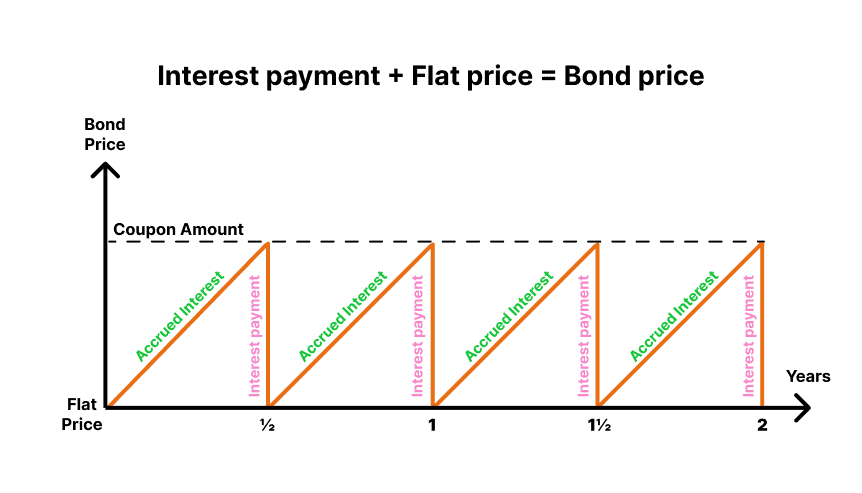
The mechanics of fixed-income investments are relatively straightforward. You invest a certain amount (the face value), receive regular interest payments throughout the bond’s life, and get your initial investment back at maturity.
For instance, if you buy a £10,000 bond with a 5% semi-annual coupon rate and a 2-year maturity, you’ll receive four payments of £250 over two years, plus your £10,000 back at the end of Year 2. Your capital at the end of the process totalling £11,000.
These examples are simplified and for illustrative purposes only; actual liability depends on personal circumstances and local laws.
Why Invest in Bonds Now?
The attractiveness of fixed-income investments will be a function of factors within the wider investment landscape and personal investment objectives.
After a period of many years when ultra-low interest rates made bonds less appealing, the current environment has changed the interpretation of the pros and cons of bond investing. With real yields in some areas of the bond markets turning positive they now have potential to outpace inflation – preserving and growing your purchasing power.
Unlike variable-rate savings accounts that can change at any time, bonds provide certainty about your future income. This can be advantageous should future interest rates fall, but of course represents an opportunity cost should interest rates rise.
Tip: Government Bonds offer varying maturity periods to match your investment timeline – from short-term Treasury Bills to long-term gilts.
Investing in bonds also offers a way to gain exposure to a sector with lower risk-return. Something which might appeal to investors who consider their portfolio to be weighted towards higher risk sectors which they think could be due a price correction.

The Benefits of Bond ETFs
Investing in bond ETFs involves buying shares of a fund that consists of a portfolio of numerous bonds.
Bond ETFs may be more suitable for investors looking for diversification and liquidity in their fixed-income investments, rather than those targeting individual bonds which have terms that suit a specific investment horizon.
- Diversification: Bond ETFs offer the benefits of diversification, since they hold a variety of bonds issued by different entities.
- Liquidity: Bond ETFs can be bought and sold throughout the trading day offering relatively high liquidity.
- Cost efficiency: Management fees on bond ETFs are generally lower than actively managed bond funds.
- Transparency: You can see exactly what bonds the fund holds and establish if the fund’s investment mandate matches your personal aims.
Bond ETFs combine the stability of bonds with the functionality of stock trading. Choosing between investing in single bonds or bond ETFs depends on an investor’s individual circumstances, preferences, and investment objectives.
Tip: Bond ETFs typically have lower minimum investments than individual bonds, making them accessible to more investors.
Bond Investing Terms You Need to Know
Navigating the bond market requires familiarity with specific terminology. Here are the essential terms every bond investor should understand:
- Bond market: The market where bonds are bought and sold, including both primary markets where new bonds are issued and secondary markets where existing bonds are traded.
- Face value: The amount of money that the bond issuer will repay the investor when the bond matures. A £1,000 face value bond will return £1,000 at maturity, regardless of what you paid for it in the bond market.
- Coupon rate: The fixed rate of interest that the bond issuer will pay to the investor, expressed as a percentage of the face value. A 4% coupon on a £1,000 bond pays £40 annually.
- Maturity date: The date when the bond will expire and the issuer will repay the investor the face value of the bond.
- Yield to maturity (YTM): The total return you’ll earn if you hold the bond until maturity, accounting for the purchase price, coupon payments, and face value repayment. This is the most comprehensive measure of a bond’s return.
- Duration: A measure of a bond’s sensitivity to changes in interest rates. Bonds with longer durations are generally more sensitive to changes in interest rates than bonds with shorter durations.
- Call option: A provision in some bonds that allows the issuer to redeem the bond before its maturity date. This can be advantageous for the issuer if interest rates have fallen since the bond was issued, as they can issue new bonds at a lower interest rate.
- Credit rating: Letter grades (AAA, AA, A, BBB, etc.) that assess the issuer’s ability to repay. Higher ratings indicate lower risk but typically offer lower yields.
- Default risk: The risk that the bond issuer will be unable to repay the investor the face value of the bond. Bonds issued by companies or governments with lower credit ratings generally have higher default risk.

The Different Types of Bonds
The bond market offers diverse options to match different investment goals and risk tolerances. Understanding these categories helps you build a portfolio aligned with your objectives.
Government Bonds
Government bonds, including UK gilts and US Treasury securities, are considered the safest fixed-income investments.
- UK gilts are backed by the British government and offer various maturities from two to 50 years.
- US Treasury Bills (T-Bills) are short-term securities that mature in one year or less, while Treasury bonds extend up to 30 years.
Other countries issue their own government bonds, such as German Bunds or Japanese Government Bonds, each reflecting their nation’s creditworthiness.
Corporate Bonds
Companies issue corporate bonds to raise capital for operations or expansion. These typically offer higher yields than government bonds to compensate for additional credit risk.
Investment-grade corporate bonds (rated BBB or higher) balance reasonable safety with attractive yields, while high-yield bonds typically offer greater returns but with increased risk.
Municipal and International Bonds
Beyond government and corporate bonds, investors can access municipal bonds (issued by local authorities) and international bonds from foreign governments or companies. These provide additional diversification but may involve currency risk for international investors.
Tip: Consider your investment timeline when choosing bonds – shorter duration bonds typically experience less price volatility but offer lower yields.
Putting Bond Investments into Practice
Building a successful bond portfolio requires balancing several factors: your income needs, risk tolerance, and investment timeline.
Start by determining what percentage of your entire portfolio should be held in the form of fixed income investments. A common rule suggests your age as a percentage, meaning a 40-year-old might hold 40% in bonds though this varies based on individual circumstances.
Then consider what type of bonds make up your allocation to the fixed-income asset class. A combination of government and high-quality corporate bonds provides a solid foundation. You might allocate 60% to government bonds for stability and 40% to investment-grade corporates for higher yields.
Tip: Bond ETFs can simplify the allocation/diversification process – a single fund can contain thousands of bonds.
Example:
For an example of how you could gain diversified exposure to the US bond market as an investor, let’s look at the Vanguard Total Bond Market ETF (BND).
This is the world’s largest fixed-income fund with total net assets in excess of $384 billion. This fund invests in a diverse range of bonds, from short-term government bonds with low risk to higher risk corporate and mortgage bonds.
In providing exposure to the entire universe of investment-grade rated US bonds, the BND offers a one-stop investment solution:
- A yield to maturity of 4.3%
- Average duration of 5.7 years
- Maintains a high credit quality by investing only in investment-grade rated bonds
- Benefits from a very low expense ratio of 0.03%
- Includes over 11,000 individual holdings, ensuring a well-diversified portfolio
(All data as of Jan 20th 2026)
Being an ETF product it is also possible to take a closer look at the fund’s key metrics.
| Vanguard Total Bond Market ETF (BND) Composition |
|---|
| Factor | BND |
|---|---|
| Number of bonds | 11,444 |
| Average effective maturity | 8.0 years |
| Average coupon | 3.8% |
| Expense ratio | 0.03% |
It is also possible to gain a view on the credit ratings of the bonds it holds.
| Vanguard Total Bond Market ETF (BND) Credit Ratings |
|---|
| Credit rating | % of fund |
|---|---|
| AAA | 3.09% |
| AA | 3.28% |
| A | 11.92% |
| BBB | 12.44% |
| BB | 0% |
| B | 0% |
| CCC or lower | 0% |
| US Government | 69.25% |
(All data as of Jan 20th 2026)
These examples are simplified and for illustrative purposes only; actual liability depends on personal circumstances and local laws.
Bond Investment Risks: What You Need to Know
Every investment carries risk, and bonds are no exception. Understanding these risks helps you make informed decisions and build a resilient portfolio.
Interest Rate Risk
This is the primary concern for bond investors. When interest rates rise, existing bond prices fall because new bonds offer higher yields. Conversely, falling rates increase bond values.
This reflects the additional compensation investors require to hold longer-term bonds relative to shorter-term bonds. Longer-maturity bonds experience greater price swings from rate changes.
Inflation Risk
Inflation risk poses another challenge. If inflation rises coupon payments may lose purchasing power over time. This makes inflation-linked bonds or shorter-duration securities worth considering for part of your portfolio.
Credit Risk
This varies by issuer. While high-quality government bonds such as those issued by the UK and US governments carry very low levels of default risk, corporate bonds require careful evaluation of the company’s financial health. Diversification through ETFs offers a way to mitigate the impact of any single default.
Additional risks include:
- Call Risk: Some bonds can be redeemed early by issuers, typically when rates fall
- Liquidity Risk: Less-traded bonds may be difficult to sell quickly at fair prices
- Currency Risk: Foreign bonds expose you to exchange rate fluctuations
Despite these risks, bonds remain valuable portfolio components when properly understood and managed.
Final thoughts
Bonds are the world’s most traded asset class, with a global estimated worth of around $145 trillion. Investor sentiment cooled in recent years due to the double whammy of record low interest and high inflation, but this has actually opened up new opportunities.
Investing in bond ETFs can be one option for investors, as they combine the advantages of bonds as an asset with those of an exchange-traded fund, particularly diversification and liquidity.
Visit the eToro Academy and learn more about bond investing.
Frequently Asked Questions
- What factors can influence a bond’s price?
-
Changes in interest rates have the most significant impact on bond prices – when rates rise, bond prices fall, and vice versa. Inflation expectations, the issuer’s credit quality, and time to maturity also affect prices. Economic conditions and market sentiment can cause short-term fluctuations, but holding bonds to maturity counter-balances price volatility concerns.
- How do I assess which bonds have higher investment risk?
-
Credit ratings from agencies like Moody’s, S&P, and Fitch provide standardised risk assessments using alphanumeric codes. Ratings range from AAA (highest quality) down to D (default). Investment-grade bonds (BBB- or higher) offer reasonable safety, while high-yield or “junk” bonds (BB+ or lower) carry significantly higher default risk but offer higher potential returns.
- Are government securities a good option for a diversified portfolio?
-
Yes, government securities like gilts and T-Bills provide essential portfolio ballast. They offer capital preservation, reliable income, and some protection against stock market downturns. Their low correlation with equities makes them excellent diversification tools, though returns are generally lower than riskier assets.
- How does inflation impact bond prices?
-
There is a strong but indirect link between bond prices and inflation. Bond prices are sensitive to interest rates, and interest rates are heavily influenced by rates of inflation. If inflation is high or rising, a central bank will generally raise interest rates and that could encourage bond investors to sell bonds and hold cash in savings accounts instead.
- How do credit ratings affect bond returns?
-
The returns on bonds (coupons) are fixed, but if a rating agency downgraded the credit rating on a bond it could be expected that some investors would sell their positions due to the increased default risk. Investors holding existing positions would still receive the same coupon returns, but new entrants to the market who are able to buy the bond at a lower price will benefit from their position having a higher yield.
This information is for educational purposes only and should not be taken as investment advice, personal recommendation, or an offer of, or solicitation to, buy or sell any financial instruments.
This material has been prepared without regard to any particular investment objectives or financial situation and has not been prepared in accordance with the legal and regulatory requirements to promote independent research.
Not all of the financial instruments and services referred to are offered by eToro and any references to past performance of a financial instrument, index, or a packaged investment product are not, and should not be taken as, a reliable indicator of future results. The availability of all the above-mentioned products and services may vary by jurisdiction and country.
eToro makes no representation and assumes no liability as to the accuracy or completeness of the content of this guide. Make sure you understand the risks involved in trading before committing any capital. Never risk more than you are prepared to lose.