



Cryptoassets have emerged as a significant topic in the investment world, with their market capitalisation reaching trillions of dollars and millions of investors now holding them. This guide provides an overview of what cryptoassets are and why they might be considered worthy of investment.
Whether you’re curious about Bitcoin, wondering about
Crypto: Understanding a Volatile Asset Class
The prices of cryptoassets can move sharply due to sentiment changes, news events, liquidity factors and wider economic conditions, with markets known to move by more than 10% in a matter of minutes.
Investing in crypto has long been a divisive topic, partly because of the dramatic price moves associated with this emerging asset class. It is a risky but potentially rewarding option, and understanding the sector’s sometimes extreme price volatility is crucial for anyone considering investing.
This volatility stems from several factors:
- Crypto prices can move suddenly with no warning on the back of high-profile social media posts
- Other influences include company or government-level announcements on crypto policies.
- The relatively small size of the crypto market compared to traditional assets means that large trades can significantly impact prices.
- The 24/7 nature of crypto markets means prices can change dramatically while traditional markets are closed.
The crypto market has experienced extreme price movements throughout its history. For example, Ethereum (ETH) reached a peak of $4,942 in August 2025 before falling 46% to $2,622 by December 2025 – meaning a $300 investment would have dropped to $140.
Bitcoin, recognised as the world’s first crypto, and the one which has been trading for longest, has historical price volatility between x3 – x4 that of the S&P 500 Index.
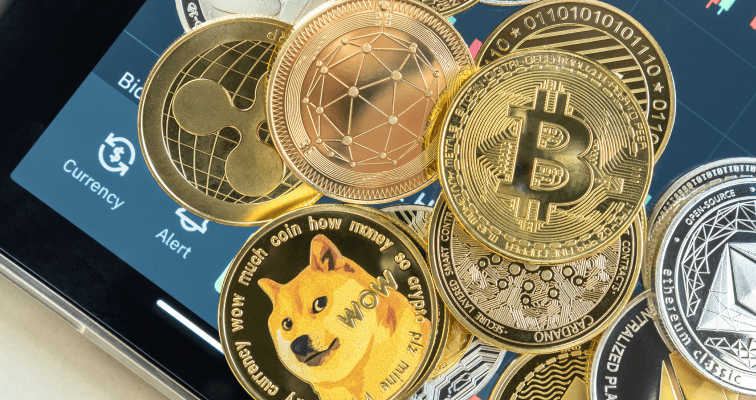
What Are Cryptoassets?
Cryptoassets are assets recorded digitally on a blockchain which provides a record of value or rights. They are secured by encryption and typically use
This
How a blockchain records ownership
When someone transfers a cryptoasset, the transaction is broadcast to the network, verified by multiple participants (called nodes), and then added to a “block” of transactions. This transparent and unchangeable process means that blockchains have distinctive features, which include:
- When a new block is created it is cryptographically linked to previous blocks, creating an immutable chain of ownership records.
Consensus mechanisms ensure all participants agree on the current state of ownership.- The decentralised nature of record-keeping eliminates the need for traditional intermediaries like banks to verify and process transactions.
- No single entity controls the ledger
Common types of cryptoassets
The cryptoasset ecosystem includes various types of digital assets, each serving different purposes:
Coins are native to their own blockchains and primarily function as digital money. Bitcoin (BTC), the largest by market capitalisation, operates on the Bitcoin blockchain.
Stablecoins aim to maintain stable value by pegging to traditional currencies or assets. Tether (USDT) is a stablecoin, meaning its value is linked to stable assets such as the US Dollar, but uses blockchain rather than traditional protocols to record transfers of ownership.
NFTs (Non-Fungible Tokens) represent unique digital items or proof of ownership for digital or physical assets, differing from fungible cryptoassets where each unit is identical and interchangeable.

Why Are Some Investors Interested in Cryptoassets?
There are many and varied reasons investors see value in cryptoassets, these range from the potential long-term viability of decentralised digital finance to pure speculation – the likelihood that the price will go up.
Understanding these price drivers, and how they can rapidly grow and fall in strength, helps develop a greater understanding of what generates the extreme price volatility seen in crypto markets. They include:
- An alternative financial system: Some find the peer-to-peer and
pseudonymous nature of blockchain technology appealing. Believing it offers greater control over funds than is provided by traditional financial institutions. - Technological innovation: The underlying blockchain technology has potential applications beyond currencies. Smart contracts on platforms like Ethereum enable programmable transactions and decentralised applications.
- Portfolio diversification: Increasingly, consumers are considering cryptoassets as part of ‘a wider investment portfolio’, viewing them as an alternative asset class with different risk-return characteristics than traditional investments.
- Speculation on adoption: Some investors believe cryptoassets could become more widely accepted for payments or as stores of value.
- Inflation concerns: Some unbacked cryptoassets, like bitcoin, have limited issuance and therefore claim to be a hedge against inflation, though this remains highly debated among economists.
Tip: Many people state ‘friends and family’ as the main reason for purchasing crypto – always conduct your own thorough research.
Common Crypto Myths
Understanding the realities behind some of the common misconceptions surrounding crypto can help investors make more informed decisions. The table below outlines ways that perception and reality can sometimes differ.
| Myth | Reality |
|---|---|
| Crypto trading is anonymous | Most crypto blockchain networks are pseudonymous – transactions are publicly visible on the blockchain, and identities can often be traced through exchanges |
| Crypto is mainly for criminals | The nature of blockchain transactions might be attractive to criminals but the vast majority of crypto activity is legitimate investment and trading |
| Cryptoassets are guaranteed to increase in value | All cryptos pose high risks and are speculative – investors should never invest money they can’t afford to lose and should be prepared to lose all their money |
| All cryptoassets are the same | There are millions of different cryptoassets in circulation, comprising a very broad spectrum of products beyond those commonly known |
| Crypto investments are protected | Crypto investors are highly unlikely to have access to the regulatory compensation schemes such as the Financial Services Compensation Scheme if something goes wrong |
The table above clarifies that while cryptoassets offer certain features, they come with significant limitations and risks that differ substantially from traditional investments. These realities underscore the importance of thorough research and risk awareness.
How People Typically Gain Exposure to Cryptoassets
People gain exposure to cryptoassets through various routes, each with different characteristics regarding custody, costs, and user experience. Understanding these options helps investors choose approaches aligned with their knowledge and
The typical process for gaining cryptoasset exposure includes several conceptual steps:
- Understanding the asset type and use case – Research what different cryptoassets do, their technology, and their intended purpose beyond speculation
- Choosing an access route – Options include crypto exchanges, traditional brokers offering crypto, or investment products like
ETFs where regulatory permitted - Understanding custody models – Deciding between custodial services (where a third party holds the assets) versus self-custody (managing your own private keys)
- Understanding common cost categories – These may include trading fees, spreads, deposit/withdrawal fees, and network fees for blockchain transactions
- Considering security concepts – Learning about private keys, wallet security, two-factor authentication, and common security threats
The differences between the custodial and non-custodial approach are summarised in the table below.
| Aspect | Custodial | Non-custodial |
|---|---|---|
| Who controls keys | Service provider | Individual user |
| Ease of use | Generally simpler | Requires technical knowledge |
| Security responsibilities | Shared with provider | Entirely user’s responsibility |
Operational risk, the chance that a broker or platform is a scam or goes bust, has historically been higher than average in the crypto sector, though using trusted and secure platforms may help mitigate some risk.
Tip: High price volatility and values changing from one day to the next currently limit crypto’s use for making payments.
The Risks of Crypto Investing
Investing in cryptoassets generally involves very high risks. The industry is still in a formative stage which makes it hard to evaluate its true prospects. This uncertainty leads to high levels of price volatility which in turn attracts speculators, and even greater volatility.
Crypto investors should be prepared to lose everything and ensure they understand all the risks involved. Understanding these risks is essential before considering any investment.
The primary risk facing crypto investors is market risk – that the value of their holding will go down, But there are other risk factors to consider, some of them unique to the crypto sector. These include:
| Risk Type | What It Means |
|---|---|
| Volatility risk | Significant price volatility combined with valuation difficulties places consumers at high risk of losses |
| Liquidity risk | No guarantee cryptoassets can be converted back to cash – conversion depends on market demand and supply |
| Technology/security risk | Vulnerabilities in code, exchange hacks, lost private keys, or wallet compromises can result in total loss |
| Counterparty/platform risk | Exchange insolvencies, exit scams, or poor segregation of client assets – as seen in high-profile collapses |
| Regulatory risk | Changes in regulations can impact ability to buy, sell, or use cryptoassets in different jurisdictions |
Charges tend to be significantly higher than for other products, including spreads, funding charges, and commissions – investors should consider how these fees impact potential returns.
Tip: It’s never recommended to commit all available capital to a single asset class, especially one as volatile as crypto.

Final thoughts
While some investors may find crypto and its potential applications appealing, the cryptoasset landscape continues to evolve rapidly.
That means that extreme price volatility can be expected to remain a feature of the market. That along with the numerous associated risks means that developing a thorough understanding is essential before investing.
Visit the etoro Academy to learn more about crypto investing.
Quiz
FAQ
- Can I use leverage when trading crypto?
-
Leverage availability varies by jurisdiction and platform. Many jurisdictions restrict or prohibit leveraged crypto trading due to the extreme risks involved. Leverage multiplies both losses and potential gains and can result in losing more than your initial investment, meaning you could owe money to the firm.
- Do cryptoassets suit all risk appetites?
-
Cryptoassets are generally considered higher risk than traditional asset classes due to their volatility and speculative nature. Whether they’re suitable varies entirely by individual circumstances, risk tolerance, and investment objectives. This educational content doesn’t constitute personal advice – investors should carefully assess their own situation.
- What happens to my crypto if my broker goes bust?
-
This will depend on the exact T&Cs of your agreement with your broker. Some brokers will hold cryptoassets in segregated accounts, so that if the firm goes bust, investors’ interests are protected. Cryptoassets are unregulated, so there is less protection available to them as an asset group, compared to stocks and bonds, for example.
- How closely are cryptoassets correlated to traditional asset classes?
-
Historically, cryptoassets have been viewed as having a low correlation to traditional financial assets like stocks and bonds, but that situation could be changing. As more investors have entered the space, correlations have occasionally increased, particularly with “risk-on” assets like tech stocks during certain economic cycles. Like other assets, crypto can be influenced by macroeconomic and geopolitical events that affect global investor sentiment.
- Do I pay tax on crypto investments?
-
You can typically expect to pay tax on crypto investments but it will depend on where you live, your tax status, and the type of investment you make. How the tax is applied will also vary. In some jurisdictions returns from selling, trading, or exchanging crypto are subject to Capital Gains Tax (CGT) whereas income tax may apply if you receive crypto as payment, for carrying out mining, or as rewards from
staking .These examples are simplified and for illustrative purposes only; actual liability depends on personal circumstances and local laws.
This information is for educational purposes only and should not be taken as investment advice, personal recommendation, or an offer of, or solicitation to, buy or sell any financial instruments.
This material has been prepared without regard to any particular investment objectives or financial situation and has not been prepared in accordance with the legal and regulatory requirements to promote independent research.
Not all of the financial instruments and services referred to are offered by etoro and any references to past performance of a financial instrument, index, or a packaged investment product are not, and should not be taken as, a reliable indicator of future results. The availability of all the above-mentioned products and services may vary by jurisdiction and country.
etoro makes no representation and assumes no liability as to the accuracy or completeness of the content of this guide. Make sure you understand the risks involved in trading before committing any capital. Never risk more than you are prepared to lose.