



The technology sector continues to reshape our world, from artificial intelligence breakthroughs to quantum computing advances. Whether you’re interested in established giants or emerging innovators, understanding tech stocks can help you make more informed investment decisions.
With continual innovation and disruption the norm these days, the tech sector is a popular choice for those seeking out investment opportunities. The sector continues to offer ways to add some digital power to your portfolio.
Read on to learn about what drives the tech industry, the benefits of investing in these stocks and what to look for when trying to find the best technology stocks.
What Is the Technology Industry?
The technology industry encompasses companies that develop, manufacture, and distribute products and services that drive our digital world. In stock market terms, the sector includes four key categories that often overlap and interconnect.

including devices, and the programs and systems run on them.


including the companies responsible for researching and developing much of the hardware and software we use in our everyday lives.

which make products such as switches, modems and microchips.
Computer hardware and software companies form the backbone of the sector, creating everything from the devices we use daily to the operating systems and applications that power them.
Telecommunications firms provide the infrastructure and services that keep us connected, whilst information technology (IT) companies focus on enterprise solutions and digital transformation services. Semiconductor manufacturers produce the critical components found in virtually all modern electronics.
The boundaries between these subsectors continue to blur as companies expand their offerings. A hardware manufacturer might develop its own software ecosystem, whilst a software company might venture into hardware production.
Convergence across business sectors and new business developments create both opportunities and complexities for investors analysing growth potential across the sector.

What is Driving the Technology Sector?
Several powerful trends are propelling the technology sector forward, creating opportunities for both established players and innovative newcomers. Understanding these drivers helps investors identify potential growth areas within their portfolios.
Artificial intelligence and machine learning
From healthcare diagnostics to financial modelling, AI is transforming how businesses operate and compete. Companies investing heavily in AI research and development are positioning themselves for potential long-term growth as experimental concepts move on to being practical applications.
Tip: Generative AI has particularly captured investor attention, with applications in content creation, coding assistance, and customer service automation.
Cloud computing and Software-as-a-Service (SaaS)
The shift from one-time software purchases to subscription models is a major theme in the sector which has created more predictable revenue streams for many companies. This extends beyond traditional software to include emerging technologies like quantum computing offered as cloud services.
Enhanced connectivity
Infrastructure investments such as 5G networks and satellite internet constellations create opportunities for hardware manufacturers producing compatible devices and software developers creating applications that leverage faster speeds and lower latency.
Edge Computing
Analysing data locally using edge computing supports real-time decision-making, enhances security, and enables faster, more reliable, and more autonomous applications for IoT devices, smart factories, and AI.
What are the Benefits of Investing in Tech Stocks?
Technology stocks offer several compelling advantages for investors seeking growth and innovation in their portfolios. Understanding these benefits can help you make more informed decisions about allocation within this dynamic sector.
Long-term growth potential
Unlike many traditional industries that might face physical constraints or market saturation, technology companies have the potential for scaling rapidly through digital distribution and network effects.
A software company can serve millions of additional customers with minimal incremental costs, whilst a social media platform becomes more valuable as more users join. This scalability often translates into sustained revenue growth and expanding profit margins over time.
“The best way to predict the future is to invent it.”
Alan Kay
Innovation and disruption
The technology sector is associated with companies which constantly push boundaries, entering new markets and creating entirely new product categories. This ability to pivot and expand keeps successful tech companies relevant even as individual products or services mature.
The rapid pace of technological change means there’s always potential for the next breakthrough that could transform industries and create substantial shareholder value.
Portfolio diversification
Diversity within the technology sector is possible due to the sector’s breadth. From established blue-chip stocks offering dividends to high-growth startups pursuing market disruption, investors can find opportunities matching various risk tolerances and investment horizons.
The sector spans everything from infrastructure providers to consumer-facing applications, allowing investors to spread risk across different business models and market segments.

Which Risks are Involved with Tech Stocks?
Whilst technology stocks offer significant opportunities, they also come with distinct risks that investors should carefully consider. Being aware of these challenges helps in making balanced investment decisions and managing portfolio risk effectively.
Competition and disruption
The dynamic aspects of the technology sector cut both ways. The same innovative spirit that creates opportunities also poses threats to established companies.
The risk that today’s market leader might become tomorrow’s cautionary tale if they fail to adapt drives stock price volatility which can create significant losses for investors.
Regulatory scrutiny
Oversight of the sector has intensified as technology companies have grown more influential. Governments worldwide are implementing stricter rules around data privacy, antitrust concerns, and content moderation.
Regulatory restrictions can impact business models, limit growth strategies, or result in substantial fines and geopolitical tensions can affect market access or supply chains of technology companies operating internationally.
Valuation concerns
Whilst growth potential might justify premium valuations, market corrections can be particularly severe for overvalued stocks. Understanding fundamental analysis and avoiding the temptation to chase momentum without considering underlying business metrics becomes crucial for technology investors.

Which Metrics Should I Look For?
Evaluating technology stocks requires understanding both traditional financial metrics and sector-specific indicators. These measurements help investors assess current performance and future potential across different types of technology companies.
Revenue growth and scalability
Look for consistent year-over-year revenue increases and improving gross margins, which suggest the company is successfully scaling its operations. Companies demonstrating strong unit economics whilst maintaining growth often represent attractive investment opportunities.
Tip: When evaluating SaaS companies, consider metrics such as customer retention rates which indicate the health of the subscription model.
Innovation and R&D investment
Technology companies typically invest 10-20% of revenue in research and development, though this varies by subsector. Examining patent filings, product pipeline announcements, and strategic partnerships can indicate whether a company is positioning itself for future growth.
Strong balance sheets found in company financial statements suggest potential for continued innovation investment even during market downturns, providing competitive advantages over cash-strapped rivals.
User engagement and network effects
Customer satisfaction and network effects matter particularly for platform-based technology companies and help assess whether a company’s products remain relevant and monetisable. Monitor net promoter scores and contract renewal rates indicate to form a view on revenue predictability.
Tip: Companies demonstrating strong network effects often enjoy defensive moats against competition.
Which Tech Stocks can I Invest in?
The technology sector offers diverse investment opportunities, from established giants to emerging innovators. Understanding the major players and their market positions helps investors build well-rounded technology portfolios aligned with their investment goals.
Industry leaders continue to dominate the technology landscape whilst pursuing new growth avenues.
NVIDIA
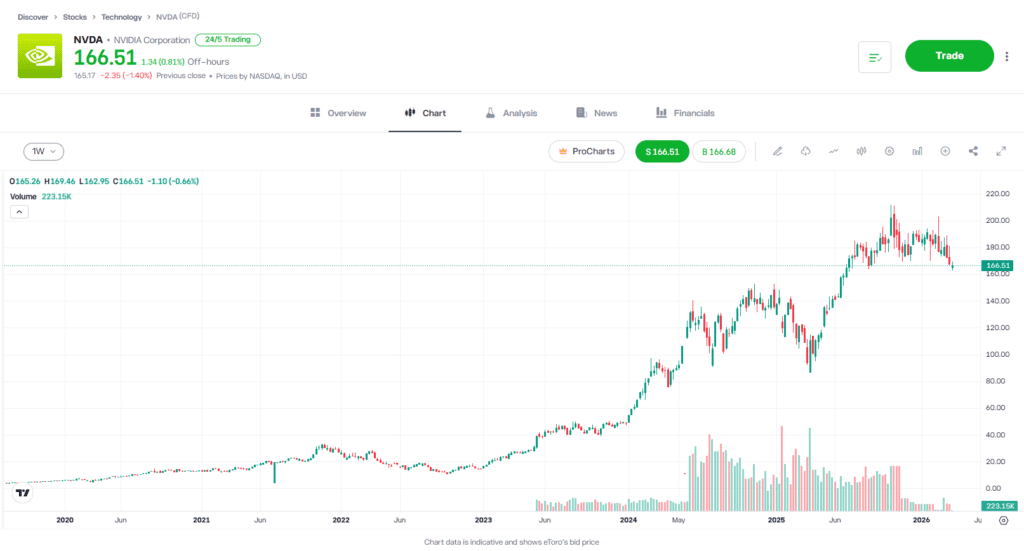
Semiconductor manufacturer NVIDIA (NVDA) has emerged as the preeminent company in artificial intelligence infrastructure.
Its graphics processing units power everything from gaming to data centres and the company’s strategic positioning in AI computing has driven remarkable growth as demand for machine learning capabilities explodes across industries.
Risk factors include an often aggressive valuation which could be challenged by US export controls, a slow down in data centre expansion or competition from rivals and clients manufacturing in-house chips.
Past performance is not an indication of future results.
Apple
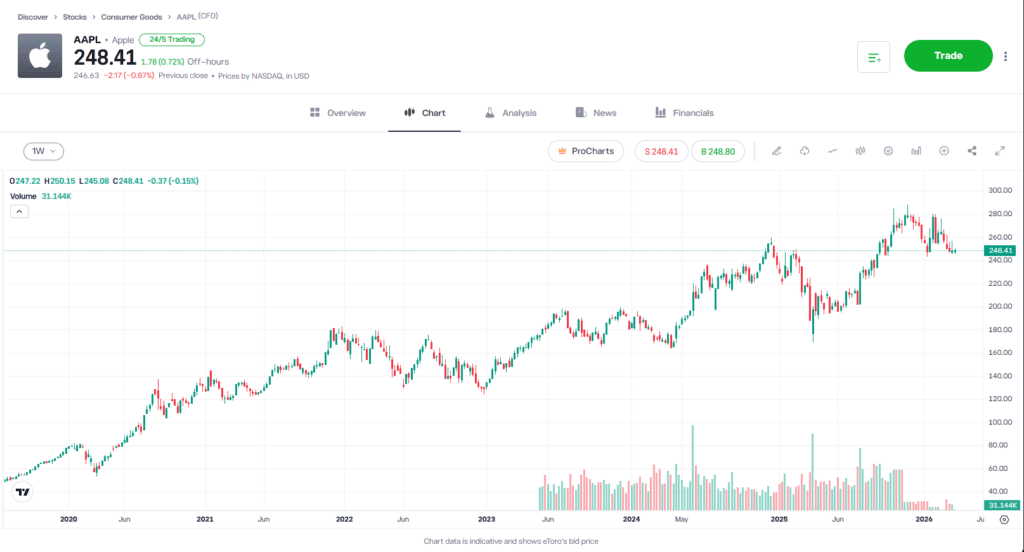
The comprehensive ecosystem built by Apple (AAPL) encourages customer loyalty with there being 2.5bn active Apple devices globally. That strong relationship converts to recurring revenue streams and the ability to leverage commitment into new services such as wearables.
The firm also has a significant cash pile to support investment in new initiatives or return to investors in the form of dividends or stock buy-backs.
As an established market leader Apple faces the risk of AI developments creating disruption in the markets in which it operates, a situation not helped by the company’s own pipeline of new products not being as healthy as it once was.
Past performance is not an indication of future results.
Microsoft
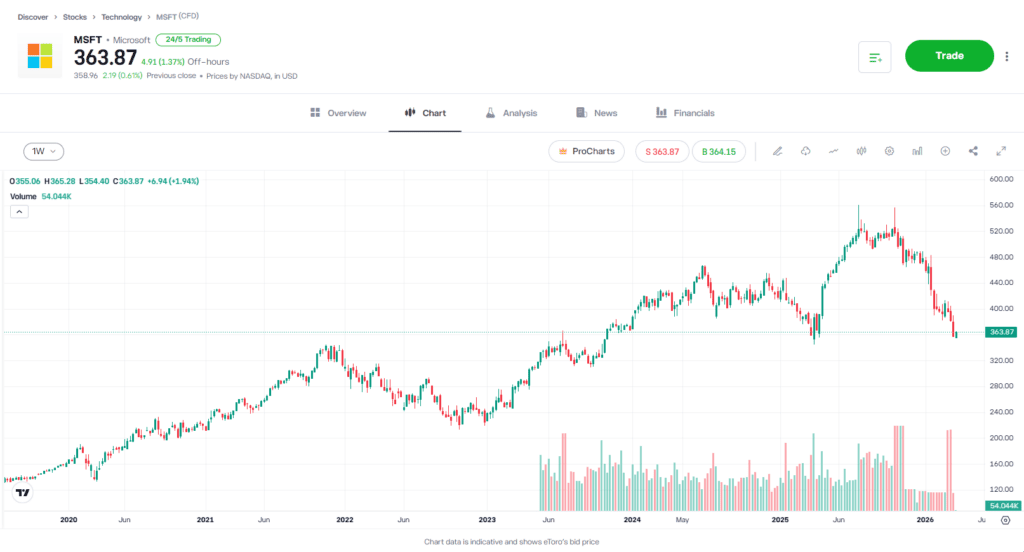
Positioning itself as a model of continuous growth Microsoft (MSFT) have successfully transitioned from traditional software licensing to subscription-based models.
Microsoft’s Azure cloud platform competes directly with Amazon Web Services whilst its Office 365 suite dominates productivity software.
One risk factor facing Microsoft and its shareholders is the law of large numbers. Massive growth could be harder to sustain for an already enormous company.
Past performance is not an indication of future results.
Salesforce
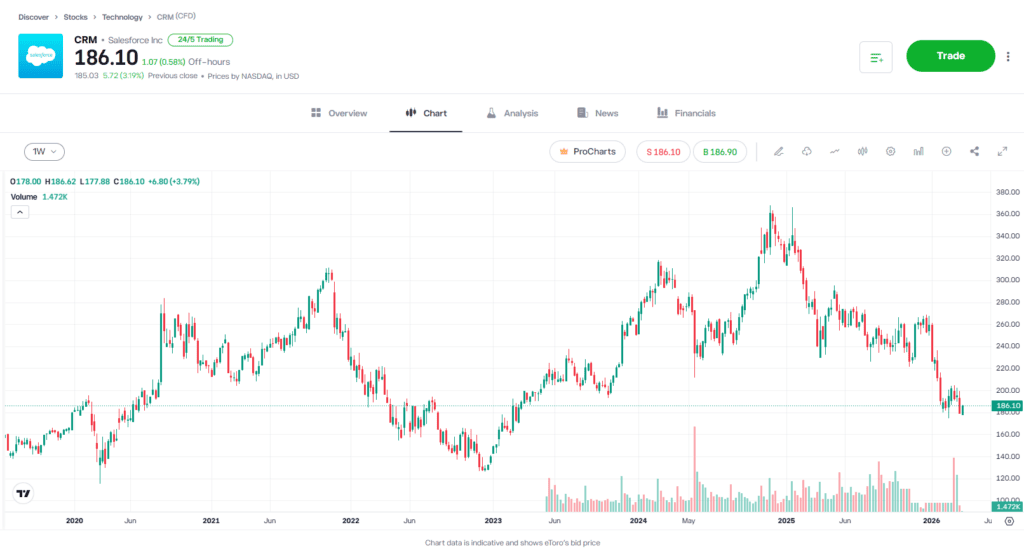
The market leader in the CRM sector, Salesforce (CRM) stock offers growth from adoption of AI technology into its customer relationship management software. Analysts predict its EPS could increase annually by 15% thanks to operational efficiency savings.
A lot rides on the ability of Salesforce to monetise its huge spending on AI initiatives. Time will tell on whether that is the case and the company also faces challenges from other tech giants moving into its core market.
Past performance is not an indication of future results.
Amazon
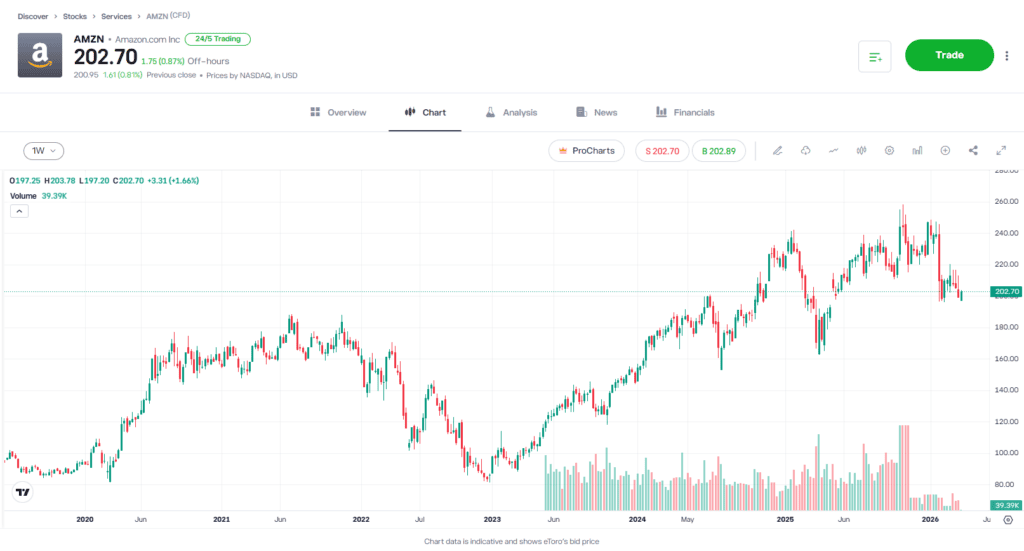
E-commerce giant Amazon (AMZN) exemplifies the potential for tech firms to continue evolving beyond their original missions. Growing from an online retailer into a cloud computing powerhouse with AWS, the firm is also pursuing opportunities in advertising, logistics, and entertainment.
Amazon’s growth trajectory was formed from aggressive decision making but some investors are questioning whether the $200bn annual capital expenditure on AI projects will impact free cash flow and the AMZN stock price.
Past performance is not an indication of future results.
Final thoughts
Investing in technology stocks requires balancing growth potential with risk management whilst staying informed about rapidly evolving industry trends. All investment decisions require careful consideration, but that is even more important in a sector where so many future developments might fail.
Diversifying across different technology subsectors and company sizes can help mitigate some sector-specific risks whilst maintaining exposure to growth opportunities.
Visit the etoro Academy to learn more about investing in specific sectors.
Frequently Asked Questions
- What percentage of my portfolio should be in tech stocks?
-
The appropriate allocation to technology stocks depends on your risk tolerance, investment timeline, and overall portfolio strategy. Financial advisors often suggest 15-25% for moderate investors, though younger investors with longer time horizons might allocate more. Consider your existing exposure through index funds, as technology already represents a significant portion of major indices.
- How do I evaluate early-stage tech companies?
-
Early-stage technology companies require different evaluation criteria than established firms. Focus on addressable market size, competitive advantages, management team experience, and pathway to profitability. Look for companies solving real problems with scalable solutions, strong intellectual property protection, and evidence of product-market fit through customer growth and retention metrics.
- Should I invest in individual tech stocks or ETFs?
-
Both approaches have merits. Individual stocks offer potential for higher returns but require more research and carry concentration risk. ETFs provide instant diversification and professional management but may include underperforming companies. Many investors combine both strategies, using ETFs for broad exposure whilst selecting individual stocks in areas of particular conviction or expertise.
- How do stock splits affect tech investments?
-
Corporate events such as stock splits don’t change a company’s fundamental value but can impact accessibility and liquidity. Technology companies often split shares to maintain reasonable price levels for retail investors. Whilst splits themselves aren’t buy or sell signals, they often reflect management confidence and can increase trading volume by making shares more affordable to smaller investors.
- What role does intellectual property play in tech valuations?
-
Intellectual property, including patents, trademarks, and trade secrets, forms crucial competitive moats for technology companies. Strong IP portfolios can justify premium valuations by protecting market positions and enabling licensing revenue. When evaluating tech stocks, consider both the quantity and quality of IP assets, pending litigation risks, and the company’s history of successfully defending or monetising its intellectual property.
This information is for educational purposes only and should not be taken as investment advice, personal recommendation, or an offer of, or solicitation to, buy or sell any financial instruments.
This material has been prepared without regard to any particular investment objectives or financial situation and has not been prepared in accordance with the legal and regulatory requirements to promote independent research.
Not all of the financial instruments and services referred to are offered by etoro and any references to past performance of a financial instrument, index, or a packaged investment product are not, and should not be taken as, a reliable indicator of future results. The availability of all the above-mentioned products and services may vary by jurisdiction and country.
etoro makes no representation and assumes no liability as to the accuracy or completeness of the content of this guide. Make sure you understand the risks involved in trading before committing any capital. Never risk more than you are prepared to lose.