



Investors pondering which artificial intelligence (AI) stocks to pick for 2026 face a rapidly maturing landscape.
While 2024 and 2025 were defined by the initial hardware build-out, 2026 is shaping up to be the year of “AI Execution”—where software monetisation, custom silicon, and advanced chip manufacturing technologies move from prototypes to high-volume production.
Investors are increasingly looking at how these global giants manage their international operations and capital expenditure (capex) as interest rates and inflation begin to normalise.
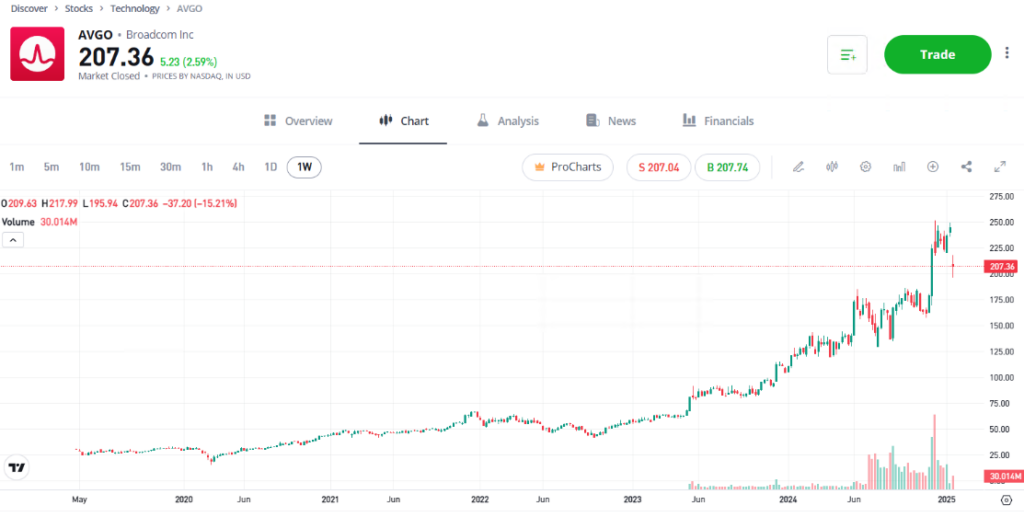
Broadcom (AVGO)
Past performance is not an indication of future results.
Broadcom is positioned as the primary leader in custom AI accelerators (XPUs), co-designing specialised chips for hyperscalers like Alphabet and Meta.
- The company recently outlined an ambitious $19.1 billion revenue target for Q1 fiscal 2026, representing a 28% year-on-year increase.
- Its AI-related backlog has surged to $73 billion, providing strong revenue visibility that extends through the next 18 months.
- Management has secured multi-billion dollar orders for delivery in late 2026, including a massive partnership with Anthropic.
- Broadcom’s networking division is seeing record bookings for its Tomahawk 6 102-terabit switches, which are essential for high-speed AI data clusters.
- A key business driver is the “AI Monetisation Supercycle”, which shifts focus toward inference, where Broadcom’s custom silicon offers significant cost and power advantages.
- Associated risks include customer concentration among a few “Big Tech” firms and potential margin pressure as the mix of AI hardware revenue increases.
Your capital is at risk. Not investment advice.
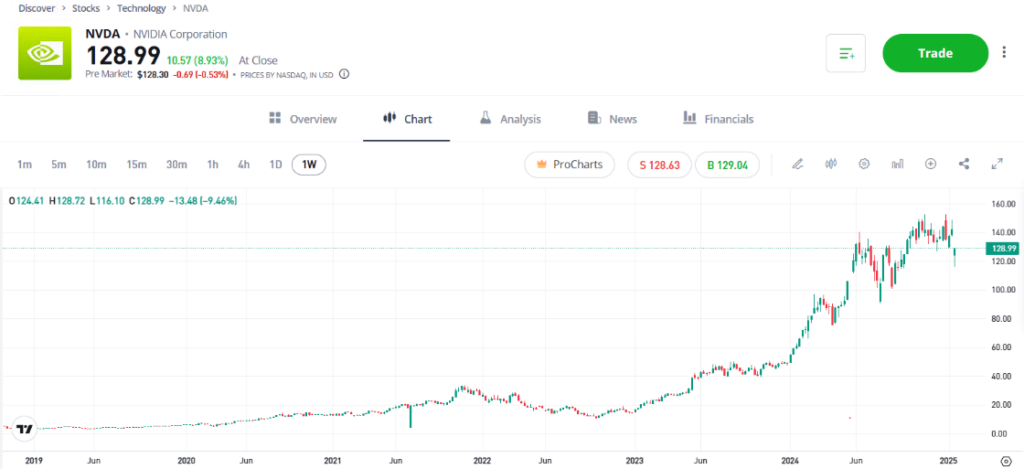
NVIDIA (NVDA)
Past performance is not an indication of future results.
NVIDIA enters 2026 with its Blackwell architecture in full high-volume production, following record-breaking results in late 2025. These developments look poised to significantly cut down training times for huge AI models, accelerating research and deployment.
- The company reported record revenue of $57 billion in Q3 fiscal 2026, a 62% increase from the previous year, driven primarily by its Data Centre segment.
- CEO Jensen Huang has highlighted that cloud GPUs remain “sold out”, with demand for both training and inference growing exponentially across every industry.
- Strategic partnerships, such as a 10-gigawatt infrastructure deal with OpenAI, ensure long-term demand for NVIDIA’s integrated hardware and software stack.
- NVIDIA is expanding its reach into “AI Factories” and sovereign AI, investing billions in markets like the UK and Japan to build localised infrastructure.
- The company’s Spectrum-X Ethernet networking is being adopted by Meta and Microsoft, diversifying NVIDIA’s role beyond just GPUs into full data centre networking.
- Investors should monitor the high valuation and the risk that heavy front-loaded capex by customers could slow down if AI ROI (Return on Investment) lags behind.
Your capital is at risk. Not investment advice.
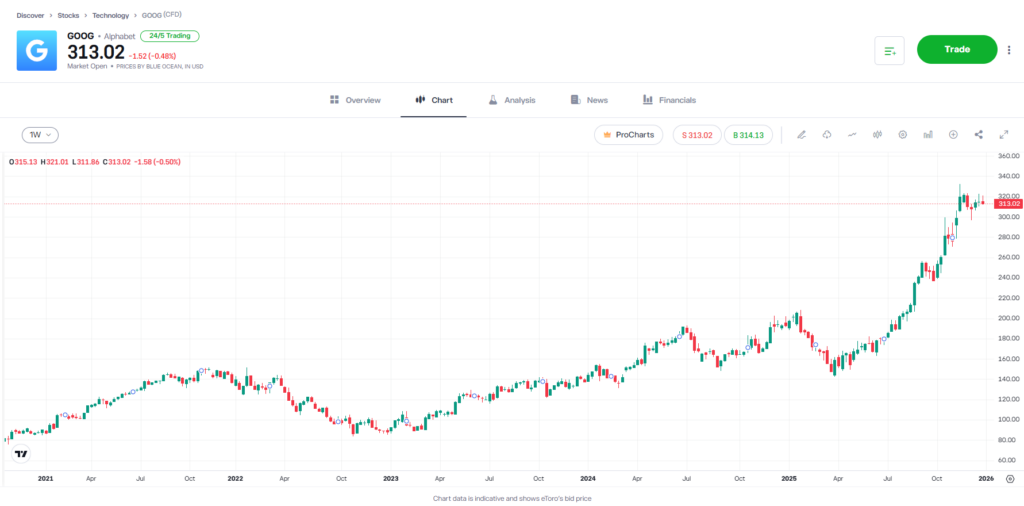
Alphabet (GOOGL)
Past performance is not an indication of future results.
Alphabet continues to successfully leverage its durable advertising dominance and expand into new ventures, with 2026 being the year some of those developments may start offering material returns.
- Google’s Tensor Processing Units (TPUs) have since 2018 allowed customers to leverage AI infrastructure without heavy upfront investment. That has transformed them from an internal secret weapon to a major external revenue lever for Google Cloud.
- A massive deal with Anthropic for up to one million TPUs is set to come online throughout 2026, representing a “tens of billions” dollar opportunity.
- By 2026, Alphabet’s Gemini 2.0 and beyond are expected to be fully integrated across its search and workspace ecosystems, driving productivity-based subscription growth.
- The company’s vertical integration—designing its own chips, operating the cloud, and developing the AI models—allows for significantly higher margins than competitors who rely on third-party hardware.
- Analysts suggest Alphabet could explore selling TPUs directly to other tech giants, a move that would open a new “hardware-as-a-service” revenue stream.
- Alphabet’s cash position remains among the strongest in the sector. It has $100bn in cash and marketable securities compared to $20bn of debt, allowing it to fund a $100 billion+ annual capex cycle without compromising its balance sheet.
- Primary risks include regulatory antitrust challenges in the US and Europe, as well as the potential for AI-generated search results to cannibalise traditional ad revenue.
Your capital is at risk. Not investment advice.
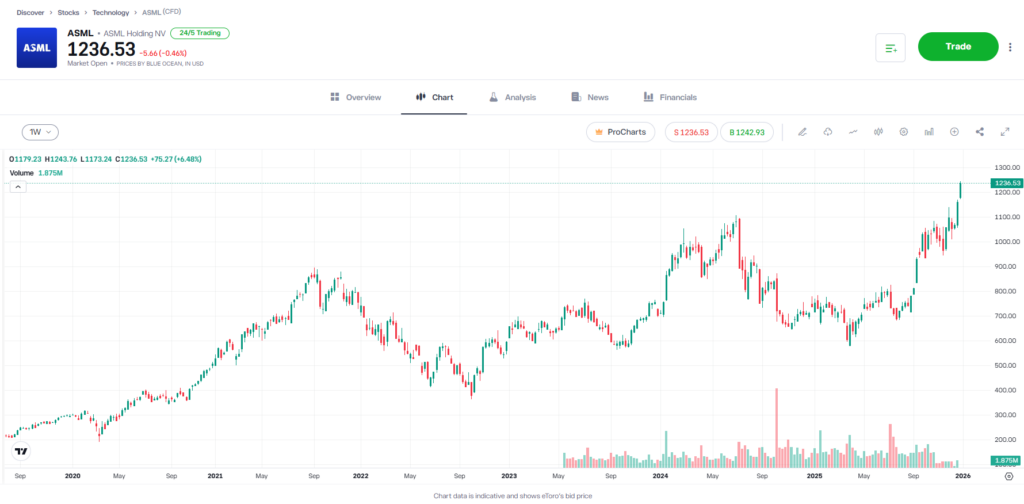
ASML (ASML)
Past performance is not an indication of future results.
ASML’s near monopoly in the provision of the Extreme Ultraviolet (EUV) lithography machines required to manufacture the world’s most advanced 2nm and 1.4nm chips means the stock demands attention from anyone looking to gain exposure to the AI sector.
- 2026 is expected to be a pivotal year for High-NA EUV (numerical aperture 0.55) as high-volume manufacturing begins for leading customers like Intel and TSMC.
- The company has recently navigated geopolitical headwinds, signalling that while growth remains robust, China sales are expected to decline in 2026 due to export controls.
- Despite sales to China forecast to decline due to trading restrictions ASML’s non-China order backlog remains strong, fuelled by the “Angstrom Era” as chipmakers race to reclaim process leadership.
- The transition to High-NA EUV allows for single-pass patterning, which reduces production defects and cycle times for next-generation AI accelerators.
- Analysts project that ASML could reach annual sales of €44–€60 billion by 2030, with 2026 acting as the launchpad for this next growth phase.
- Risks to watch include the high cost of High-NA systems (approx. $350 million each), which may lead to order delays if semiconductor customers face their own margin pressures and geopolitical headwinds such as Chinese import controls.
Your capital is at risk. Not investment advice.
Amazon (AMZN)
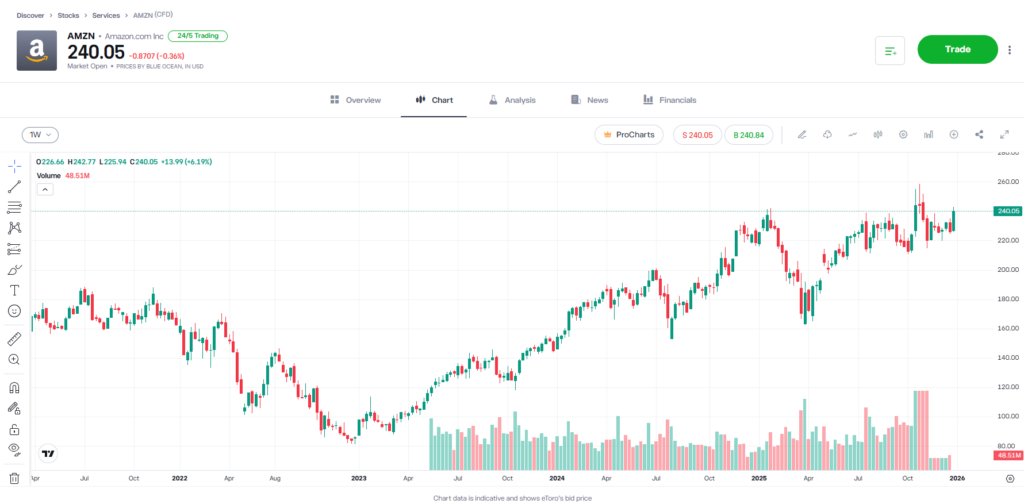
Past performance is not an indication of future results.
Amazon is executing a massive $125 billion capital investment cycle for 2025/2026 to secure its position as the dominant AI cloud platform.
- The company has unveiled plans for up to $50 billion in AI infrastructure specifically for US government agencies, with data centres breaking ground in 2026.
- Wall Street analysts estimate that AWS revenue growth could reaccelerate to over 20% in 2026 as generative AI workloads move into full-scale production.
- Amazon’s custom AI chips, Trainium and Inferentia, are gaining traction with major partners like Anthropic, providing a lower-cost alternative to traditional GPUs.
- Beyond the cloud, AI is being used to optimise Amazon’s retail logistics driving higher operational efficiency.
- Every incremental gigawatt of data centre capacity Amazon adds is estimated to generate roughly $3 billion in annual revenue.
- Associated risks include the high debt levels used to finance this unprecedented capex and intense competition from Microsoft Azure and Google Cloud.
Your capital is at risk. Not investment advice.
Micron (MU)
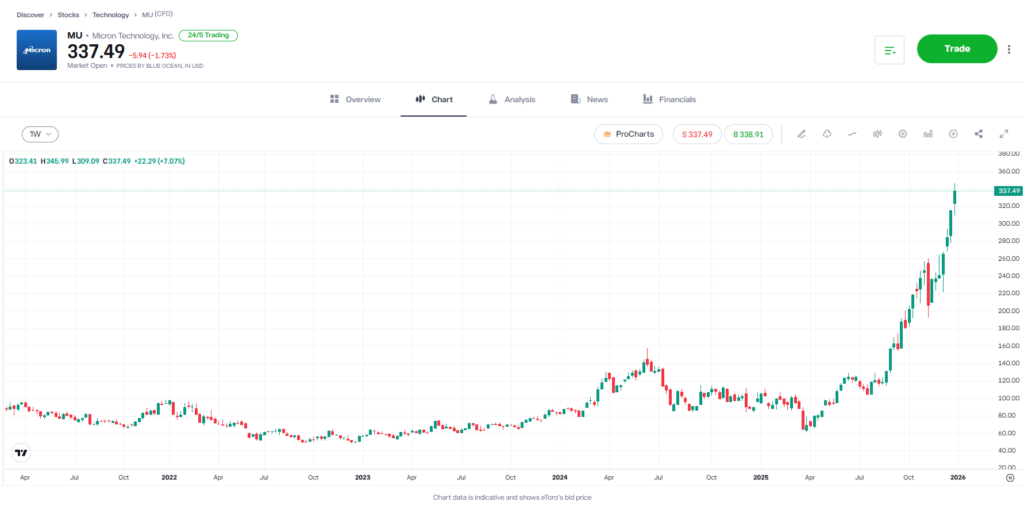
Past performance is not an indication of future results.
Micron recorded its highest-ever revenue in late 2025 and enters 2026 with its High-Bandwidth Memory (HBM) supply already sold out for the entire year.
- The company’s next-generation HBM4 is on track to ramp with high yields in the second calendar quarter of 2026, delivering industry-leading speeds of 11 gigabits per second.
- Micron expects the HBM market to reach $100 billion by 2028, a milestone that management now projects will arrive two years earlier than previously forecast.
- To meet this demand, Micron has increased its fiscal 2026 capital expenditure to $20 billion (from $18bn), focussing on expanding production in Idaho and New York.
- The company is also seeing a structural shift in demand for DDR5 and data centre SSDs, as AI servers require significantly higher memory content than traditional servers.
- Micron’s 1-gamma DRAM and G9 NAND nodes are set to become its primary production drivers in the second half of 2026, offering superior bit density.
- Risks include the cyclical nature of the memory market and potential oversupply if rivals Samsung and SK Hynix ramp production faster than the market can absorb.
Your capital is at risk. Not investment advice.
Final thoughts
The AI landscape in 2026 is transitioning from a “hardware rush” to a more nuanced era of performance and efficiency.
While the massive capital expenditures by the world’s largest tech firms provide a powerful tailwind for chip designers and manufacturers, retail investors must remain mindful of valuation risks and geopolitical tensions.
Diversification across different segments—from foundry leaders like ASML to memory giants like Micron and platform owners like Alphabet—may help mitigate the risks associated with any single company’s execution.
As the AI sector continues to evolve, staying informed on corporate capex guidance and technical production milestones will be key to identifying long-term opportunities.
Learn more about AI stocks and other asset classes at the eToro Academy.
This information is for educational purposes only and should not be taken as investment advice, personal recommendation, or an offer of, or solicitation to, buy or sell any financial instruments.
This material has been prepared without regard to any particular investment objectives or financial situation and has not been prepared in accordance with the legal and regulatory requirements to promote independent research.
Not all of the financial instruments and services referred to are offered by eToro and any references to past performance of a financial instrument, index, or a packaged investment product are not, and should not be taken as, a reliable indicator of future results. The availability of all the above-mentioned products and services may vary by jurisdiction and country.
eToro makes no representation and assumes no liability as to the accuracy or completeness of the content of this guide. Make sure you understand the risks involved in trading before committing any capital. Never risk more than you are prepared to lose.