



For retail investors in 2026, dividend-paying stocks remain a cornerstone of a balanced investment strategy, offering a blend of consistent passive income and the potential for long-term capital appreciation.
In a market environment where economic cycles and interest rate shifts can create uncertainty, companies with a proven track record of returning value to shareholders often provide a psychological and financial buffer.
The following selection highlights six industry leaders with robust fundamentals and reliable payout histories, helping you identify opportunities within the income-oriented equity sector.
Johnson & Johnson (JNJ)
Past performance is not an indication of future results.
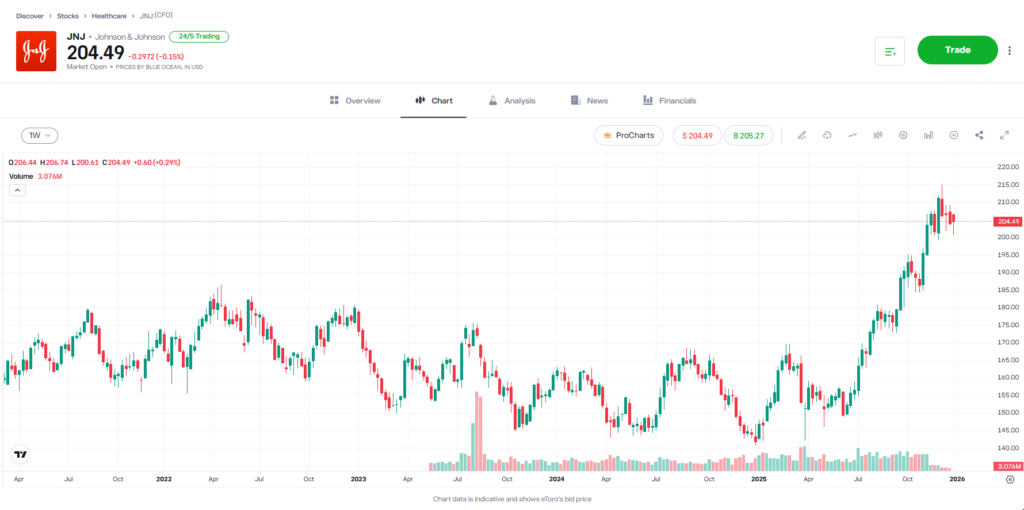
Johnson & Johnson enters 2026 as a premier Dividend King, having increased its annual dividend for over 60 consecutive years, demonstrating exceptional operational resilience.
- The company offers a forward dividend yield typically in the region of 2.5%, supported by a manageable payout ratio that provides ample room for future growth.
- Following the successful separation of its consumer health business, J&J is now a streamlined healthcare leader focussed on high-margin pharmaceuticals and innovative medtech.
- Its AAA credit rating reflects a balance sheet of immense strength, allowing the firm to fund aggressive research and development while maintaining shareholder returns.
- In 2026, the scaling of its oncology and immunology drug pipelines is expected to be a primary driver of the free cash flow required to sustain dividend hikes.
- The stock remains a favourite for defensive portfolios, offering lower volatility compared to the broader healthcare sector and consistent quarterly income.
- Investors should monitor litigation risks related to legacy products, although the company has established significant reserves to manage potential legal settlements.
Your capital is at risk. Not investment advice
Chevron (CVX)
Past performance is not an indication of future results.
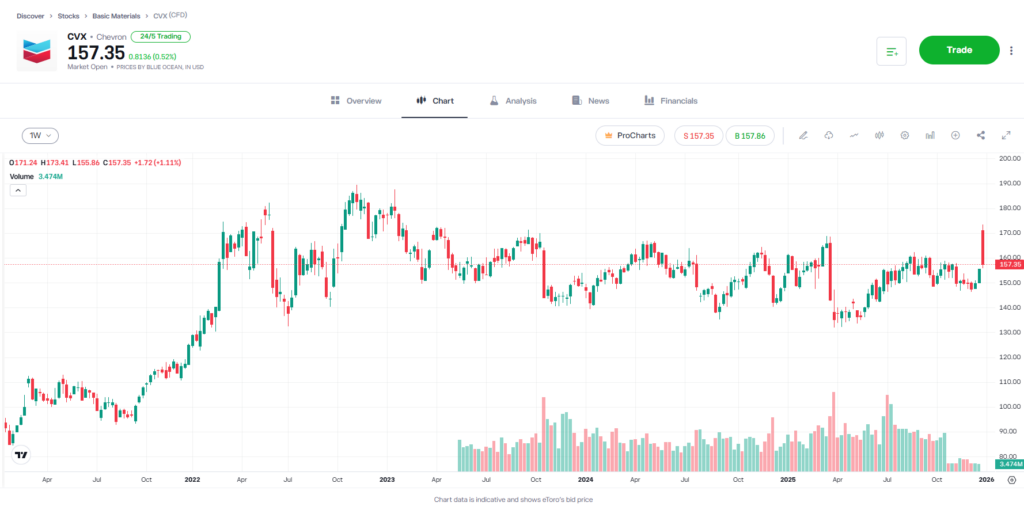
Chevron remains a staple for income investors, providing a robust dividend yield often projected to exceed 4.5% depending on prevailing energy market conditions.
- The firm is a Dividend Aristocrat with nearly four decades of consecutive increases, showing a steadfast commitment to shareholders despite commodity price volatility.
- Chevron’s acquisition of Hess Corporation has enhanced its long-term production profile, particularly in high-growth regions like Guyana, boosting cash flow prospects for 2026.
- The company maintains a disciplined capital allocation strategy, prioritising its dividend and share buybacks while keeping its debt-to-capital ratio among the lowest in its peer group.
- Analysts anticipate that Chevron will generate significant free cash flow in 2026, assuming stable crude prices, which secures the sustainability of its quarterly payouts.
- Chevron offers exposure to the global energy sector with a focus on capital efficiency and total shareholder return.
- A key risk involves the global energy transition, as Chevron must balance traditional oil and gas production with increasing investments in lower-carbon technologies.
Your capital is at risk. Not investment advice
Coca-Cola (KO)
Past performance is not an indication of future results.
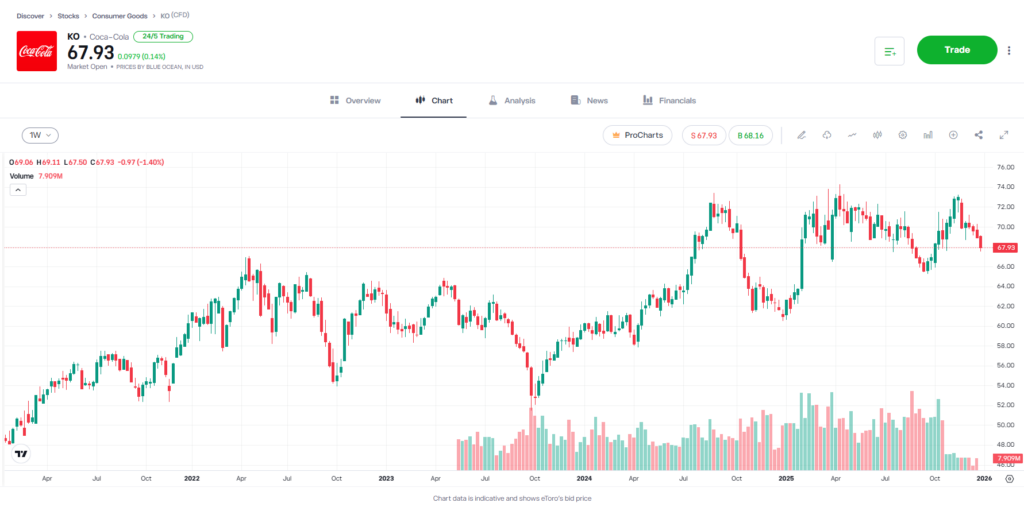
Coca-Cola is a world-renowned Dividend King with a 63-year streak of dividend increases, making it a hallmark of reliability for passive income seekers.
- The stock generally provides a dividend yield hovering around 2.8% to 3.2%, offering a competitive return compared to other consumer staple giants.
- Despite inflationary pressures, Coke’s immense pricing power and global distribution network allow it to maintain the margins necessary to fund consistent payout growth.
- In 2026, the company is focussing on its “Total Beverage” strategy, expanding its footprint in rapid-growth categories such as sports drinks, coffee, and sparkling water.
- The company’s capital-light business model, which utilises independent bottling partners, ensures that a high percentage of earnings can be converted into dividends.
- Coca-Cola acts as a core defensive asset, tending to show resilience during periods of broader market correction or economic slowdowns.
- Investors should consider currency headwinds, as a significant portion of Coca-Cola’s earnings are generated internationally and subject to US dollar fluctuations.
Your capital is at risk. Not investment advice
Verizon (VZ)
Past performance is not an indication of future results.
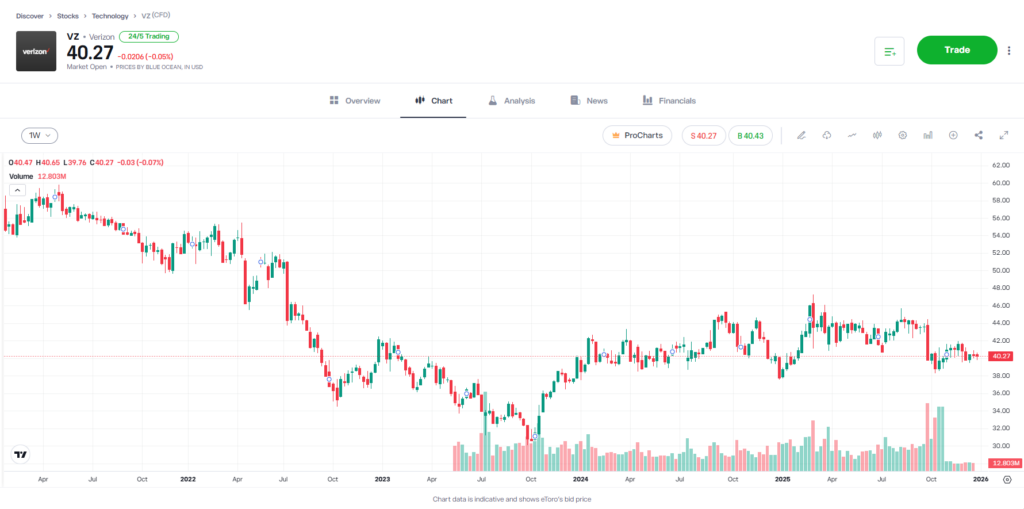
- Verizon is often selected for its high-yield profile, entering 2026 with a prospective dividend yield that frequently sits above 6.5%.
- The telecommunications giant has increased its dividend for 19 consecutive years, the longest current streak in the US wireless industry.
- Verizon’s business is underpinned by essential services and recurring monthly subscription revenue, providing highly predictable cash flows to cover dividend obligations.
- The company is focussed on expanding its 5G network and fixed wireless access (FWA), which are expected to be meaningful revenue contributors throughout 2026.
- Intense competition within the US telecom market remains a risk, potentially impacting the firm’s ability to raise prices for consumer mobile plans.
- For many retail investors, VZ serves as a “bond-proxy” stock, offering a yield that significantly outpaces traditional savings accounts.
- A primary consideration for investors is Verizon’s significant debt load. The company has committed to using excess cash to deleverage its balance sheet which could impact the amount paid in the form of dividends.
Your capital is at risk. Not investment advice
Caterpillar (CAT)
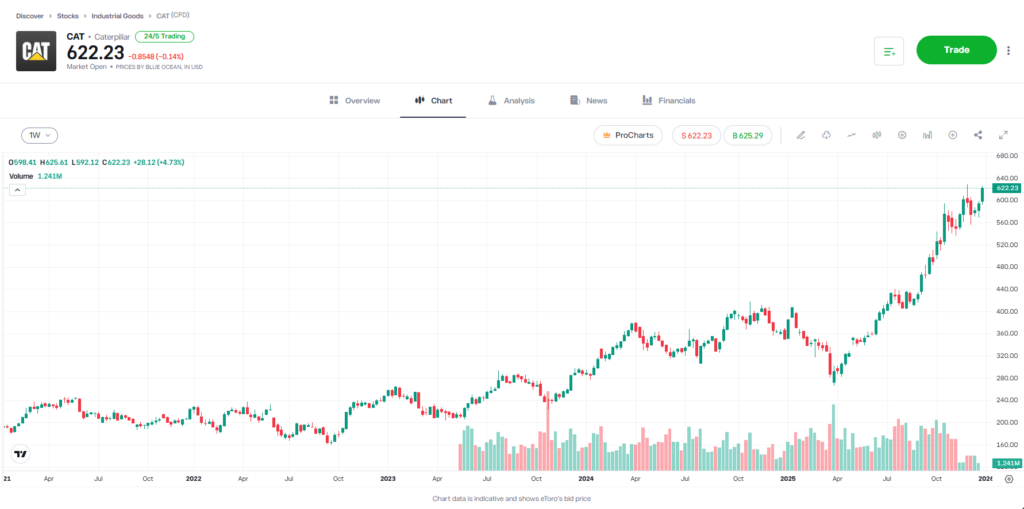
Past performance is not an indication of future results.
- Caterpillar is a global industrial leader that has earned Dividend Aristocrat status by increasing its payout for over 30 consecutive years.
- While its dividend yield is typically more modest (often around 1.0% to 1.5%), the company offers superior dividend growth rates compared to many other industrials.
- As a primary beneficiary of global infrastructure spending, Caterpillar is well-positioned to benefit from long-term construction and mining projects in 2026.
- The company’s payout ratio remains conservative, ensuring that dividends are well-covered by earnings even during the cyclical troughs of the industrial sector.
- The firm is increasingly leveraging digital services and automation to drive high-margin recurring revenue, which provides a more stable foundation for future dividends.
- Caterpillar often engages in significant share repurchase programmes, which combined with the dividend, enhances the total yield for long-term shareholders.
- Investors should be aware of macroeconomic sensitivity, as Caterpillar’s machinery sales are closely tied to global GDP growth and commodity demand.
Your capital is at risk. Not investment advice
McDonald’s (MCD)
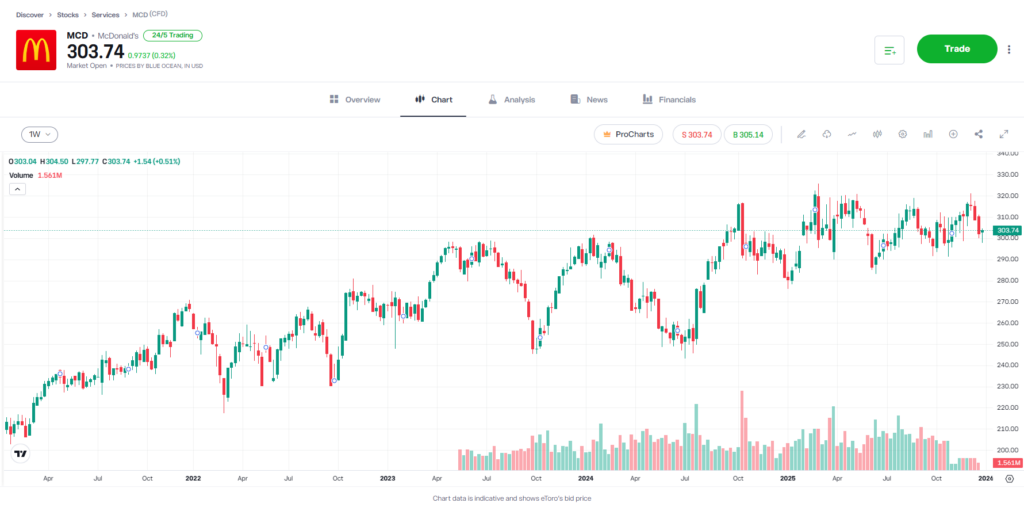
Past performance is not an indication of future results.
- McDonald’s is expected to reach the historic Dividend King milestone in 2026, marking 50 years of uninterrupted annual dividend increases.
- The stock provides a reliable dividend yield of approximately 2.2% to 2.4%, supported by a highly profitable franchise-based business model.
- Because McDonald’s owns a vast amount of real estate and collects rent from its franchisees, its cash flow is significantly more stable than typical restaurant operators.
- The “Accelerating the Arches” strategy has successfully boosted digital sales and delivery, which are projected to remain key growth engines through 2026.
- Risks to monitor include wage inflation and fluctuating food costs, although the company’s scale allows it to manage supply chain pressures effectively.
- McDonald’s remains a classic “defensive-growth” hybrid, performing well during economic downturns as consumers trade down to value-priced dining options.
- The company’s consistent buyback activity further reduces the outstanding share count, helping to drive earnings per share and support the annual dividend hike.
Your capital is at risk. Not investment advice
Final thoughts
Dividend investing in 2026 is about more than just chasing the highest yield; it is about finding companies with the earnings power and cash flow stability to sustain and grow those payouts over time.
Whether you prefer the high yield of Verizon or the historic stability of Coca-Cola and Johnson & Johnson, these stocks offer a pathway to a more resilient portfolio. As always, investors should conduct thorough due diligence and consider how these income-oriented positions fit within their overall diversification strategy and risk tolerance.
Learn more about dividend stocks and other assets at the etoro Academy.
This information is for educational purposes only and should not be taken as investment advice, personal recommendation, or an offer of, or solicitation to, buy or sell any financial instruments.
This material has been prepared without regard to any particular investment objectives or financial situation and has not been prepared in accordance with the legal and regulatory requirements to promote independent research.
Not all of the financial instruments and services referred to are offered by etoro and any references to past performance of a financial instrument, index, or a packaged investment product are not, and should not be taken as, a reliable indicator of future results. The availability of all the above-mentioned products and services may vary by jurisdiction and country.
etoro makes no representation and assumes no liability as to the accuracy or completeness of the content of this guide. Make sure you understand the risks involved in trading before committing any capital. Never risk more than you are prepared to lose.