



Investors pondering which stocks to pick for 2026 face the challenge of factoring in a number of trends which are impacting the world economy. These are the stocks best positioned to outperform as geopolitical realignments and new technologies expand their influence over the markets.
Microsoft (MSFT)
Past performance is not an indication of future results.
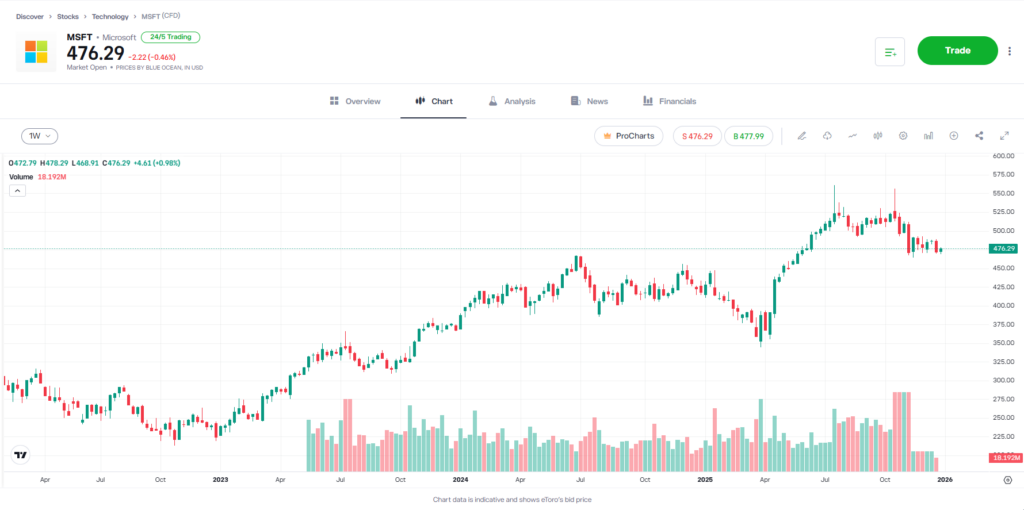
Back-to-back impressive annual share price gains in the three years since 2022 have been welcomed by those already holding Microsoft (MSFT) stock, but with the firm demonstrating an ability to monetise AI and cloud developments there are still good reasons for new investors to buy into the stock.
- Fiscal 2026 Growth: Analysts have set high expectations for the first quarter of fiscal 2026, with consensus revenue estimates reaching $64.51 billion and earnings per share (EPS) forecast at $3.11.
- Intelligent Cloud Dominance: The Microsoft Cloud division remains the company’s primary engine, with Microsoft Cloud revenue reaching $46.7 billion, up 27% year-over-year.
- AI Capital Expenditure: Microsoft is aggressively scaling its AI infrastructure, with capital expenditures expected to reach approximately $30 billion in Q1 2026 alone to expand data center capacity and GPU availability.
- Bull Case Valuation: Leading Wall Street analysts have laid out a bull case for Microsoft to reach a $5 trillion market valuation by 2026, driven by an aggressive AI roadmap and operating leverage.
- Copilot Monetization: A key revenue driver for 2026 is the widespread adoption of paid AI assistants (Copilot) across the Microsoft 365 suite, creating a powerful new recurring revenue stream.
- Technical Support: Shares have recently shown a technical consolidation range, with a mean analyst target price of approximately $632.24, implying significant upside from 2025 levels.
- Consistent Outperformance: Microsoft enters 2026 having beaten EPS estimates for eight consecutive quarters, a track record that supports strong investor confidence in management’s execution.
- Risk Factors: High expectations for AI and cloud growth may already be priced into the MSFT stock price. Other key risks include the scale of the capital expenditure being undertaken, intense competition, and increased regulatory scrutiny.
Your capital is at risk. Not investment advice
Amazon (AMZN)
Past performance is not an indication of future results.
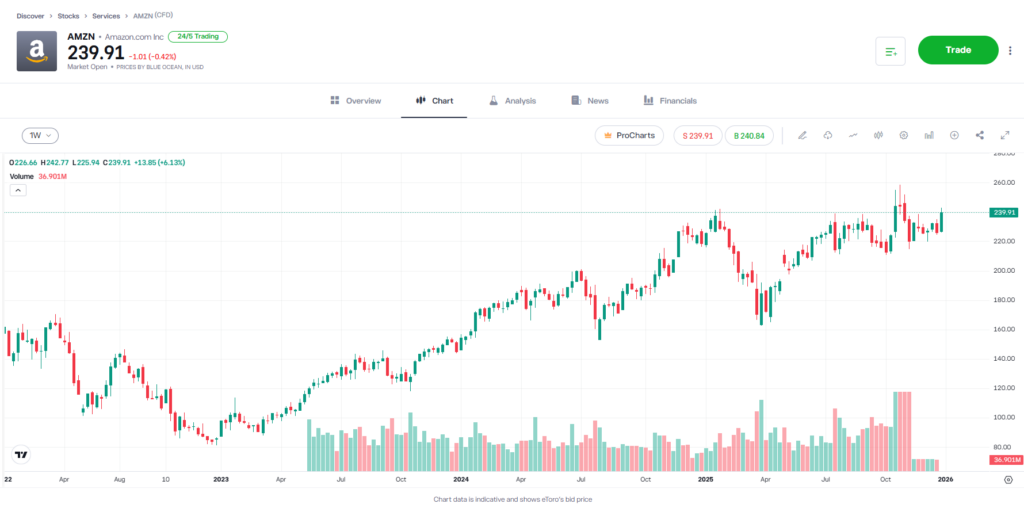
2026 looks set to be a year where Amazon’s impressive suite of services combine to fuel overall growth. The e-commerce division could see improved margins and the AWS division is well positioned to capitalise on growth in AI and cloud computing.
- AWS Acceleration: Wall Street analysts estimate that AWS revenue growth could reaccelerate to over 35% by 2026, up from 20% in late 2025, as generative AI applications move into full production.
- Price Targets: The median analyst target price for Amazon is $297 per share, with some “bull case” forecasts suggesting the stock could challenge the $340 mark by the end of 2026.
- Advertising High Margins: Amazon’s advertising segment is now its third-largest business and remains a high-margin engine, with year-on-year growth being 24% in Q2 of 2025.
- Custom Silicon Edge: To lower costs, Amazon is scaling its custom Trainium2 chips, with partners like Anthropic expected to train models on clusters of over 1 million chips by 2026.
- E-commerce Efficiency: The roll-out of the AI shopping assistant Rufus is projected to generate over $10 billion in incremental annualized sales by improving transaction completion rates.
- Cash Flow Health: In its last Q2 statement, the company held $93.1 billion in cash, cash equivalents, and marketable securities which combined with trailing-twelve-month operating cash flow of $121.1 billion supports further heavy spending on evolving sectors.
- Risk Factors: The Amazon stock price has historically been more volatile than that of the broader market which can make it harder for investors to hold on to. Remaining in a position can be harder during times of economic uncertainty when the stock typically overshoots to the down-side due to the prospects of future earnings growth appearing to be challenged by deteriorating economic fundamentals.
Your capital is at risk. Not investment advice
JP Morgan (JPM)
Past performance is not an indication of future results.
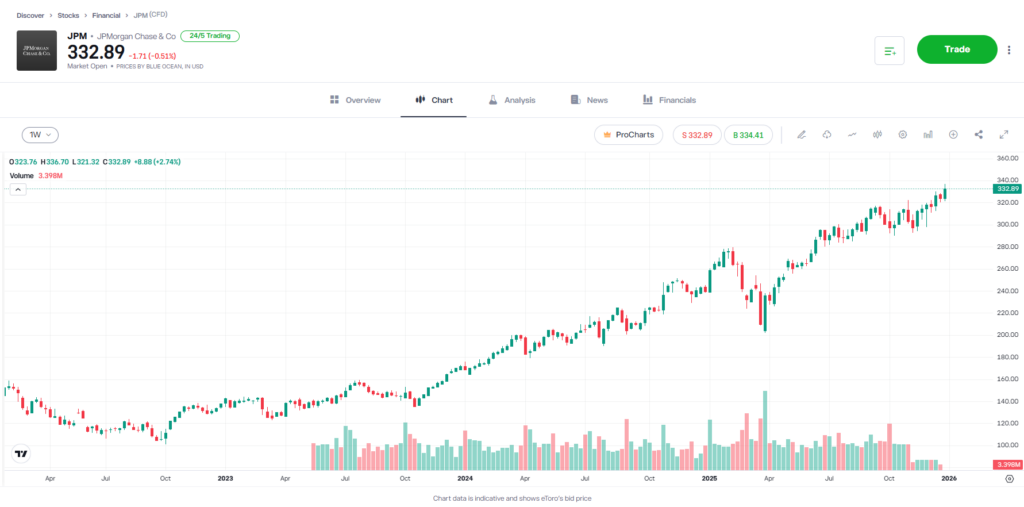
J.P. Morgan Global Research anticipates 2026 to be a year of “U.S. economic resilience,” with GDP growth expected to surge to above 3% in the first half of the year with the bank being well-positioned to benefit from that strong growth.
- Interest Rate Strategy: In a “shallow easing” environment, J.P. Morgan is positioned to protect income streams as the Federal Reserve is projected to reduce rates only 2–3 times through 2026.
- Net Interest Income: The bank has historically upgraded its net interest income guidance, currently targeting over $95.5 billion as it manages a massive $4.1 trillion asset base.
- Earnings Resilience: Analysts estimate an AI-driven “supercycle” could drive above-trend earnings growth for the broader banking sector through 2026.
- Fortress Balance Sheet: J.P. Morgan maintains a superior Tier 1 capital ratio, its Common Equity Tier 1 (CET1) ratio of 15.3% represents a level of capital that provides an impressive buffer against potential market volatility.
- Sector Leadership: JPM stock has consistently outperformed the S&P 500 Index over several timeframes yet continues to prioritise quality over cyclicality.
- Technical Trend: The stock remains in a long-term rising trend channel established in late 2022, with a technical “floor” firmly set by its consistent dividend growth and share buyback programs.
- Risk Factors: J. P. Morgan’s own research team predicts the chance of a global/US recession to be more than 30% in 2026. If that happens, macroeconomic headwinds can be expected to impact loan demand, bring about credit losses, and disrupt fee income, which could leave current valuations looking pricey.
Your capital is at risk. Not investment advice
TSMC (TSM)
Past performance is not an indication of future results.
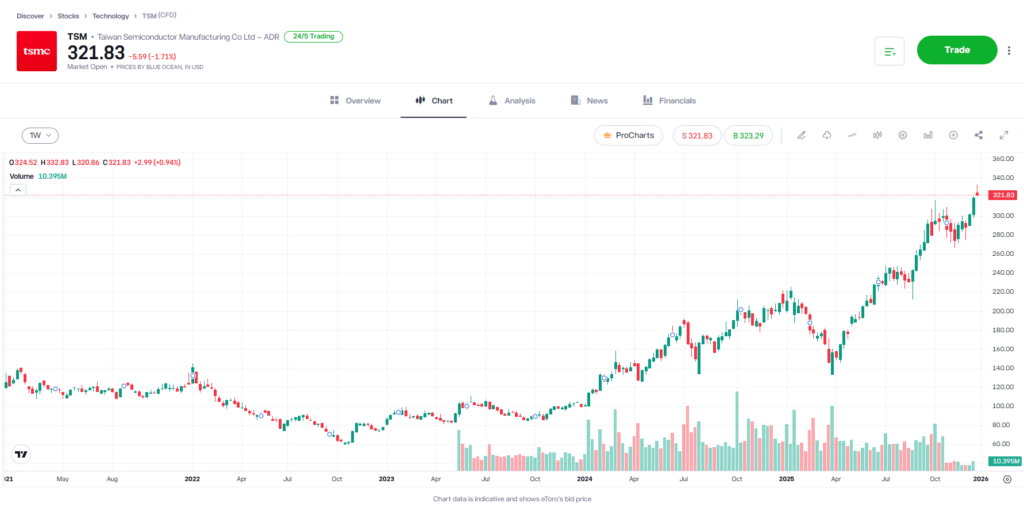
2026 is a pivotal year for TSMC as it ramps up mass production of 2nm chips, which are expected to offer significant power and performance gains over the current 3nm standard.
- Earnings Forecast: For 2026, consensus estimates suggest TSMC will report earnings growth of 20.2%.
- Foundry Dominance: TSMC continues to hold a 60%+ share of the global foundry market, acting as the primary manufacturer for high-performance AI accelerators from NVIDIA and Broadcom.
- Monetisation of AI growth: The company’s profits rose in Q3 by 39% on the back of continued demand for semi-conductors used in AI applications.
- Valuation Advantage: TSMC’s forward 12-month P/E ratio of 31.04 is at the top of the range for the US technology sector but doesn’t fully price in the firm’s preeminent position.
- Global Capacity Expansion: By 2026, TSMC’s investments in new facilities in Arizona and Japan are expected to provide greater supply chain resilience against regional geopolitical risks.
- Advanced Packaging: Demand for “CoWoS” (Chip on Wafer on Substrate) packaging is expected to remain extremely high 2026, as AI hardware requires increasingly complex chip integration.
- Risk Factors: Despite TSMC’s efforts to build new production facilities in the US, Japan, and Germany, the majority of its most advanced chip production still remains concentrated in Taiwan. This heightens operational risk in the event of any regional disruption which could be triggered by Taiwan’s long-term political stand-off with mainland China.
Your capital is at risk. Not investment advice
Costco (COST)
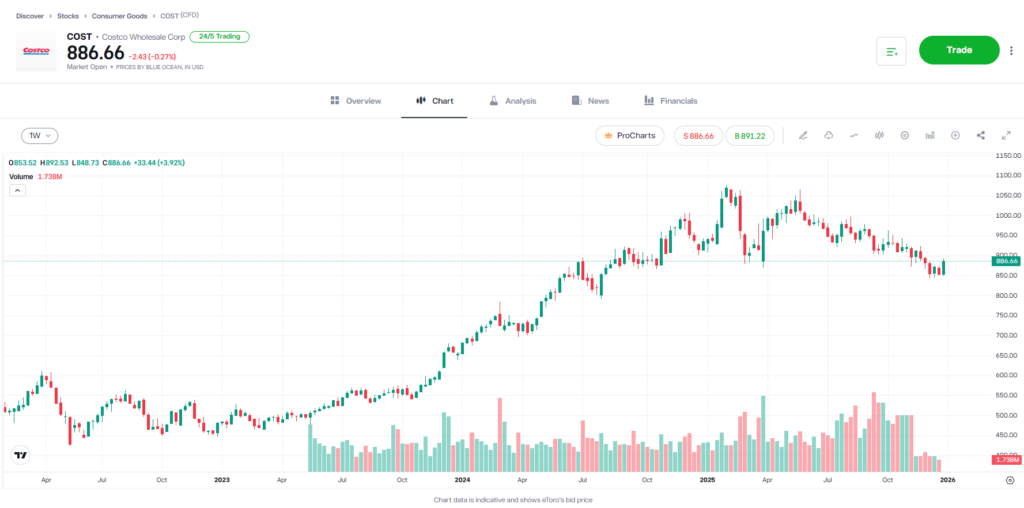
Past performance is not an indication of future results.
Costco’s membership model continues to be a durable competitive advantage, generating predictable, high-margin recurring revenue.
- Membership Renewal Rates: Costco enters 2026 with a robust U.S. renewal rate of 92.2%, a critical metric that supports its high-margin membership fee income (MFI).
- Revenue Projections: Analysts forecast revenue and adjusted earnings per share (EPS) to grow by 8% and 11%, respectively.
- Price Targets: Consensus analyst price targets for Costco average $1,074, with high-end estimates reaching as high as $1,074 for the 2026 period.
- Cash Position: Costco reported a cash balance of over $16.2 billion in late 2025, up 15% year-on-year, providing a strong foundation for capital returns and potential special dividends in 2026.
- E-commerce Momentum: The company has seen a notable 20.5% growth in e-commerce sales, driven by digital initiatives that attract a younger, more “tech-enabled” membership base.
- Defensive Quality: With J.P. Morgan Global Research forecasting the chances of a US and global recession at 35% Costo’s “value” proposition acts as a defensive buffer for diversified portfolios.
- Operational Efficiency: Costco is increasingly using AI to optimize its internal logistics and inventory management, a move highlighted by analysts as a key long-term margin driver.
- Risk Factors: Costco’s approach of targeting growth could be good news for investors but there are risks involved with the execution of those plans. These need to be added to the perennial risks associated with supply chain disruptions and potential shifts in consumer loyalty or spending habits.
Your capital is at risk. Not investment advice
Eli Lilly (LLY)
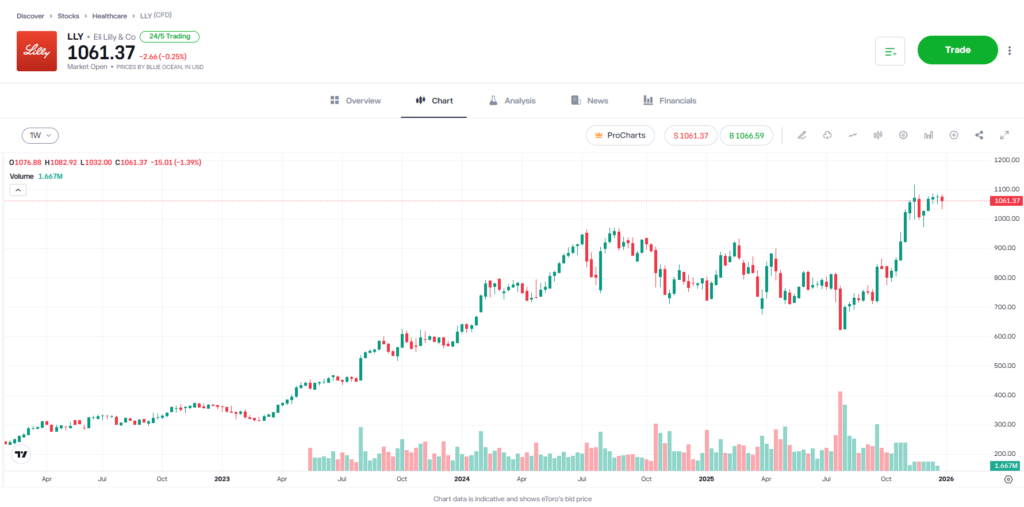
Past performance is not an indication of future results.
Eli Lilly is forecasted to continue strong growth into 2026 driven by blockbuster incretin and obesity drugs and pipeline expansion. Revenue growth is forecast to be above historical levels as key products mature and new ones get approved and launched.
- Revenue Drivers: Mounjaro and Zepbound continue to drive sales growth with overall Q3 revenue at Lilly beating analyst expectations by 9%, while earnings per share (EPS) were 19% higher than consensus estimates.
- Production Ramps: New manufacturing facilities, including a site in Concord, North Carolina, are expected to reach full output by 2026, finally addressing the long-standing “supply-constrained” growth.
- Earnings Outlook: Median share price growth forecasts by analysts predict a stock price close to $1,171 by the end of 2026 with some up-side estimates being as high as $1,500.
- Pipeline Diversification: Beyond GLP-1s, 2026 will see the continued launch and scaling of drugs like Kisunla (Alzheimer’s) and Omvoh (Ulcerative Colitis) across international markets.
- Obesity Market Lead: Late-stage candidates like Orforglipron (oral GLP-1) and Retatrutide are advancing toward 2026 milestones, potentially widening Lilly’s moat in the cardiometabolic space.
- Valuation and Cap: Having recently become the first drugmaker to hit a $1 trillion market cap, Lilly’s stock continues to trade at a premium, though it remains below its 5-year mean P/E ratio.
- Strategic M&A: Management is actively pursuing M&A in oncology and neuroscience to diversify revenue and protect against the 2028 “loss of exclusivity” risks faced by industry peers.
- Risk Factors: Eli Lilly is heavily exposed to potential price pressure from US drug pricing reforms impacting the returns from its blockbuster drugs. Political developments can be hard to predict, and with Monjuaro and Zepbound generating such a large percentage of the company’s revenue new challenges for either of those two drugs could be expected to knock the price of Lilly stock.
Your capital is at risk. Not investment advice
Final thoughts
Investing in markets which are already showing bullish sentiment comes with its own set of risk factors. It could be that the good news is already priced in. There is also a need to consider how geopolitical events and macroeconomic cycles could impact the stock sector as a whole.
Even if these stocks do outperform their peer group, they could still fall in value. Carrying out careful research and ongoing risk management are crucial elements of getting the most out of stock investing. Taking a long-term view also helps, which is why these top stock picks for 2026 include firms which could post long-term gains.
The selection also targets stocks from different sectors, so that they offer a way of building a diversified portfolio designed to ride out the inevitable ups and downs of the markets.
Learn more about stocks and other asset classes at the etoro Academy.
This information is for educational purposes only and should not be taken as investment advice, personal recommendation, or an offer of, or solicitation to, buy or sell any financial instruments.
This material has been prepared without regard to any particular investment objectives or financial situation and has not been prepared in accordance with the legal and regulatory requirements to promote independent research.
Not all of the financial instruments and services referred to are offered by etoro and any references to past performance of a financial instrument, index, or a packaged investment product are not, and should not be taken as, a reliable indicator of future results. The availability of all the above-mentioned products and services may vary by jurisdiction and country.
etoro makes no representation and assumes no liability as to the accuracy or completeness of the content of this guide. Make sure you understand the risks involved in trading before committing any capital. Never risk more than you are prepared to lose.