


This short guide will introduce you to the currency markets. It will explain how they work, how to trade them, and what factors drive currency price moves. Read on to learn more about one of the biggest financial markets in the world and the reasons why it is so popular with traders.
Currency trading, or ‘forex’ trading as it is often called, has become increasingly popular in recent years. It’s not hard to see why.
Not only have advances in technology made it much easier for retail traders to access the currency market, but innovative new trading tools have also made it possible to start trading currencies with just a small amount of capital.
What Is Currency Trading?
Currency trading is the process of buying and selling different currencies such as the US Dollar, the Euro, and the British Pound.
Often called foreign exchange (forex) trading, it involves purchasing one currency while simultaneously selling another, with the aim of generating a return from respective price moves.
Currency trading takes place on the foreign exchange market – a global exchange in which traders all over the world trade currency pairs. The forex market is the largest financial market in the world, with around $9 trillion in currencies traded every day.
The forex markets are highly liquid market which means frictional costs are relatively low, and liquidity also assists in terms of market access and you can start trading forex with a small amount of capital.
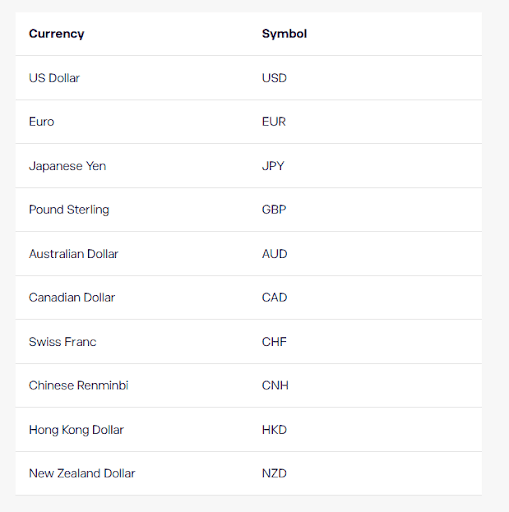
The 10 Most Traded Currencies in the World
The most actively traded currencies in the world unsurprisingly mirror the size of the underlying economic activity related to a currency.
Even if you have never actively traded currencies before, you’ve probably had some experience buying and selling currencies.
For example, if you’ve taken a holiday abroad, you most likely swapped your home currency for an international currency. By exchanging one currency for another, you essentially participated in the foreign exchange market.

What Drives Currency Movements?
Currency values are largely determined by real world events which can be short-term and long-term in nature. These include geo-political developments or economic fundamentals which make a currency more or less attractive.
Some of the macroeconomic factors which create a currency to up or down in value, include:
Interest rates
A country’s interest rate has a major impact on demand for its currency. A higher interest rate attracts foreign capital flows into the country as international investors take advantage of the relatively higher return on capital. When interest rates are lower the reverse is true.
Inflation
A country’s rate of inflation can also impact demand for its currency. A high inflation rate can lead to reduced demand as the underlying price rises in an economy erode the true value of any capital held in cash form
Economic performance
Countries that are experiencing economic growth tend to see increased demand for their currencies. Conversely, countries that are experiencing economic challenges such as a recession tend to see decreased demand for their currencies.
This is because strong-growth economies are seen as a good investment opportunity. Financial assets such as shares of companies are considered more attractive, and when purchased on a market that uses a different currency, the process of buying shares starts with a forex transaction to convert capital into the target country’s currency.
Tip: Data reports to study include Gross Domestic Product (GDP), unemployment, retail sales, property prices and surveys which measure sentiment.
Debt
A country’s debt levels can also have an impact on demand for its currency. Governments, corporations and individuals all influence the total debt levels, and if international investors fear a default on loans, they are more likely to withdraw their cash from that country, causing the currency to drop in value.
Political stability
Foreign investors tend to seek out politically stable countries when investing their capital. Historical case-studies highlight how geo-political uncertainty can result in international investors losing their money.

Developing a currency trading strategy
Before you begin trading currencies, it’s worth taking the time to develop a trading strategy. This is essentially a plan to help you determine when to buy or sell a currency pair at any given time.
Fundamental analysis
An effective trading strategy based on fundamental analysis should consider the factors which influence currency exchange rates, and there are a lot of variables in play. In some instances, the different price drivers will be pushing a forex rate in different directions.
Take for example a country with a high inflation rate and high interest rates which are being used to suppress rising prices. The high inflation element will reduce demand for the country’s currency, but the high interest rate will attract buyers.
Tip: An effective trading strategy based on fundamental analysis will consider how different price drivers interact with each other.
Technical analysis
Some forex traders also use technical analysis which uses historical market data, such as record high, and low, price levels. Technical analysis can help traders plot the course that market price might take over a period of time or spot new trends.
Technical analysis can also be used to try to identify the optimal time to trade forex and provide trade entry and exit signals.
There is no single formula for success when it comes to trading currencies. The key is to start with a basic strategy and refine it over time.
Potential Benefits of Currency Trading
There are some distinct features of the currency markets which help make them popular with traders, these include:
- You don’t need to have a lot of money to get started. It’s not unusual to find a well-regarded broker having minimum opening balance requirements as low as $100.
- That capital can be used to take on leverage, which means you can scale up on your risk/return but it is important to remember that leverage will magnify losses as well as gains.
- The foreign exchange market is open 24/5 which means trading activity can fit around other commitments.
- The high volumes of trades going through the market mean that trading costs are low and it’s hard for unscrupulous agents to manipulate the market price.
Getting your decision making correct is obviously crucial to being a successful trader, but it is also worth considering which market might be the best one to use as each market will have characteristics which might, or might not, suit a particular style of trading.
Risks of Currency Trading
One inescapable fact is that any form of investing or trading involves risks and currency trading is no different. In an effort to make risk management easier it is often broken down into different categories.
- Market risk: The likelihood of you getting on the wrong side of a trade. Buying when you should have sold, or vice versa. This could be due to ineffective strategy management or news events impacting the market.
- Volatility risk: the foreign exchange market can be highly volatile and the overall level of price fluctuations varies over time. While this volatility can create trading opportunities, it can also knock you out of positions.
- Leverage risk: leverage is a powerful tool that can magnify gains, but will also magnify losses. If a large amount of leverage is used to trade, even a relatively small price movement in the wrong direction can result in substantial losses.
- Emotional risk: The ups and downs of trading can lead to traders making panic decisions. Trading with lower amounts and using risk management tools such as stop-loss instructions can instil some discipline into your trading.
- Operational risk: Not all brokers offer the same degree of client care. It’s expensive and time consuming to ensure their operations comply with regulatory protocols. Choosing a broker which is regulated by a Tier-1 authority such as the FCA, CySEC, or ASIC is a good first step.
- Overtrading: One common mistake made by beginners is to overtrade. That causes confusion and sticking with a well-thought-out strategy is a much better option.

Trading Currencies with CFDs
One way to trade forex is using Contracts For Difference (CFDs). These are derivative instruments where traders gain exposure to a market without actually owning the underlying asset.
With CFDs, the client and broker engage in a binding contract where one pays the other the difference on a trade according to the price when the trade is opened and closed.
CFDs also offer some additional functionality which makes them popular with forex traders.
- It’s possible to buy long, or sell short, depending on whether you think a price will go up or down.
- Leverage can be applied which allows traders to scale up on overall exposure.
- Live price feeds mean that profit and loss on a trade is reported instantly.
Tip: When trading currencies with CFDs, you are always quoted two prices – a buy price and a sell price. The difference between the two is the ‘spread.’
Setting up a CFD trade is relatively straightforward, and most broker platforms have similar functionality. A typical step-by-step guide includes the following:
- Choose the currency pair you wish to trade. For example, EUR/USD
- Set up the trade by selecting Buy or Sell, depending on your view of the currency pair
- Input the amount you wish to invest
- Adjust the level of leverage you want to use on the trade
- If you want to use them input stop loss and take profit orders
- Open the position
The position will remain open until you either close it, it is closed by a stop loss or take profit order, or by your broker if there is a margin call on your account.
Tip: Keep a trading journal and engage in self-analysis to learn from your mistakes.
Final thoughts
The basics of forex trading are relatively easy to grasp but it is important to develop a clearer understanding of the nuances of the currency markets.
Hands-on practice is one of the most effective ways to pick up the required skills and starting trading using a demo account and virtual funds is recommended.
Visit the eToro Academy to learn more about forex trading strategies.
FAQs
- Is forex trading different from currency trading?
-
No, ‘forex’ stands for ‘Foreign Exchange’ and refers to the market in which people are able to buy and sell different international currencies in the form of currency pairs. It is also sometimes referred to as FX trading. Investors purchase currency pairs, selling one currency to purchase another in the expectation that price will change over time. Then they close out the position by buying instead of selling, or vice versa.
- What is a risk/return?
-
Risk/return is a ratio that compares how much you are willing or able to risk and what the return or reward may be for that investment. Risk/return has nothing to do with the probability of success of your next trade, but rather describes the ratio between your potential profit and the risk you are taking.
Establishing your tolerance of risk is an important part of developing a better understanding of what kind of trader you are and how that will influence your approach to trading.
- What is leverage?
-
Leverage is a way for traders to increase their investment exposure. It involves borrowing money from a broker to open a position with a greater exposure to the market than if only the initial capital was used to trade.
Any amount of leverage increases your exposure to a financial instrument. If you increase the level of leverage of any trade, it allows you to multiply your exposure to the instrument in proportion to the leverage ratio (for example, X5 as opposed to X2).
- Is there a difference between forex trading and forex investing?
-
Forex trading and investing both involve buying and selling currencies but the major differential is the length of time positions are held. Forex trading is speculative and short-term, while forex investing involves taking a view on long-term trends and adopting a “buy-and-hold” approach.
- What’s the difference between trading currency pairs and currency ETFs?
-
Trading currency pairs involves directly exchanging one currency for another on the decentralised 24/5 forex market and is short term in nature. Conversely, currency ETFs are regulated, exchange-traded funds that track currency performance, offering long-term exposure, though they come with management fees.
This information is for educational purposes only and should not be taken as investment advice, personal recommendation, or an offer of, or solicitation to, buy or sell any financial instruments.
This material has been prepared without regard to any particular investment objectives or financial situation and has not been prepared in accordance with the legal and regulatory requirements to promote independent research.
Not all of the financial instruments and services referred to are offered by eToro and any references to past performance of a financial instrument, index, or a packaged investment product are not, and should not be taken as, a reliable indicator of future results. The availability of all the above-mentioned products and services may vary by jurisdiction and country.
eToro makes no representation and assumes no liability as to the accuracy or completeness of the content of this guide. Make sure you understand the risks involved in trading before committing any capital. Never risk more than you are prepared to lose.