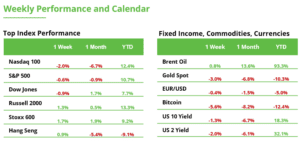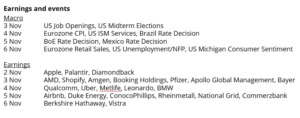


Big tech’s spending spree is testing investors’ patience. The Nasdaq 100 briefly entered correction territory, as doubts grew over when AI investment would translate into cash. Meanwhile, gains in healthcare and energy suggest the selloff is also creating room for new market leaders.
Alphabet’s negative quarterly free cash flow, Amazon’s spending overshoot and Intel’s disappointing outlook helped trigger the recent tech selloff. Investors are questioning how quickly AI spending will pay off, alongside concerns about chip demand and supply constraints.
Microsoft’s strong cloud growth offered a brighter picture, suggesting demand for AI services remains robust. But growing sales alone are no longer enough: investors want to see cash left over after the infrastructure bills are paid.
How companies fund that spending also comes under scrutiny in a higher cost of capital world. More borrowing adds interest costs, while issuing shares can dilute existing shareholders, another pressure on already nervous equity investors.
The next dividing line could be between companies that can fund expansion from their own cash generation and those increasingly reliant on raising fresh capital.
Rotation is happening, but needs to prove itself
Equal-weight equities remain below their peaks. Nevertheless, gains in healthcare and energy, improving insurance trends and resilience in selected industrials suggest opportunities beyond the largest technology names.
Healthcare and energy stand out most clearly in recent sector performance. Healthcare’s participation is particularly strong, with around 88% of constituents above their 200-day moving averages.
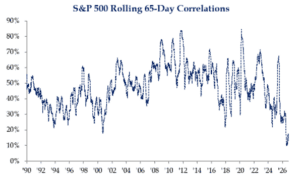
Correlations between stocks also remain relatively low. Broad liquidation usually brings a jump in correlations as investors sell across sectors. That signal has not yet confirmed a wholesale retreat, although correlations move slowly.
The next test is whether these emerging leaders retain their gains when technology comes under further pressure.
Which sectors can handle higher rates?
Healthcare, including large drugmakers such as Eli Lilly and Gilead Sciences, offers essential demand and growth driven by new treatments. Prefer financially strong businesses; heavily indebted healthcare providers have less protection from higher borrowing costs.
Banks could benefit as income from loans rises faster than the interest paid to depositors. Banks with stable, low-cost deposits look better placed, provided higher rates do not trigger a sharp slowdown and rising loan losses.
Energy offers opportunities among financially strong oil and gas companies such as ExxonMobil and Chevron, which can fund investment from their own cash flow. Be more cautious about fuel refiners, following sharp share-price gains and signs of weakening refining margins.
Payment services and selected software, including Visa, Mastercard, Palo Alto Networks, offer another approach. Payment networks benefit from ongoing transaction activity, while cybersecurity companies provide protection customers find difficult to cut. Their businesses depend less directly on rate relief, although their share valuations remain sensitive to yields.
These are starting points for selection, rather than blanket sector endorsements.
The weak borrowers are showing strain
Around 10.7% of technology leveraged loans are trading at distressed levels, versus roughly 5% across the broader loan index. Technology’s distressed share exceeds its COVID-era level.
Financing some data-centre projects is becoming more expensive as lenders demand greater compensation for risk. The pressure is most concerning for borrowers that depend on continued access to debt to fund their expansion.
The danger is that financing stress starts restricting investment, then spreads to suppliers and employment.
Earnings are the cushion
Recent earnings growth around 30% makes an outright bearish stance difficult. The Fed held rates, and the ten-year yield sits near 4.93%.
Higher yields can remain manageable while profits deliver. The more dangerous combination is expensive borrowing alongside falling earnings expectations.
Portfolio Takeaway: Keep the horizon longer than the headlines
Drawdowns are part of investing, but they can reveal risks that rising prices made easy to overlook. Use this one to reassess concentration and ask which businesses can keep delivering if funding stays expensive.
The aim is to own companies you can hold through uncertainty because their finances and earnings support your conviction. A cheaper share price helps; a business that can fund its own future matters more.
Big Show, Weak Numbers? Tesla Has to Deliver
The spectacular presentation of the new Tesla Roadster 2 with SpaceX thrusters has made major headlines. However, ahead of Tesla’s quarterly results on Wednesday after the market close, the event could also serve as a distraction. Other factors will matter more.
What Investors Should Watch at Tesla
- Vehicle deliveries and revenue
- Margins amid inflation and price competition
- Progress in autonomous driving and robotics
- Consumer sentiment as an indicator of consumer demand
- Free cash flow after the billions invested in AI data centers
Analysts expect revenue of around $27.8 billion. Earnings per share are expected to fall to around $0.44 to $0.45. The key question is how much cash Tesla actually generates after its heavy investment spending.
Technical Recovery at Risk
Tesla shares fell 7.3% last week to $355 and moved back below the 20-week moving average at around $366. It is still trading around 20% above its July low. Prior to this, the stock had formed an ABC correction after reaching a record high of $496 in December 2025.
For the chart to improve sustainably, Tesla must overcome several resistance levels. First, the stock needs to reclaim the 20-week moving average, followed by the 50-week moving average at $396. Above that, an important resistance zone awaits around $410.
In the short-term, the risk of another decline toward the July low has increased. Buyers need further confirmation before a medium-term change in direction can be discussed.
SpaceX will also release its results on Tuesday after the US market close.
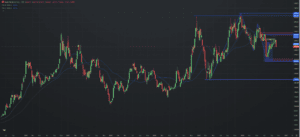
Tesla, weekly chart. Source: etoro
Credit Markets Are Getting Nervous
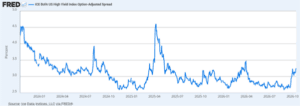
The US High Yield OAS shows the additional interest premium investors demand for US corporate bonds with low credit quality compared with US government bonds. A narrow spread signals limited concern about risk, while a wider spread points to growing worries about defaults, financing and the economy.
The spread currently stands at around 3.2 percentage points, up from approximately 2.6 percentage points at the end of August. This level is not yet alarming from a long-term perspective. However, the sharp increase shows that credit markets are becoming more cautious.
Rising spreads make financing more expensive for companies with high capital needs. This particularly affects the expansion of data centers, chip production and other areas of AI infrastructure. Higher financing costs can weigh on investment, margins and expected earnings.
The credit market is therefore becoming an important stress test for the AI story. Strong revenue growth is not enough if that growth becomes too expensive or difficult to finance.
A significant widening of the spread would signal lower risk appetite and higher default risks. A level of 4% or more would be a much stronger warning signal, although it would not automatically mark a crisis threshold. Investors should therefore assess the spread together with bond yields, credit default swaps, banks and corporate guidance.
A further increase could weigh particularly on highly valued technology stocks. Companies with high debt, weak cash flow or major investment needs would be especially vulnerable. Stabilization in the spread, on the other hand, would provide short-term reassurance for equity markets.
For long-term investors, the key question is whether the widening spread remains a normal repricing or develops into broader credit stress.
Bitcoin’s resilience deserves attention, even as ETF outflows continue
A major hack at a centralised platform has added uncertainty to an already weak market. Yet bitcoin’s initial reaction has been relatively contained given the scale of the incident.
So far, the episode appears more contained than past industry failures that spread through interconnected lenders, platforms and counterparties. That remains a provisional assessment. Restoring withdrawals and providing credible reserve disclosures will matter.
The market’s ability to absorb bad news is encouraging. Whether that resilience lasts is the next test.
Bitcoin is trading around $77,300, down 7.6% in October. Ethereum is near $2,240, down 16.4%
Four points matter for investors
- ETF outflows remain significant
On Friday, bitcoin ETFs recorded $643 million in net outflows, while ethereum ETFs lost $155 million. ETH outflows for October exceed $1 billion.
Those figures make bitcoin’s relatively contained reaction worth watching. The next sessions will show whether redemptions ease or continue to weigh on prices.
- Recent holders are close to their cost basis
The estimated short-term holder cost basis is around $75,900. This on-chain metric covers coins that last moved within 155 days and approximates their acquisition cost.
With BTC near $77,300, the cohort’s aggregate unrealised gain is barely 2%. A sustained move below that reference would put recent holders into an aggregate unrealised loss and could increase selling pressure.
The $76,000 area is therefore an important test of recent holders’ conviction, rather than a guaranteed floor.
- Leverage has declined, but risks remain
Liquidations reached $1.57 billion, while open interest fell 3% to $136.3 billion. Some exposure has been cleared, although BTC funding remains positive.
Long positions are still paying shorts. That does not predict a decline, but another break lower could trigger further long liquidations.
Around $76,300 is the immediate technical reference, close to the short-term holder cost basis. On the upside, $78,670 is an initial level to reclaim and hold.
- Ethereum has yet to show the same relative strength
ETH/BTC has fallen from 0.0319 at the start of October to roughly 0.029. Ethereum continues to lose ground against bitcoin while its ETFs face redemptions.
Tokenisation and new applications may support its longer-term case, but stronger relative performance has yet to follow.
Bitcoin has absorbed a serious security shock without a proportionate price collapse so far. That is useful information. Holding near recent holders’ cost basis, avoiding wider contagion and seeing ETF outflows moderate would give that resilience more substance.