



The Daily Breakdown takes a closer look at Deere, a stock that has fluctuated amid changing business environments. Interested in more Deep Dive content? Check out our latest research.
Deep Dive
John Deere is a global equipment maker serving agriculture, construction, forestry, landscaping, and turf-care markets. It sells machinery like tractors, combines, sprayers, excavators, loaders, and roadbuilding equipment, while also offering financing to support equipment sales and leases.
And think we’re just talking about tractors? No, Deere also has an AI component too. Its “sense-and-act” technology uses machine learning to help equipment understand its surroundings and make real-time decisions, while See & Spray uses computer vision, cameras, robotics, and fast processing to identify weeds and spray only where needed — reducing chemical use and making the farm a lot smarter.
Deere stock got off to a strong start this year, rallying more than 40% by mid-February. Since then, shares have given back a chunk of those gains and are now up a more modest 15% on the year. That leaves investors weighing whether the pullback is creating an opportunity — or signaling caution.
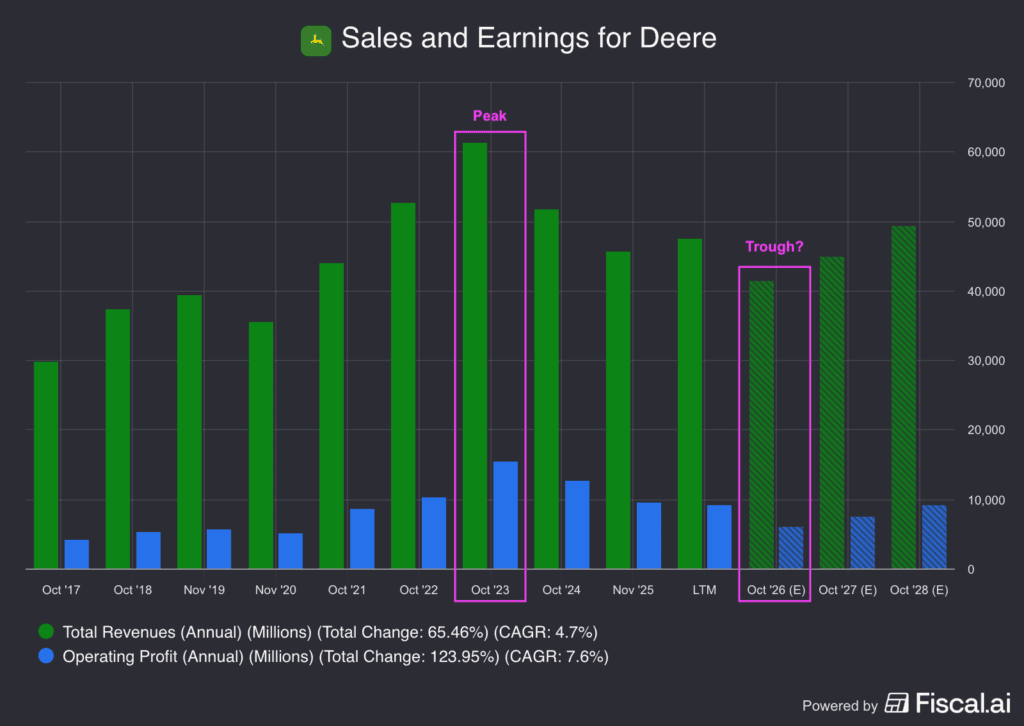
Deere’s business can be lumpy. Fiscal 2023 marked a peak for both earnings and revenue, while softening crop prices, elevated interest rates, and more normalized demand for large-ag equipment have weighed on recent results. Analysts are modeling an eventual rebound, but the key question is whether fiscal 2026 represents the trough for the business.
Future Growth Projections
Deere’s fiscal year ends in October, meaning fiscal 2027 will begin in November. While expectations are less promising for 2026, analysts expect a notable acceleration in the following years. According to Bloomberg, analysts project the following:
- Earnings Growth: -2.6% in 2026, 26.7% in 2027, and 25.5% in 2028
- Revenue Growth: 6.5% in 2026, 8.3% in 2027, and 9.5% in 2028
Analysts currently have a consensus price target of ~$618 on DE stock, implying about 15% upside to today’s stock price.
Want to receive these insights straight to your inbox?
Diving Deeper — Valuation
Valuation is another key piece of the debate. Historically, Deere has often traded at a lower earnings multiple, with trough valuations near 12 times earnings and prior peaks around 25 times. In recent years, though, the multiple has moved above that range, suggesting the market may be giving Deere more credit for its scale, margin profile, and technology-driven growth potential.
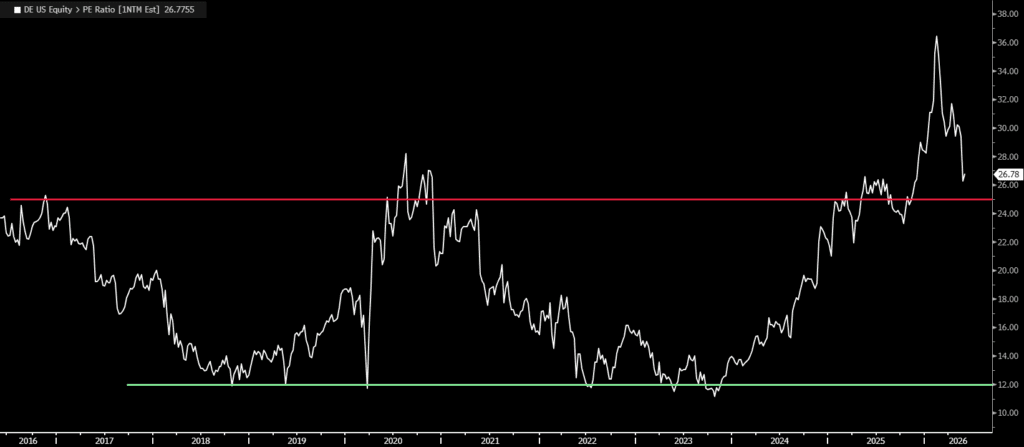
That creates a more complicated setup. On one hand, the stock looks expensive relative to its own history. On the other hand, investors may be willing to pay a higher multiple if they believe Deere can deliver the earnings rebound analysts expect in fiscal 2027, 2028, and beyond.
Risks
Deere’s top risks are cyclical demand, farm income pressure, and execution through a downcycle: when crop prices fall, interest rates stay high, or farmer confidence weakens, customers delay big-ticket purchases. The company also faces risks from tariff and trade uncertainty, input-cost inflation, supply-chain disruptions, and competition from both traditional equipment makers and tech-forward ag players. Longer term, Deere needs to prove that its precision-ag, autonomy, and AI investments can keep expanding margins and customer value, especially if the core machinery cycle remains soft.
The Bottom Line
Deere remains a high-quality industrial leader with a powerful brand, global scale, and a growing technology angle that extends well beyond traditional farm equipment. At the same time, the business is moving through a softer part of the cycle, with demand, earnings, and valuation all central to the debate. The key question is whether fiscal 2026 represents a trough, setting the stage for the growth analysts expect in 2027 and 2028 — or whether the current valuation already reflects much of that rebound.
Disclaimer:
Please note that due to market volatility, some of the prices may have already been reached and scenarios played out.