



The Daily Breakdown dives into the semiconductor trade, exploring the SMH and SOXX ETFs as AI fueled this semiconductors to a record quarter.
Interested in more Deep Dive content? Check out our latest research.
Deep Dive
So far, 2026 has been the year of semiconductor stocks. In the second quarter alone, the Philadelphia Semiconductor Index surged more than 87%, marking its best quarterly performance on record. The rally has been fueled by strong AI demand, providing a major lift to chipmakers, semiconductor suppliers, and memory companies.
The two largest US-listed semiconductor ETFs are SMH and SOXX, with roughly $70.6 billion and $45.9 billion in assets under management, respectively. Both have delivered exceptional returns across multiple time frames:
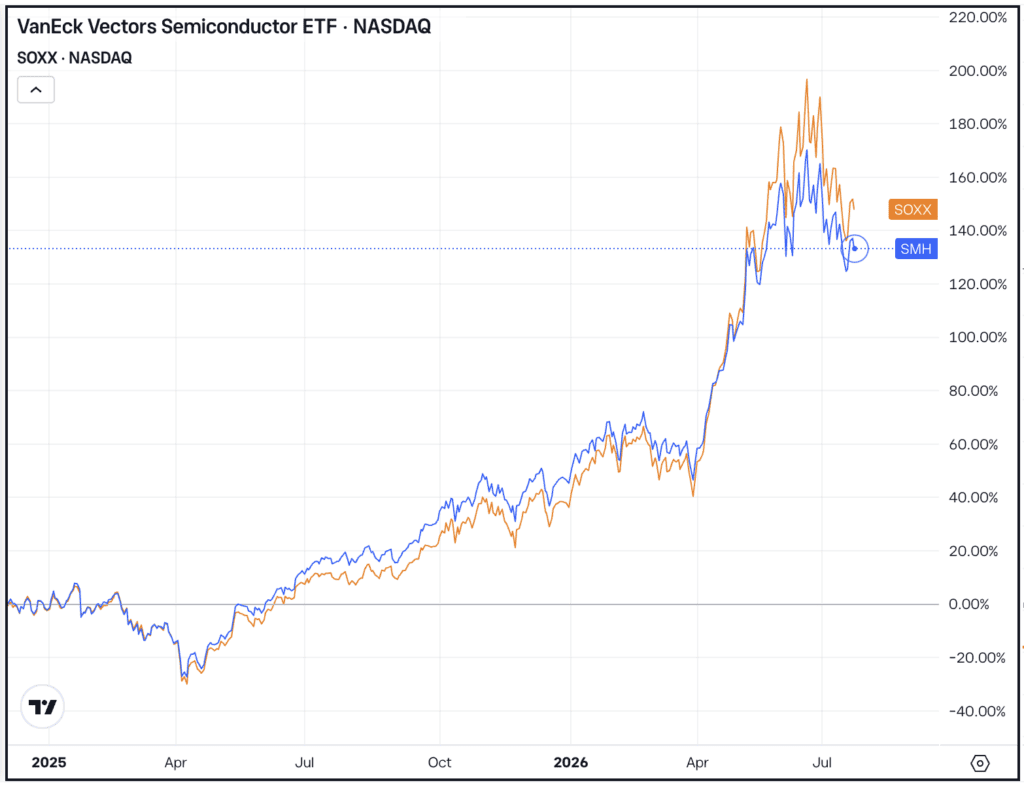
SOXX holds the performance edge over the past year, gaining approximately 127% versus 102% for SMH. However, SMH has delivered stronger returns over the prior three- and five-year periods, rising 279% versus 227% and 362% versus 283%, respectively.
Allocation and Analyst Outlook
The performance gap largely reflects how each fund is weighted.
SMH’s five largest holdings are Nvidia (20.8%), Taiwan Semiconductor (9.2%), Broadcom (6.2%), Advanced Micro Devices (6%), and Micron (5.3%).
SOXX’s five largest holdings are Advanced Micro Devices (8.9%), Nvidia (8.3%), Micron (8.2%), Broadcom (7.4%), and Intel (5.4%).
SMH carries heavier exposure to several of the industry’s largest companies, including Nvidia, Taiwan Semiconductor, and Broadcom. Its Nvidia allocation is also more than double that of SOXX, helping support SMH’s stronger long-term returns. More recently though, SOXX has benefited from its larger allocations to AMD, Micron, and Intel, all of which are up at least 100% year to date.
Analyst expectations are similar for both ETFs. For the SMH ETF, they have a consensus price target of ~$749, implying about 30% upside. Meanwhile, analysts have a ~$692 price target on the SOXX ETF, implying about 27% upside to today’s stock price.
Want to receive these insights straight to your inbox?
Diving Deeper — Valuation
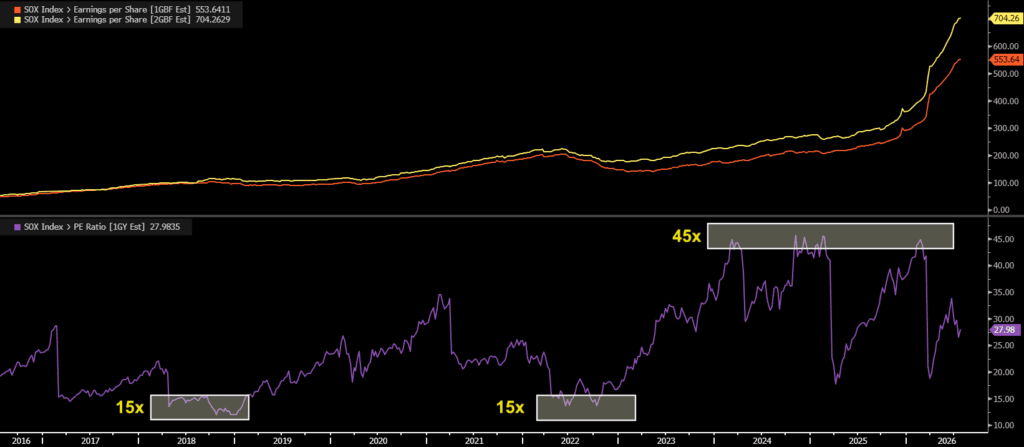
When we look at the Semiconductor Index, valuation has been volatile (due to the assets’ underlying volatility) but has generally peaked near 45 times forward earnings. Over the past decade, support has often emerged around 15 times, though that floor has been closer to 18 times over the past two years. The chart also shows a sharp rise in earnings expectations for both this year and next.
Risks
Semiconductor investors face several key risks, including heavy dependence on hyperscaler spending from companies such as Microsoft, Amazon, Alphabet, and Meta. If AI infrastructure budgets slow, chip demand and earnings expectations could reset quickly. The industry is also exposed to export controls, tariffs, supply-chain disruptions, elevated valuations, shifting pricing power, and rapid technological change that can alter market leadership.
The Bottom Line
Semiconductors remain one of the strongest areas of the AI trade, but the group may not be suitable for every investor, particularly those with a lower tolerance for volatility. Valuations remain below prior peaks but well above historical lows, while sentiment and market leadership can shift quickly. The long-term opportunity may remain intact, but recent gains should be weighed against the potential for sharp pullbacks, weaker demand, and elevated expectations.
Disclaimer:
Please note that due to market volatility, some of the prices may have already been reached and scenarios played out.