

Markets are getting choppier, but the weakness is uneven. Big tech is losing momentum while healthcare, financials and parts of the consumer sector show resilience. For investors, the question is whether those emerging leaders can withstand a broader selloff.
Selling gets louder
- Thursday brought a broad retreat: roughly seven stocks fell for every one that rose, the weakest reading since October 2025. Investors also stepped up demand for protection against further losses.
- Nerves alone don’t signal a bottom. Sentiment has cooled, but the S&P 500 and Nasdaq 100’s weakening trends suggest that a rebound would need more evidence behind it.
The average stock holds up better
- Size matters. The equal-weight S&P 500, which gives each company the same influence, is holding up better than the tech-heavy Nasdaq 100. It outperformed the traditional S&P 500 by 3.2% through October.
- Why that matters: market returns could become less dependent on a handful of giants. Historically, this kind of relative strength has often continued into the following year, although outperformance can still mean losing less in a falling market.
Healthcare takes the lead
- The gap is striking: 90% of S&P 500 healthcare stocks were above their average price over the past 200 trading days, compared with just 37% of technology stocks.
- Financials are improving too, along with consumer shares, showing encouraging momentum, although their longer-term trends need more work.
Energy hits turbulence
- Another weak spot: refiners have quickly fallen around 20% from their highs, while smaller energy companies are also struggling. Recent weakness challenges energy’s place among the market’s stronger sectors.
Investment takeaway: Use changing leadership to review concentration. An equal-weight approach can spread exposure beyond the largest technology companies, while healthcare’s resilience and improving financials warrant closer attention. Consumer shares need more confirmation, and energy’s weakness argues for selectivity. Keep the distinction between relative strength and protection: sectors holding up better can still fall in a broader selloff. Favour businesses with reliable cash generation, manageable debt and reasonable valuations. Rebalance gradually, leaving room to add if broader market strength develops, rather than treating the first rebound as confirmation that the correction is over.
US Midterm Elections Results: Implications for Investors
The US midterm elections could bring important changes for data centres, healthcare, defence and fiscal policy. A divided Congress may make it harder to pass major legislation, but changes at the state level and negotiations over government spending could still have a meaningful impact on certain sectors.
-
Data centers: Political risks are not fully priced in
The political environment is becoming less favourable for data-centre development. Both Democrats and Republicans are increasingly questioning new projects, particularly at the state level.
- Texas: Around 25% of the US data-centre development pipeline is linked to the state. A proposed moratorium on new projects could put a significant amount of planned capacity at risk.
- Georgia and Ohio: New governors could introduce higher taxes and tighter restrictions on data-centre construction.
- Federal policy: Democrats could push to remove a tax break that lets data-centre companies deduct their investment costs immediately, making new projects more expensive.
What it means for investors: Higher taxes, fewer tax benefits and tighter construction rules could make new data centres more expensive to build and less profitable.
Data-centre stocks have already reflected some of these concerns since July, but the risks may not be fully priced in.
We think that the impact may vary across companies. Restrictions on new data centres could make existing computing capacity more valuable, potentially benefiting hyperscalers such as Microsoft, Amazon and Alphabet, which already operate large data-centre networks. On the other hand, developers such as IREN, Applied Digital and Hut 8 could face delays and higher costs as they build new facilities. Chipmakers such as Nvidia and AMD, along with cooling and electrical equipment suppliers like Vertiv and Eaton, could also face slower demand if fewer data centres get built.
The key difference is between companies that already have computing capacity available and those relying on new data centres being built.
-
Healthcare: More regulation, but major changes may be difficult
Healthcare is likely to be one of the first priorities for Democrats. They are expected to focus on protecting Medicaid funding and bringing back Affordable Care Act subsidies, which help people afford health insurance.
At the same time, proposals to lower drug prices and introduce tighter rules for Medicare Advantage are likely to return.
What it means for investors:
- Hospitals: Protecting healthcare coverage could mean more insured patients and fewer unpaid medical bills, supporting hospital finances.
- Health insurers: Companies with large Medicare Advantage businesses could face pressure from tighter rules and potential changes to payments.
- Pharmaceuticals: Renewed efforts to lower drug prices could put pressure on profits and share prices.
Many of these proposals may never become law. However, even the prospect of tougher regulation could weigh on investor sentiment.
The key point is that healthcare should not be treated as one sector. Hospitals could benefit from greater insurance coverage, while insurers and drugmakers face different risks.
-
Defence: Higher spending may be harder to deliver
The administration is likely to push Republicans to raise the debt ceiling and approve higher defence spending before Democrats take office.
However, reaching an agreement may prove difficult.
What it means for investors: Defence companies have benefited from expectations of higher military spending, but those increases may take longer to materialise than expected.
This does not necessarily mean defence budgets will fall. The bigger risk is that spending rises more slowly than investors anticipate.
Companies relying on new government contracts could be more exposed to delays, while those with established, long-term contracts may be better protected.
-
Fiscal policy: More political gridlock
A divided Congress could make negotiations over government borrowing, spending and taxes more difficult.
The debt ceiling could become an important bargaining tool, with Democrats potentially demanding changes to tax benefits in exchange for supporting an increase.
What it means for investors: The impact may be greater for individual sectors than for the overall stock market.
Companies that rely heavily on tax incentives or government spending could face more uncertainty. Data centres are one example, given the potential removal of their upfront tax deductions.
Even if proposed changes never become law, uncertainty could make companies more cautious about committing to large investments.
-
The potential market surprise: AI growth faces political obstacles
Investors have spent much of the past year asking whether companies are spending too much on AI and whether those investments will generate sufficient returns.
A different risk is now emerging: what if companies want to build more AI infrastructure but face growing political obstacles?
Higher taxes, restrictions on construction and delays in approvals could slow data-centre development even if demand for AI continues to grow.
This could create divergences within the sector.
Companies that already operate data centres, have access to electricity and hold the necessary approvals could be in a stronger position. Developers that still need to build large amounts of new capacity may face higher costs and delays.
However, existing operators would not be completely protected, particularly if higher taxes and operating costs affect the whole industry.
The investment question is whether markets have fully accounted for the possibility that political restrictions, rather than weak demand, could slow AI infrastructure growth.
Main Investment Takeaways: The elections could bring different risks and opportunities across sectors.
- Data centres: Higher taxes and tighter development rules could put further pressure on stocks, with some risks not yet fully priced in.
- Healthcare: Hospitals could benefit from efforts to protect insurance coverage, while drugmakers and Medicare Advantage insurers face the prospect of tougher regulation.
- Defence: Higher military spending may take longer to deliver, creating a risk for companies where expectations are already high.
- Fiscal policy: Debt-ceiling negotiations could create uncertainty around government spending and existing tax benefits.
The broader investment takeaway is that political changes do not need to become law to affect markets. The prospect of higher costs, tighter regulation or delayed spending can influence company investment plans and share prices well before any final decision is made.
For investors, the important question is which risks are already reflected in valuations and where there may still be room for disappointment,
Nasdaq 100 in Correction Territory – Buying Opportunity or Warning Signal?
The Nasdaq 100 fell 5.5% last week to around 26,900 points and closed below its 50-week moving average at 27,480 points.
A weekly close below the 50-week moving average is particularly important for two reasons. First, it happens relatively rarely. Second, similar situations in recent years often created attractive entry opportunities. The key question now is how long the index will remain below the moving average.
The chart shows that the duration can vary significantly, as illustrated by the purple rectangles. After the 2020 coronavirus crash and Trump’s tariff announcements in 2025, the Nasdaq 100 recovered relatively quickly and resumed its uptrend. In 2022, however, the index remained below the 50-week moving average for longer during a gradual, multi-wave sell-off.
Investors should therefore watch for reversal signals. A move back above the July low at around 27,060 points, followed by a return above the 50-week moving average, could help stabilise the market. Until that happens, the risk of further declines remains.
The Nasdaq 100 is currently around 14% below its record high and is therefore officially in correction territory. The most important support level is the double top formed in January at 26,250 points. This area was already tested last week. If it fails to hold, the next important level is much lower, at the March low of around 22,800 points.
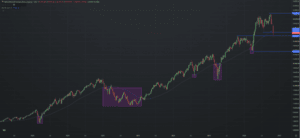
Nasdaq 100, weekly chart. Source: etoro
Could Q3 Results Trigger a Breakthrough for Siemens Energy?
Siemens Energy will publish its Q3 results on Wednesday. After the recent market turmoil, the stock has become a test of the resilience of major trends such as infrastructure, AI and geopolitics.
The correction in US technology stocks was driven by concerns that tech companies could scale back their massive infrastructure investments as returns from AI take longer to materialise. Siemens Energy supplies transformers and grid technology for data centers, making it a key bottleneck in the AI boom.
Following the Democrats’ election victory, local moratoriums on data-center construction are a risk in the US. During the earnings call, investors should therefore listen closely for any indications of delays to major US projects. Persistently high bond yields are also relevant. Siemens Energy’s customers, including grid operators, utilities and wind-farm developers, often finance multibillion-euro projects over many years. Higher financing costs could slow these projects down.
The stock fell 6.4% last week to €118.40 and temporarily reached €110.90, its lowest level in around a year. It is now almost 40% below its record high.
The technical picture therefore remains tense. The 20-week moving average has crossed below the 50-week moving average. However, such signals often appear with a delay. The continued downward trend structure is therefore more important.
If the stock continues to fall, the next support levels are at €100 and €94. These levels mark higher lows from the 2025 uptrend. To signal a trend reversal, Siemens Energy would first need to break above the high at €138. The stock tested this level several times during the year and initially held it as support, but eventually broke below it in October. The question now is whether buyers can regain control at this level.
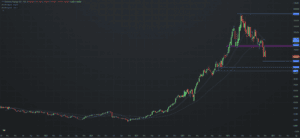
Siemens Energy, weekly chart. Source: etoro
Bitcoin and Ethereum in a market with less liquidity
Our base case for the next few weeks is that bitcoin continues to consolidate. However, we see a greater risk of another leg down than of a sustained recovery.
Spot bitcoin ETFs ended the week with $1.28 billion in net outflows. Stablecoin market capitalization also fell 2.2% over seven days, pointing to less potential liquidity in the crypto market. If both trends persist, a rebound will be harder to sustain.
On November 4, only 38% of the bitcoin held by short-term holders was in profit. On Friday, coins from that group that moved on-chain did so, in aggregate, at a slight loss. If the price returns to their entry levels, some recent buyers may use the opportunity to exit, slowing the rebound. We would look for the rally to hold, a larger share of those coins to move back into profit, and ETF outflows to ease.
For Ethereum, the question is whether ETH can regain ground against BTC. If bitcoin rebounds and ETH lags, the recovery will remain concentrated in bitcoin. If ETH outperforms for several sessions and other liquid crypto assets follow, that would point to a broader recovery. Over the longer term, fund tokenization is expanding institutional use of ethereum. Its impact will depend on how much capital is managed through the network and how much activity it generates.
Over the next two to four weeks, we estimate a 50% chance of consolidation, with flows stabilizing and recent buyers hovering near break-even. We assign a 30% chance to a deeper decline if ETF redemptions persist and realized losses rise on-chain. The remaining 20% goes to a firmer recovery, with improving flows, more short-term holdings back in profit, and ETH regaining ground against BTC.
The next US inflation report could move the dollar and bond yields. We’ll watch what happens in the sessions that follow. If the rebound holds and flows improve, we’ll give the recovery scenario more weight. If prices rise while outflows continue, we’ll remain cautious.