






JPMorgan stock has stumbled 15% from its highs, as this high-quality bank saw its valuation stretch. The Daily Breakdown zeroes in.
Before we dive in, let’s make sure you’re set to receive The Daily Breakdown each morning. To keep getting our daily insights, all you need to do is log in to your eToro account.
Deep Dive
The 2008 financial crisis dealt a crippling blow to the US banking industry, but the biggest players emerged larger and more dominant than ever. The largest of them all is JPMorgan, which commands a $775 billion market cap. Founded in 1799, JPMorgan is a diversified global financial-services firm, with its businesses spanning consumer banking, credit cards, mortgages, investment banking, commercial lending, payments, securities services, and investment management for both institutions and individuals.
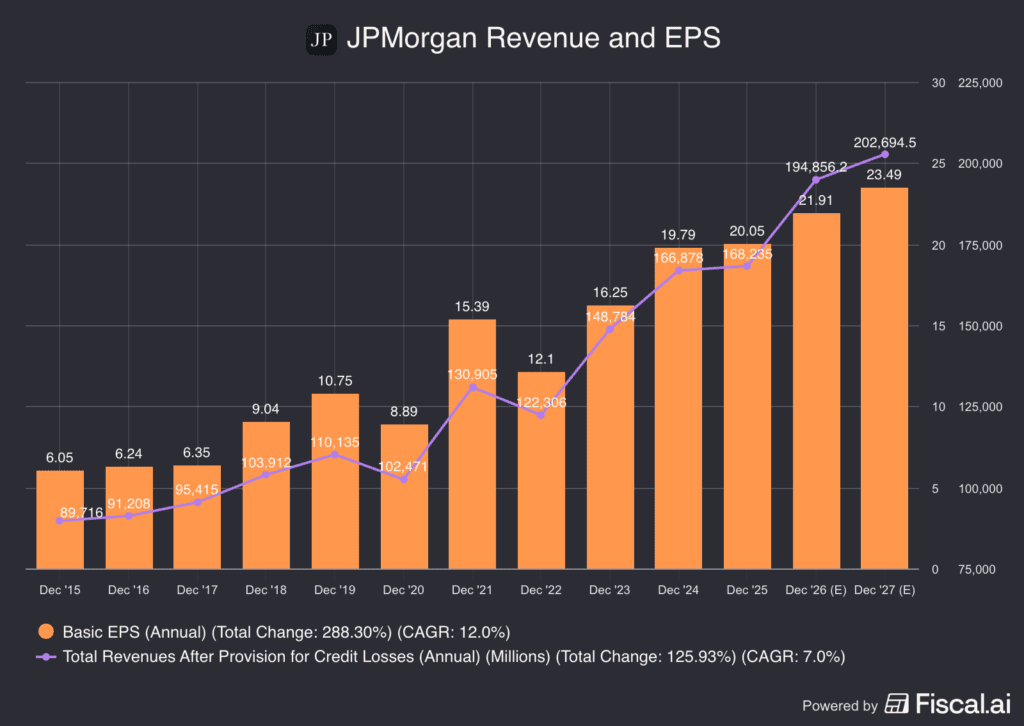
The company got to its size by consistently growing its earnings and revenue. While JPMorgan’s business experienced some volatility from 2020-22, its growth since has reassured investors.
Future Growth Projections
Growth estimates for JPMorgan have been inching higher this year, but still call for fairly modest growth. According to Bloomberg, analysts project the following:
- Earnings Growth: 5.9% in 2026, 7.9% in 2027, and 9.8% in 2028
- Revenue Growth: 5.5% in 2026, 4.7% in 2027, and 5% in 2028
Analysts currently have a consensus price target of ~$347 on JPM stock, implying about 20% upside to today’s stock price.
Want to receive these insights straight to your inbox?
Diving Deeper — Valuation
On Thursday, US regulators proposed easing capital requirements for banks, a move that could let the largest banks hold about $20 billion less in capital on average and potentially free up more lending while helping them compete with private-credit firms. Supporters say it will strengthen traditional bank lending, while critics warn it could weaken safeguards and spark a broader decline in global banking standards. Overall though, it’s being viewed as a positive for banks like JPMorgan, Bank of America, Wells Fargo, and Citigroup, among others.
Even with that good news though, some investors may still have questions about valuation.
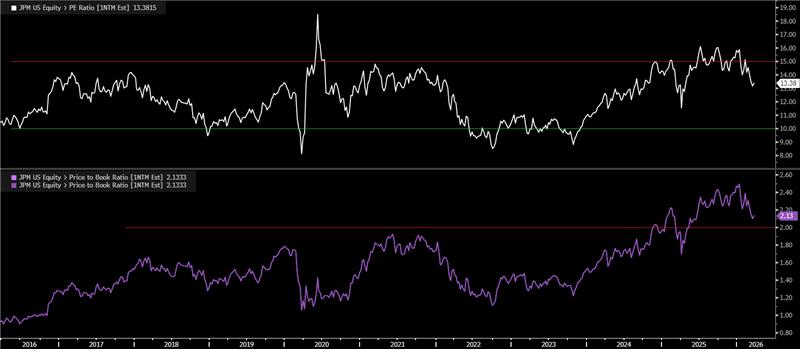
On a forward price-to-earnings basis, JPM stock may not look especially expensive, particularly with the S&P 500 trading above 20x earnings. However, history suggests JPM tends to look relatively expensive around 14x to 15x earnings, while dips toward 10x have generally marked more attractive entry points. Price-to-book is also an important valuation metric for banks, and on that basis, JPMorgan has rarely traded above 1.7x to 2.0x book value — but it recently climbed to about 2.5x, its highest level in at least 25 years.
Risks
JPMorgan is a high-quality bank, but it is still exposed to the same core risks that drive bank stocks: a weaker US or global economy can pressure the business. On top of that, private credit is an emerging watchpoint — not necessarily because JPMorgan sits at the center of the risk, but because stress in that market could expose issues that spill back into broader credit conditions. Jamie Dimon has warned there may be more “cockroaches” there, which is another way of saying early cracks can reveal deeper problems.
The Bottom Line
Financials have been the worst-performing sector so far this year, down about 10% in 2026. Meanwhile, JPMorgan has fallen nearly 15% from its record high in early January.
The pullback has helped ease some valuation concerns, and growth expectations have continued to trend higher, but the stock still does not look outright cheap by historical standards. Add in lingering macro and geopolitical uncertainty — plus potential spillover risks in areas like private credit — and it is easy to see why some investors may still be hesitant to step in aggressively. Conversely, the highest quality firms rarely come at a steep discount.
Disclaimer:
Please note that due to market volatility, some of the prices may have already been reached and scenarios played out.