






Analyst Weekly, March 23, 2026
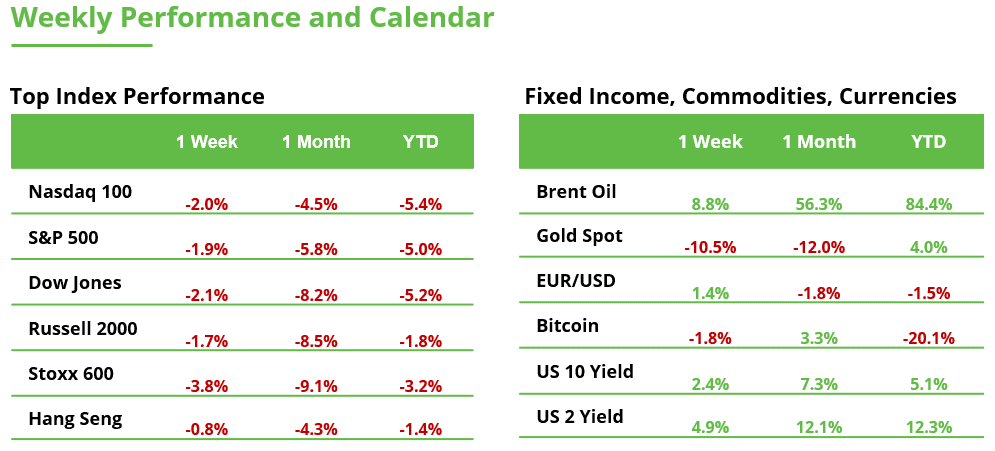
Markets are increasingly being driven by a single force: energy. As tensions in the Middle East disrupt supply routes and push energy prices higher, asset prices are moving less on fundamentals and more on exposure to that shock.
In this environment, not all regions will react equally. Those tied to energy imports are facing pressure, while exporters, and more broadly, commodity-linked markets, are starting to behave differently.
Latin America: From high beta to macro lever
Latin America has historically been characterised as a higher-beta segment of global equities. But so far in 2026, it has behaved differently.
While global equities wobble on geopolitics and rate uncertainty, Latam is quietly leading emerging markets, up around 7% year-to-date, supported by commodity exposure, improving policy dynamics, and still undemanding valuations.
That shift is not coincidental. The current macro environment is increasingly being driven by energy dynamics and supply-side shocks, and Latin America is structurally positioned within that trend. The opportunity sits at the intersection of a near-term macro shock and a longer-term structural shift toward real assets.
Valuations: a supportive backdrop
From a valuation perspective, the region remains constructive.
Markets across LatAm have de-rated in recent weeks, with most countries now trading below their long-term average multiples, while earnings expectations have held relatively steady.
In our view, this creates a more balanced setup, where,
- Prices have adjusted
- Earnings have not meaningfully deteriorated
Investment Takeaway: That combination provides a degree of valuation support, particularly relative to more crowded global equity markets.
Real assets are back in focus
At the core of the Latam story is its exposure to real assets.
The region is a key supplier of:
- Energy (with a significant share of global reserves and exports)
- Industrial metals such as copper (Chile, Peru)
- Strategic materials like lithium and rare earths (Chile, Argentina, Brazil)
- Agricultural commodities
In a market shaped by supply constraints and geopolitical fragmentation, these exposures have regained relevance. Importantly, Latam indices are not neutral: energy alone represents a meaningful share (around 9%) of the benchmark, allowing the region to translate commodity strength directly into equity performance.
Investment Takeaway: For retail investors, this shows up across both indices and instruments. Benchmarks like MSCI Latam and country indices such as Brazil’s Bovespa or Mexico’s IPC reflect this commodity tilt. Access can be gained through ETFs like iShares MSCI Brazil ($EWZ) and iShares Latin America 40 ($ILF), or via individual names tied to the cycle.
Among those, large-cap exposures such as Petrobras, Vale, and Gerdau capture energy and materials, while companies like Cemex offer leverage to infrastructure and construction. At the same time, more domestically linked or cyclical names such as Embraer, Localiza, and LATAM Airlines, reflect the recovery and growth side of the story.
Brazil as the portfolio anchor
Within Latin America, Brazil stands out with:
- Direct leverage to commodities
- A central bank transitioning toward easing
- Continued foreign investor participation
This alignment between external tailwinds (commodities) and domestic policy (rate cuts) is relatively rare across emerging markets.
Flows have remained relatively resilient, particularly in Brazil, suggesting positioning is building but not yet stretched.
Brazil also represents a broad cross-section of opportunities at the stock level. Recent market volatility has led to pullbacks across several names, including Embraer, JBS, Santander Brasil, XP, spanning industrials, consumer, healthcare, and financials.
For investors, Brazil often becomes the core allocation, accessed through ETFs or diversified exposure to these large and mid-cap names.
Understanding the risk
Latin America remains a cyclical allocation, with two key sensitivities:
- A stronger US dollar
- A deterioration in global risk sentiment
Historically, the region underperforms during periods of USD strength, even if commodity dynamics remain supportive. A sharp reversal in oil prices or a sustained USD rally would likely weaken the relative case for the region.
From a portfolio perspective, this introduces a currency dimension to the trade. Some investors may choose to leave FX exposure unhedged to capture potential upside from commodity-linked currencies, while others may partially hedge FX risk to isolate the equity component and reduce volatility.
Investment takeaway
For investors, Latin America is best understood as a selective allocation within a broader portfolio, rather than a standalone call.
It can play multiple roles:
- A diversifier away from US-heavy equity exposure
- A commodity-linked sleeve in a supply-driven macro environment
- A differentiated entry point into emerging markets, with distinct drivers
Implementation can vary, from broad ETFs and large-cap equities to more thematic exposures.
Defensive Positioning Dominates, but the Structural Story Is Advancing
The crypto market is in a transition phase where weak sentiment contrasts with a strengthening structural backdrop.
Positioning is clearly defensive. Fear & Greed sits at 27 (fear), total market cap has pulled back to ~$2.44T, and volumes remain moderate, suggesting no aggressive dip-buying yet. BTC dominance has risen to ~56.3%, reinforcing the idea of capital rotating into safety while altcoins underperform.
ETF flows are also telling: weekly flows have come in broadly flat, pointing to a pause in institutional momentum rather than active accumulation. Combined with retail risk-off behavior, this explains the lack of upside follow-through.
Under the surface, however, the structural story is advancing. The Clarity Act is moving toward a potential agreement in the U.S., with bipartisan support and active negotiations between banks and crypto firms, particularly around stablecoin yield.
Stablecoins are at the center of this shift. Their growing role, especially on Ethereum, highlights where real adoption is happening. Capital is starting to differentiate between assets with actual utility and those driven purely by narrative.
The long-term thesis remains intact: integration into the financial system, expansion of stablecoins, and increasing institutional involvement. The market is not fully pricing this yet.
Technically, the setup is softer but still orderly. BTC losing $70K opens a move toward $65K, with $55K as the key structural level below. ETH needs to hold $2,000. These are reference zones that will determine whether this remains a controlled correction or evolves into a deeper move.
This communication is for information and education purposes only and should not be taken as investment advice, a personal recommendation, or an offer of, or solicitation to buy or sell, any financial instruments. This material has been prepared without taking into account any particular recipient’s investment objectives or financial situation and has not been prepared in accordance with the legal and regulatory requirements to promote independent research. Any references to past or future performance of a financial instrument, index or a packaged investment product are not, and should not be taken as, a reliable indicator of future results. eToro makes no representation and assumes no liability as to the accuracy or completeness of the content of this publication.