






Analyst Weekly, January 5, 2026
The year began with an unusually abrupt geopolitical headline: the US captured Venezuelan president Nicolás Maduro, possibly ending a regime investors had largely written off. The news will likely inject volatility into markets, especially oil, as geopolitics collide with energy supply, and this episode is no exception.
Venezuela currently accounts for only around 1% of global oil supply. If the country stabilises and sanctions eventually ease, any recovery in production would take place gradually over several years. That introduces medium-term downside risk for oil, as additional supply enters an already well-supplied market.
On the other hand, if instability drags on, global markets may still be relatively insulated. Previous US enforcement actions have already reduced Venezuelan exports without triggering sustained price moves. This suggests much of the disruption risk is already priced in, absent a broader escalation.
We think the investment implications are selective, slow-moving, and sit below the surface: in energy value chains, sovereign debt, and relative winners and losers, rather than in broad market direction.
US Majors: Optionality, but not an Immediate Growth Story
Energy equities may benefit tactically from oil volatility, but investors should separate option value from near-term fundamentals.
Major US oil companies may not commit capital to Venezuela until they see:
- A stable security environment
- Clear legal frameworks and credible contracts
- Competitive returns relative to other global opportunities
This also explains why Chevron remains the only US oil major with operations in Venezuela, and why broader US producer participation is unlikely in the near term without major changes in security, legal frameworks, and returns.
Investment Takeaway: Even in a constructive political scenario, rebuilding production may take years, not quarters. For investors, energy exposure should be viewed through the lens of balance-sheet strength, capital discipline, and diversification, rather than expectations of a rapid Venezuelan recovery.
Where the Impact May Show Up First: US Refiners
If Venezuela’s oil sector begins to normalize under the US influence, the earliest market impact may appear in refining, and not production.
Venezuela produces heavy, high-sulfur oil. That matters because many refineries along the US Gulf Coast were built to process this type of crude. Sanctions on Venezuela, and more recently Russia, forced many US refiners to replace heavy oil with alternatives that were often more expensive or less well suited to their refineries. That squeezed margins at times, especially for refineries built to process heavy crude.
Investment takeaway: If Venezuelan oil starts flowing more reliably again, even in small amounts, it could help expand refiners’ choices and improve economics at the margin. For investors, this is a margin story, not a volume story, as it doesn’t require a full recovery in Venezuelan production to matter. Heavy Venezuelan crude is typically sold at a discount and fits well with the most complex US refineries. US refiners like Valero, Chevron, PBF Energy and Phillips 66 are likely to feel the impact first, through better margins. This may be a gradual, incremental benefit, and not a sudden shift in the global oil market.
Who’s Insulated, and Who Could Face Pressure
A potential return of Venezuelan oil would not affect energy producers evenly.
Most US shale output is light crude, which does not compete with Venezuela’s heavy oil. Shale company results are driven by drilling efficiency, costs, and overall oil prices, rather than by changes in heavy-crude supply. As a result, producers such as EOG Resources, Diamondback, Devon Energy, ConocoPhillips, and Exxon’s US shale business are unlikely to feel much direct impact from Venezuelan barrels.
The area to watch may sit further out in the market.
Venezuelan oil most closely matches Canadian oil sands crude, which is also heavy and high in sulfur and primarily sold to complex US refineries, mentioned above. Canada has filled this role while Venezuela has been largely absent, allowing Canadian producers to benefit from relatively favorable pricing.
If Venezuelan exports gradually return, that added competition could limit pricing power in this segment over time. This would not disrupt supply immediately, but it could reduce the scarcity advantage that has supported margins for Suncor, Cenovus Energy, Canadian Natural Resources, and Imperial Oil.
Investment takeaway: Venezuelan barrels may not be a competitive threat to US shale. Any impact shows up elsewhere in the value chain.
Sovereign Debt: Asymmetric Opportunity with Execution Risk
The most significant repricing is occurring in Venezuelan sovereign debt. Markets are reassessing the probability of a future restructuring following years of default.
Under a positive transition scenario, a debt restructuring involving the IMF could result in recovery values materially above current prices. Current estimates in the market suggest recoveries in the mid-40 cents on the dollar (currently trading at around 30s) under realistic assumptions.
Investment Takeaway: Debt is a convex trade: strong upside if a caretaker government and the IMF path materializes, but capped by timeline risk. Therefore, at this point, this may not be a clean distressed-to-performing transition story. The structure of a post-Maduro government, the timeline for elections, and the legal authority to negotiate with creditors all remain uncertain. As a result, this remains a high-risk, high-optionality trade, suitable only for investors who understand the complexity and potential volatility involved. Markets are already discounting a multi-year normalization path.
Crypto & Stablecoins:
Crypto markets have remained relatively calm. Bitcoin and major tokens are being driven by liquidity and risk appetite, not Venezuelan politics. Locally, dollar-linked stablecoins may see greater use as a payment and savings tool, as they have in past periods of instability. But this is a domestic adaptation, and it does not materially change the investment case for crypto assets.
Watch China Linkage: Barrels Reroute, not Disappear
Venezuela’s exports (at around less than 1 million barrels/day) and China as largest buyer means any US-led shift raises questions:
- Does crude get rerouted from China to other destinations?
- Does the US explicitly try to reduce China’s access to Venezuelan heavy crude?
Investment Takeaway: That’s a geopolitical layer markets will price via volatility, not via immediate supply loss.
BTC Watch: $91k and the Push–Pull in Bitcoin
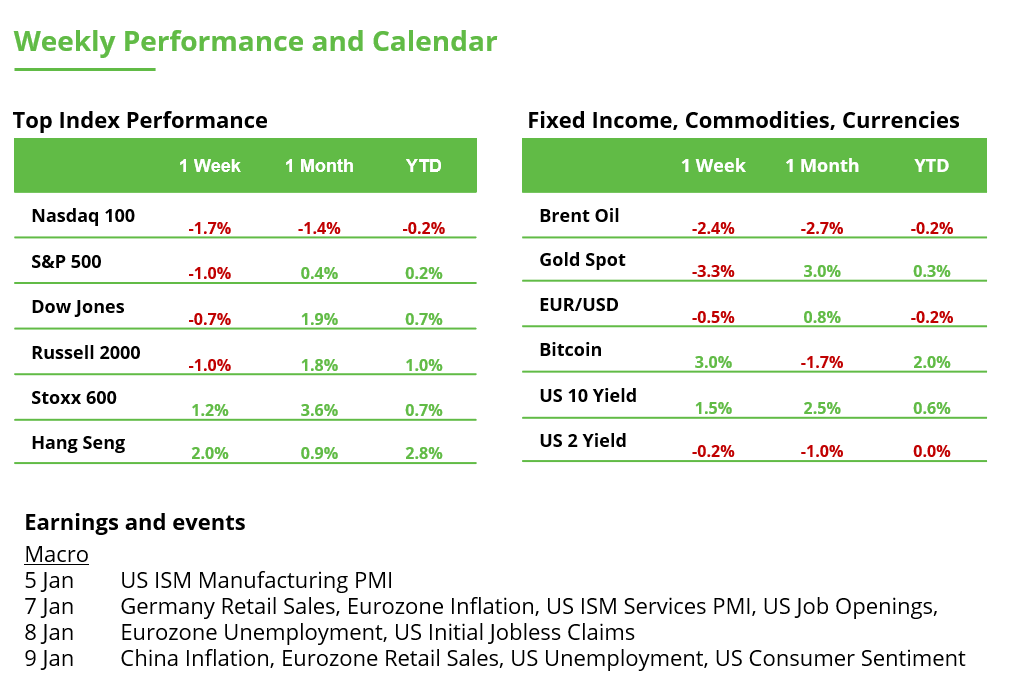
Bitcoin is hovering around $91,000, and while the price action looks calm, what’s happening under the surface is more interesting.
On the spot market, long-term investors appear to be quietly adding. Wallet data suggest steady accumulation, with Bitcoin continuing to move off exchanges and into long-term custody. That usually signals confidence rather than urgency. We do not see a clear sign of panic selling or widespread profit-taking, and new participants are still entering the market.
That said, the tone is different in derivatives markets. Short-term traders, particularly more professional participants, remain cautious. Many are positioned for limited upside in the near term, having built short exposure earlier at higher levels. So far, that positioning has worked: reinforcing a wait-and-see mindset rather than a rush to chase prices higher.
Put together, Bitcoin is sitting in a tug of war. Long-term holders are comfortable accumulating, while tactical traders remain skeptical about an immediate breakout.
That makes the next move important. A clear break below $90,000 could test confidence in the short term, while a push back toward $97,000–$100,000 would force skeptics to rethink their positioning.
For now, the message is mixed: long-term conviction, short-term caution, and a market waiting for its next catalyst.
This communication is for information and education purposes only and should not be taken as investment advice, a personal recommendation, or an offer of, or solicitation to buy or sell, any financial instruments. This material has been prepared without taking into account any particular recipient’s investment objectives or financial situation and has not been prepared in accordance with the legal and regulatory requirements to promote independent research. Any references to past or future performance of a financial instrument, index or a packaged investment product are not, and should not be taken as, a reliable indicator of future results. eToro makes no representation and assumes no liability as to the accuracy or completeness of the content of this publication.