



It’s time for another Crypto Corner, where The Daily Breakdown digs into Mantle and Render, then dives into the charts for Bitcoin.
Before we dive in, let’s make sure you’re set to receive The Daily Breakdown each morning. To keep getting our daily insights, all you need to do is log in to your eToro account.
Crypto Corner
We’re continuing our talk about the ins and outs of the crypto market, helping investors become more familiar with the 110+ cryptoassets offered by eToro. Today we’ll discuss Mantle and Render.
Mantle (MNT): Currently trading near $1.12 with a market cap of roughly $3.7 billion
Mantle is an Ethereum Layer-2 network launched in 2023 that uses Optimistic Rollups and a modular architecture to deliver faster, lower-cost transactions while inheriting Ethereum’s security. Execution runs on Mantle, with data availability handled by EigenDA. The MNT token is used for gas fees, staking, and governance within the Mantle DAO, which evolved from BitDAO and oversees a large community treasury. Mantle is EVM-compatible, supports liquid staking via mETH, and hosts DeFi, GameFi, and NFT applications focused on scalable Web3 infrastructure.
Render (RENDER): Currently trading near $2.50 with a market cap of roughly $1.3 billion
Render is a decentralized GPU rendering network developed by OTOY that connects artists and developers with unused GPU computing power. Built to support high-quality rendering, AI workloads, and digital content creation, the network enables cost-efficient processing for animations, visual effects, and 3D assets. The Render token is used to pay for rendering services and reward node operators providing GPU resources. Governed by token holders, Render supports NFTs, AI-optimized workflows, and distributed media streaming, positioning it as a key infrastructure layer for digital creation.
Want to receive these insights straight to your inbox?
The Setup — Bitcoin
Crypto roared into Q4 as a top-performing asset in 2025. Then volatility struck, dragging Bitcoin, Ethereum, Solana, and virtually every other cryptocurrency lower. BTC fell in six out of seven weeks at one point, losing more than one-third of its value from its all-time high to recent low.
Now, it’s trying to find its footing.
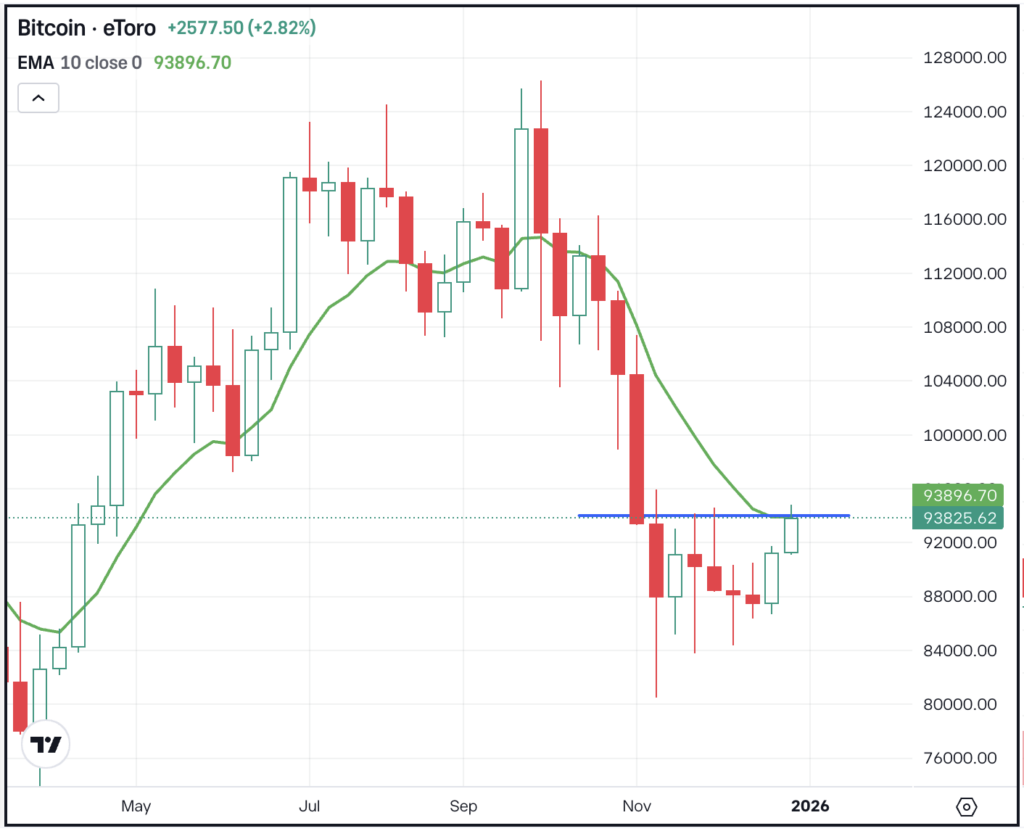
Notice how Bitcoin’s trading range has been tightening over the past few weeks, and recently, BTC hit its highest level since mid-November, which is good news. However, it’s testing into its declining 10-week moving average and the $94K zone — the latter of which has been a key level over the past few months.
If BTC regains this area, bulls might look for a continued move to the upside, potentially toward $100K. However, if this area is resistance, Bitcoin could face a pullback.
Options
For investors who can’t trade or aren’t comfortable trading cryptocurrencies outright, they can consider ETFs for BTC and ETH. On the BTC front, IBIT remains the largest ETF by assets, while also supporting options trading.
Bulls can utilize calls or call spreads to speculate on upside, while bears can use puts or puts spread to speculate on downside. In either case, investors may consider using adequate time until expiration.
For those looking to learn more about options, consider visiting the eToro Academy.
What Wall Street’s Watching
XLF
Financials got off to a strong start yesterday, with the XLF ETF jumping 2.2% and was the second-best performing sector behind energy. JPMorgan, Citigroup, Goldman Sachs, and Morgan Stanley helped lead the charge, as banks are set to report earnings next week.
SLV
Geopolitical tensions have precious metals back in the spotlight as silver and gold rallied again on Monday. The GLD ETF jumped 2.6%, while the SLV ETF climbed more than 5%. With today’s pre-market gains, it’s on the verge of record highs. Check out the charts for SLV.
NVDA
Shares of Nvidia are in focus this morning after CEO Jensen Huang spoke at this year’s 2026 CES event. He was able to showcase the Vera Rubin AI platform and said it’s on track for deployment in the second half of this year. According to Bloomberg, “the Rubin processor is 3.5 times better at training and five times better at running AI software than its predecessor, Blackwell.” Dig into the fundamentals for NVDA.
Disclaimer:
Please note that due to market volatility, some of the prices may have already been reached and scenarios played out.