

Analyst Weekly, 27 April, 2026
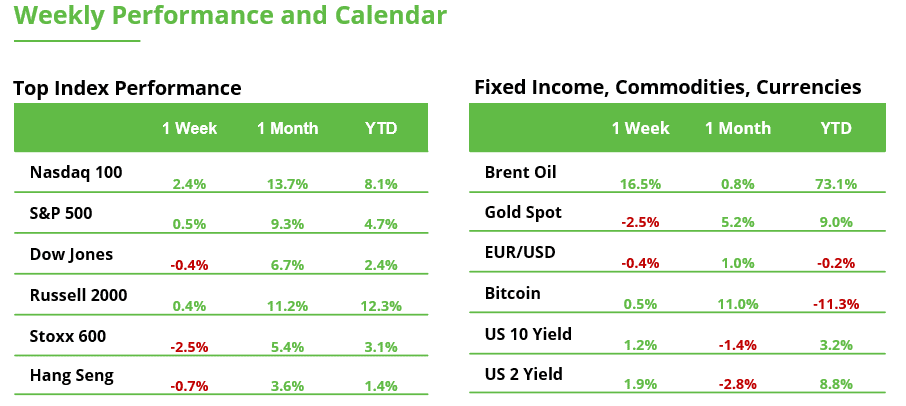
Global equities are sitting at or near record highs, with the S&P 500 up nearly 10% since late March. The underlying story is fairly clear: earnings are holding up, margins are expanding, and the high-end consumer is still spending. Still, selective strength is doing most of the heavy lifting.
Let’s start with the consumer.
American Express ($AXP) delivered a strong print: earnings up 18% y/y, spending up 10%, and travel and dining still humming. Even a hefty fee hike on its Platinum card did not slow demand.
In other words, the higher-income consumer remains resilient.
That strength is showing up elsewhere. Premium travel names like Marriott ($MAR) and Delta ($DAL) continue to benefit from steady discretionary spending.
But this is not a tide lifting all boats.
Some are calling this an “E-shaped economy”: top earners accelerating, the middle holding steady, and lower-income consumers flat in real terms. It helps explain why Walmart ($WMT) and Dollar General ($DG) have seen more mixed momentum compared to higher-end exposure plays.
Now zoom out to the market engine: profits.
S&P 500 margins are quietly climbing toward around 19.8%, with sales growth still outpacing cost growth. That is a powerful combination. Companies are protecting profitability better than expected, helped in part by efficiency gains, including AI.
And that brings us to the biggest driver in the room. Big Tech is still doing the heavy lifting.
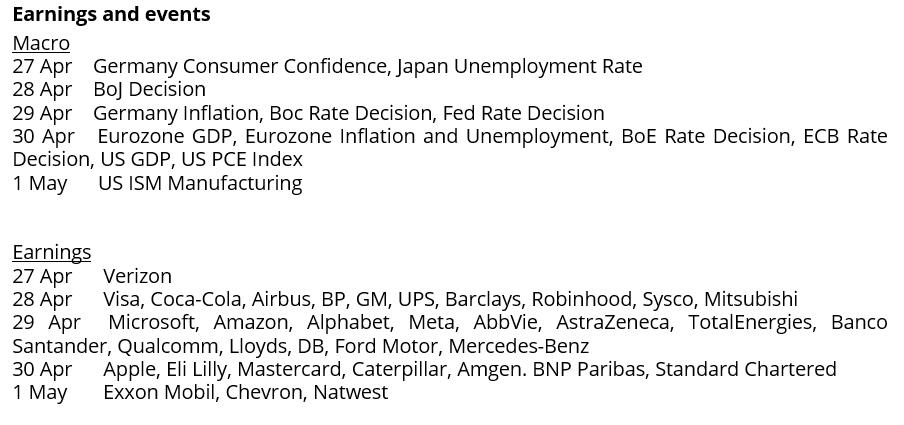
Around 60% of expected earnings growth in 2026 is projected to come from technology, with names like Microsoft ($MSFT), Nvidia ($NVDA), and Alphabet ($GOOGL) leading the charge. This week’s earnings from Microsoft, Alphabet, Amazon, Meta, and Apple will be key, as these companies represent a significant share of the index.
This market is still riding a narrow, but powerful, earnings wave led by tech.
At the same time, the pace of the rally is getting attention.
Positioning in crowded trades like semiconductors and energy is becoming more stretched, and investors are starting to hedge more actively. That does not signal a reversal, but it does suggest expectations are rising.
Then there is geopolitics.
The US-Iran conflict remains unresolved, with peace talks stalling and oil prices staying elevated. Higher energy prices have not derailed markets, but they do keep pressure on inflation and input costs.
Keep an eye on Exxon ($XOM) and Chevron ($CVX) as both beneficiaries of higher oil prices and indicators of how this trend evolves.
Investment takeaway:
- The consumer is strong, but mainly at the top end
- Earnings are growing, but concentrated in a few sectors
- Margins are expanding, but still sensitive to input costs
Growth expectations for the next few years continue to trend higher, which supports the market, but also raises the bar for delivery, especially from tech and financials.
This is a market supported by solid fundamentals, but with a clear leadership bias.
High-quality names with pricing power continue to stand out. At the same time, improving conditions suggest more sectors could gradually participate.
For investors, the message is simple: stay invested, but stay selective.
The New Fed: How Quantitative Easing (QE) Overstayed its Welcome
Markets are entering a different phase. For years, ultra-low rates and QE supported asset prices, dampened volatility, and made capital feel abundant. That backdrop is changing under the new Fed chair, and it’s becoming more relevant for retail investors as higher rates, tighter liquidity, and stress in areas like private credit begin to surface.
QE’s regressive effects matter for positioning. Asset inflation disproportionately rewarded equities, real estate, and private assets, while cash savers earned nothing. That tailwind is fading. Returns are likely to be less beta-driven and more dependent on earnings quality and valuation discipline.
Second, the era of capital misallocation is being corrected. Years of suppressed yields drove capital into riskier geographies, private markets, and ‘zombie companies.’ As financing costs normalize, weaker business models face pressure. Investors should prioritize balance sheet strength and sustainable returns on capital.
Third, QE incentivized financial engineering over productive investment. Buybacks funded by cheap debt boosted EPS but not long-term growth. In a higher-rate environment, that playbook is less effective. Markets should increasingly reward capex, innovation, and real economic value creation.
Fourth, both policymakers and investors mispriced risk. Government debt expanded dramatically under the assumption that borrowing costs would remain low, while institutions took on more risk to meet return targets. With liquidity no longer “free,” volatility and funding stress which is already visible in private credit, should be expected.
Fifth, QE and negative rate policies compressed bank profitability, distorting credit transmission. As margins normalize, lending dynamics and credit availability will shift, reinforcing tighter financial conditions.
Warsh’s broader point, that the Fed is not the “only game in town” has direct implications. As monetary policy retreats, markets must function with less support and more price discovery.
For investors, this is a transition to a market where quality, selectivity, and risk management matter more than ever.
Five Tech Giants Decide a Quarter of the Market
Regardless of how and when the Iran conflict is resolved, all eyes this week are on Big Tech earnings. Alphabet, Amazon, Meta and Microsoft (Wednesday) and Apple (Thursday) will report their results, it is the ultimate stress test. Together, these five companies account for about a quarter of the S&P 500’s market capitalization. What matters most in these results is the capex outlook, commentary on AI monetization and margin development. Operating costs are the silent margin killer of the AI era. Ultimately, it comes down to pricing power, whether rising costs can be passed on to customers. The technical outlook for Meta and Alphabet is as follows:
Meta back in trend after correction: How much upside is left?
Meta stock paused its rally last week, closing down 2.0% at $675. Despite this, it remains up around 30% from its March low. Two weeks ago, the stock reclaimed its 20-week moving average and broke above the key medium-term high at $672 on a closing basis. Before that, the stock had undergone a medium term ABC correction within its broader uptrend, at one point trading around 35% below its record high.
The turnaround occurred near a key support level at $479. Four weeks ago, the stock dropped to $519 before reversing higher. The long-term uptrend therefore remains intact. From a technical perspective, this supports a further move toward the record high. If a breakout occurs, follow through moves toward $915 to $994 dollars are possible, as gains of 15% to 25% are not unusual in such phases. On the downside, the March low at $479 remains the key support level.
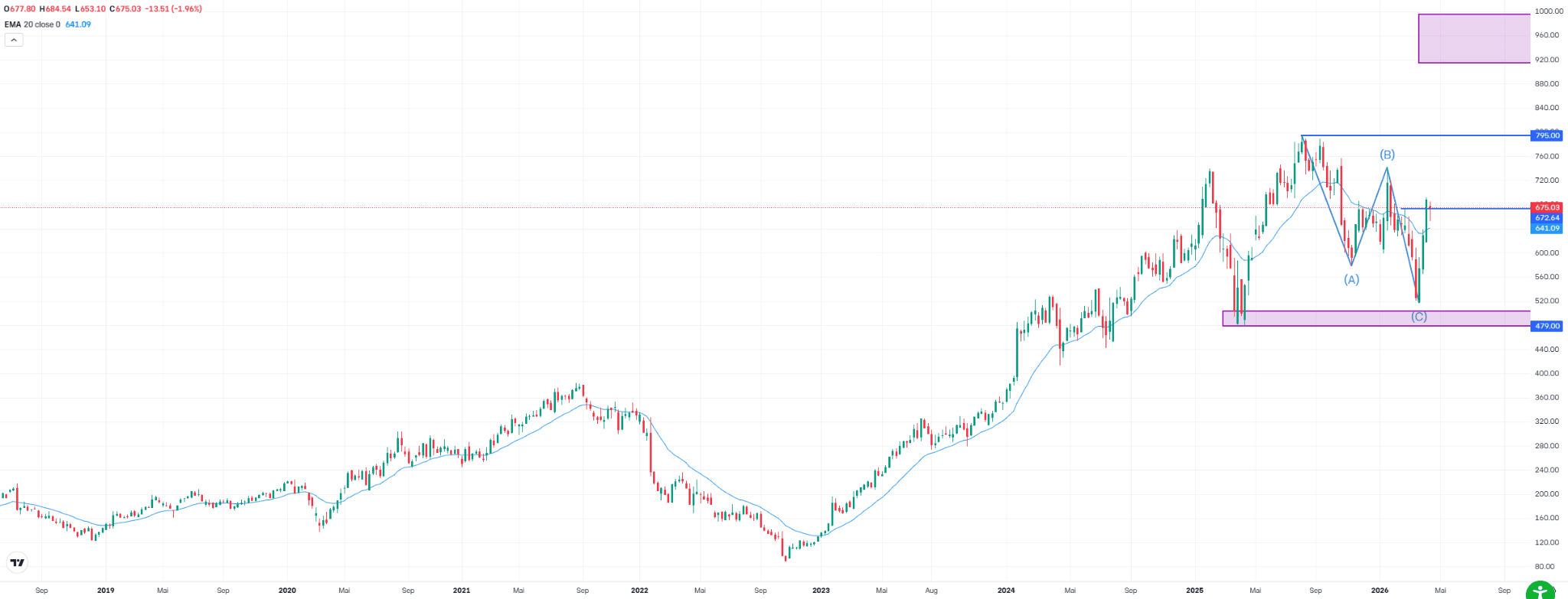
Meta, weekly chart. Source: etoro
Record high within reach: What comes next for Alphabet
Alphabet stock is already much closer to its record high at $350. The gap is now just around 2%. Last week saw another, albeit modest, move higher, with a gain of 0.9% to $342. This marks the fourth consecutive week of gains. From the March low, the stock has recovered by around 27%.
If a breakout to the upside occurs, a medium term follow through move of 15% to 25% would be possible, which is typical in such phases. This implies a potential target zone between $402 and $438. In the event of short-term profit-taking, initial support levels would be at the breakout level around $312 and at the 20-week moving average near $306. The most important support zone, however, lies significantly lower, in the fair value gap between $262 and $273.
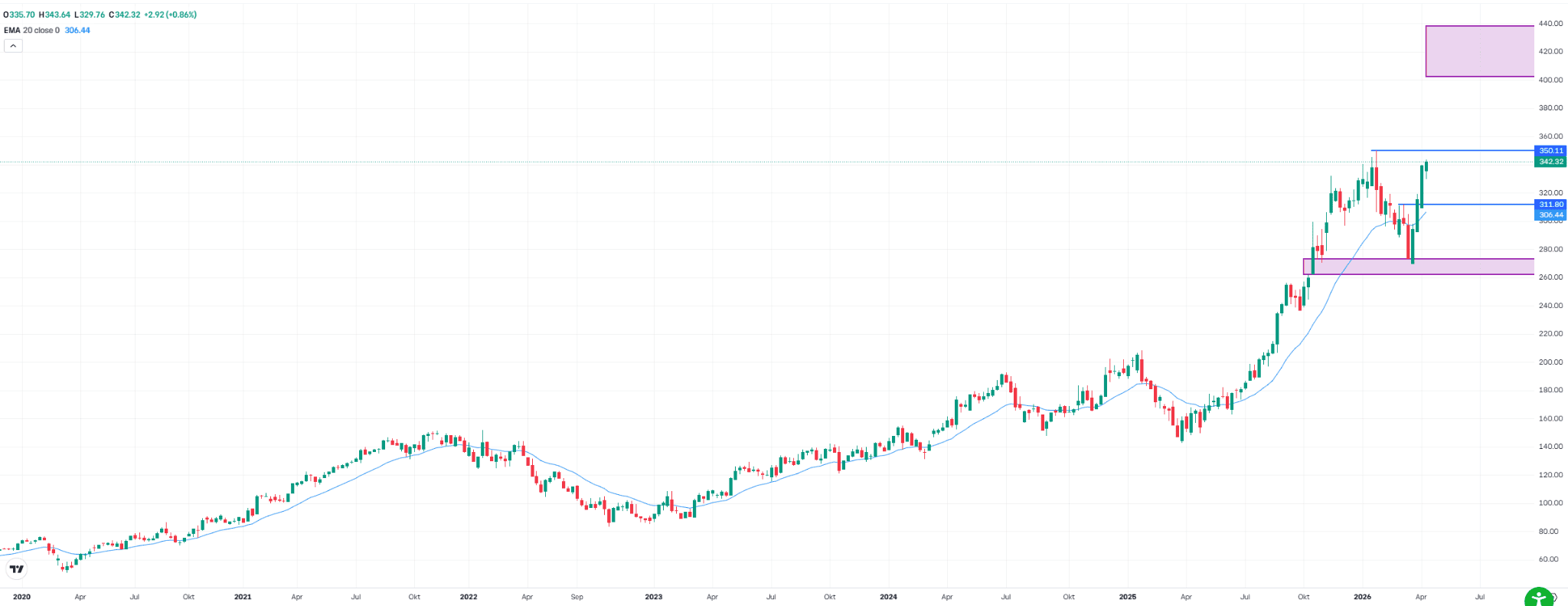
Alphabet, weekly chart. Source: etoro
Bitcoin and the fragility of the current move
Bitcoin ETFs have recorded eight consecutive days of net inflows, accumulating $2.1 billion, while the price rebounds from $68K. At first glance, the market signals strength. However, the internal supply-demand structure suggests otherwise.
Over the past month, short-term holders (STH), more tactical and price-sensitive, have sold around 290,000 BTC, acting as the main source of supply. In parallel, long-term holders (LTH), together with ETFs, have absorbed that pressure with demand exceeding 300,000 BTC. The equilibrium has shifted as supply comes from the short term, while absorption rests with strong hands. The price holds, yes, but not all rallies are the same. Here, demand is not expanding, it is simply absorbing.
The key lies in who is driving the move. Today it is not spot, but futures. And that introduces a structural fragility that the price does not reflect. When momentum depends more on leverage than on real buying, the margin for error narrows. The market rises, but on a less solid foundation than it appears.
In this context, $80,000 stops being a psychological reference and becomes a critical point of confluence. There converge the average purchase price of whales (addresses holding 1K–10K BTC), the cost basis of BlackRock’s ETF, and the aggregate average of ETFs.
At a tactical level, funding rates remain negative, an environment that has historically preceded short squeezes. At the same time, financial conditions are beginning to ease, removing one of the main recent headwinds. On a structural level, a different narrative is starting to emerge: bitcoin is decoupling from software and moving closer to scarce, inflation-linked assets.
But the market has not yet confirmed that shift. For an investor with positions above $65K, there is no urgency to act. The real signal will come if bitcoin consolidates above $80.5K with spot volume or if ETF flows exceed 50,000 BTC over 30 days. Until then, hold without increasing exposure. Losing that zone would imply a move back toward annual lows.
In the short term, moreover, not everything is technical. The geopolitical factor and the lack of progress on the CLARITY Act —whose probability of approval in 2026 has already fallen below 45%— remain relevant. And above all, it is worth monitoring the behavior of short-term holders, as they are the ones currently holding the trigger.
The market does not need more liquidity; it needs real buyers.